Saturday, August 21, 2010

Pwllheli to Aberystwyth


Aberystwth from the sea

[Kyle] On the morning we left Pwllheli, Summer had been over for a couple of days. A steady rain was falling and, unlike our arrival, we had the whole place to ourselves as we left. Out of the harbor, our first leg was an uncomfortable beat to weather in winds that were double the forecast in order to get around a nasty shoal that effectively divides Cardigan bay in half. I keep swearing I’m not bashing to windward ever again and it keeps becoming necessary.

The weather gradually cleared as the day went on and we arrived in Aberystwyth under partly cloudy skies. Aberystwyth (pronounced, well this is weird: A-ber-yst-wyth {Maryanne - pronounced Abba-wrist-with}) is very pretty from the sea. It’s sturdy stone buildings fill in the valley at the bottom of the hills. A stone promenade encompasses the horseshoe shaped beach which is dominated at it’s center by a mound atop which sits the ruins of the castle.

We rode a following sea into the narrow harbor entrance and mad a quick turn to port into calm water. The harbor is small, but very full. Floating docks fill the center while the walls are lined with boats tied two and three abreast. We were looking for an empty spot to tie up when the harbor master called us on the radio and offered us a spot just ahead. By the time we tied up, he had come down to give us a warm welcome and a pack containing all of the relevant door codes, etc.

It was getting fairly late in the day and we were tired, but we had a brief walk around while it was still sunny, including the requisite climb to the top of the nearest hill. Along the way, I noticed that I had not been met with the stare by anyone. Perhaps the Welsh Stare should really be called the Pwllheli Stare or the Llŷn Stare, but I can’t pronounce either of those so, sorry nice Welsh people, the jerks and your voiceless lateral frictive ruined it for you.. {If anyone reading this is offended, then you don't know Kyle; he loves you all really}

Pwllheli


Pwllheli Scenes

[Kyle]Pwllheli, pronounced: “Part of this complete breakfast”. Actually, the closest English approximation is somewhere between “Poothelly” and “Pooshelly”. We were advised that, unless we were Welsh, Sioux or !Kung, would never get it because of its use of what is referred to a ‘voiceless lateral frictive’ {honestly!!!!}.

Our main reason for stopping in Pwllheli was that it was the nearest Westerbeke Service center and our engine was due for a major service.

In our usual fashion, Maryanne had sent an email 2 months, 1 month, 2 weeks, 1 week, 3 days and one day before our arrival. Just to be sure, since it was quite a long way to come, she followed it up with a couple of phone calls. Well, you know what’s coming next. When we arrived, we called them and got the sneaking suspicion from their tone that we had surprised them. They did concede that they got the emails, but were clearly shuffling things around to accommodate us. Instead of bright and early as we had expected (and agreed), the guy showed up at 4:00pm, took a look at the engine and said he would start tomorrow when they get the parts. Maryanne interjected and explained that we had all of the parts that he would need in our ship’s stores so he could start now and use the shipment to replenish our stores. He countered by saying it would be better to wait until the next day in order to save the extra trip to the office to pick up the parts. “Fine” we said, “See you in the morning”. We asked when that would be and were told 11:00 - unless the shipment was late, then it would be more like 1:00.

At 1:30 the guy showed up to explain that the shipment wasn’t in and said he’d be back at 4:00. Maryanne reminded him that we had all of the necessary parts and suggested he just start now and get the parts later. He agreed and went to the truck to get his tools. I imagine that somewhere in there, he called his brother (his business partner) and told to go do what he was originally supposed to be doing.

He showed back up at 4:00. To his credit, he was friendly and prepared and he worked until the job was done, even making a much after hours trip to the shop to replace a bolt he had misplaced.

He and I chatted away as I hung off the transom fixing the drive leg. That’s when I found out it was he and his brother who owned the shop. He is full-time mechanic. His brother is part-time mechanic, part-time office manager. It turns out his brother is not so good at reading emails. He gets busy, you know. To cover the goof-up, our guy had to come out on his day off. We apologized, but he said it happens all of the time - it’s part of owning a business.

Since the shortage of good berthing opportunities combined with market forces to make the rates at the marina border on price gouging, we were determined to get full value out of our stay. On the previous day, once we realized all hope was lost, we did everything in Pwllheli. This did not take too long because Pwllheli isn’t a large town.


Another hill to climb

We started in the usual manner by heading up the nearest hill to get an overview so that we could eyeball our subsequent route. It was wonderful up there. We had long views of the Llŷn peninsula to one side, Pwllheli to the other, backed by Wales’ highest mountain, Mt. Snowdon.

We descended into the town and had a walk along the beach back toward the boat. We complimented owners on their dogs, kids on their sand castles and parents on their kids. All were met with the stare.


Oh, the kid just has to climb everything!

At the end of the beach, we had a climb on the rocks there and then made our way back along the water back to our boat. All the while, we were looking out for a promising pub, but nothing jumped out at us, so we just called it a cozy night in.

Holyhead to Pwllheli

Sailing scenes

[Kyle]We got up from our little nap just as it was getting really dark. We ran the checklist and were soon motoring the long upwind leg to the other end of the breakwater. We got the sails up while still in the protection of the harbor, then turned downwind into the darkness of the open sea.

We were making pretty respectable speed even though we were way over-reefed as a precaution. It was a good thing we were. The wind got pushed around and funneled by the hills so that it would jump from the mid teens into the high 20s every now and then. Just about the time I was about to make the trip out of the cockpit to put in another reef, it would die back down until I was seriously thinking about shaking one out because we were going too slow, then wham! The wind would return. Eventually, I decided to just live with what we had up until we made it far enough from land that the wind would be more stable.

In the meantime, as we made it back to the beginning of the breakwater on the other side, the bright lights of Holyhead became blocked by the coastal mountains and it got really dark. A bit further on, the light at South Stack came into view.

South Stack had come with a reputation. It was touted as one of the great things to see near Holyhead - a lighthouse on a small island reached by 400 steps down a steep, narrow walkway and footbridge. That wasn’t the reputation I was worried about. We had also read that the currents off of South Stack can reach as high as eight knots. A local sailor told us that the highest waves ever recorded in Britain were there: 60 foot breakers on a force 8 fresh gale - 34-40 knots, with wind against tide. South Stack was clearly not a place to be taken lightly. The reason we left at Midnight was that, like all prudent mariners, we had planned to arrive at South Stack near slack water in milder winds. Still, I knew things could get a little “uncomfortable”.

Approaching the light, The mood became more ominous. The cloud cover meant that it was completely black except for that light. Its beams swept out to sea, passed us with a flash, and then slowly swept across the mountains behind, as if to say “look at what your messing with, kid”. We got caught in a back eddy, which slowed us down, and I had too look at that scene way longer than I had wanted.

In the end, we got by uneventfully and my own worries ended up being the biggest drama. After South Stack, we gradually headed out into Caernarfon Bay until the shore was just a thin line of lights on the horizon. Maryanne had asked me to wake her after a few hours, but I know how she likes her sleep. The late hours of a night watch can be pretty tough. It’s hard to keep from nodding off and the temperature is at its coldest. I decided that my goal was to just make it until the first ray of sunshine popped over the horizon, then I would wake her. i got up at increasingly shorter intervals to pop my head into the breeze and have a look around in order to stay alert.


Kyle awakes to a sunny day.... Or is he still dreaming?

The sun came up and five minutes later I was out cold while Maryanne stood watch. I awoke a few hours later to a cloudless sky and was amazed to find that it was a beautiful day, an actual beautiful day. I mean, it was a really, really nice day. It was like, it was like....Summer! That’s what it was, it was like Summer! I had completely forgotten what Summer was even like. I hadn’t seen Summer in a long time. I had begun to think of sailing as a means of mainlining misery and suffering for the purpose of making us broke, but this was actually pleasant. I think that if I had not already been on a boat, I would have thought it would be a perfect day to go sailing. Well, lucky us, we were already there. The seas were flat, the wind was up and, even dragging our broken drive leg, we were sailing fast. Plus, it turns out, Wales is really pretty.

Everybody else in Wales that had a boat seemed to have the same idea about the day. There were boats everywhere. People were sailing, people were water skiing, Dinghies were out racing. It seemed that everybody without a boat was out at the beach. I suppose If you only really get one day of Summer, you had better make use of it.

At the entrance to Pwllheli harbor, we joined a long cue of boats heading up the narrow channel. This is when we got our first look at what I would later call the “Welsh Stare”. We would wave and smile at people in the way that we do and in return, we would get the stare. It was not one of curiosity or even indifference, like we were used to seeing, but mild hostility. Everybody seemed to be sending us the message to piss off.

The marina was huge. We had been in the boonies for a couple of years and had not been to a marina this busy since Boston. Since marinas are few and far between, it seems that every single boat in Wales is based in Pwllheli and most of them were being used this lovely day.


A very busy Marina

Our assigned berth turned out to be right next to the ramp where the powerboats haul out. Several power boats were milling around while others were temporarily filling every available dock waiting for their turn. We were clearly made to feel in the way as we maneuvered into our spot. Maryanne very politely asked a powerboat occupying our berth if they wouldn’t mind moving down a bit so we could tie up. This was met with the stare. In their haste to move along, one of the occupants ended up straddling the ever widening space between their boat and the float and fell in, earning us glares from all aboard. After we got tied up, Maryanne went over and apologized. They sheepishly accepted, but were still not happy. Luckily their trailer arrived soon after, so they weren’t there long.

The Marina had an amazing system for hauling out boats. As they entered the harbor, they would call ahead and their trailer was added to the cue behind a marina tractor. When they arrived at the ramp, they would wait for their trailer and drive on, where they would be whisked away to make room for the next boat. Our berth made for great front-row-seat entertainment, but the fumes from all of those high horsepower engines running rich at idle quickly became intolerable.

We went into the office to check in. The manager saw our whole docking incident and seemed to think there was nothing unusual about it. He said people fall in all of the time over there and he was in our spot. No, we did not do anything wrong by asking them to move.

We went for a brief walk into town and encountered more of the Welsh Stare from people walking the other way. Well, this time we knew it wasn’t the American flag. Everybody we actually talked to was very nice, but we kept getting the stare. It seemed odd in such a small town. I eventually decided to give them the benefit of the doubt. Perhaps children are taught at an early age to fear strangers so that, by the time they’re adults, they mistrust anyone openly friendly. Maybe there’s just too many damn tourists in this pretty little town and they just want us to piss of and go back home so they can resume being neighborly to each other. I want to believe they really are nice people.

Holyhead


Things so Welsh! Kyle prepares a new courtesy flag to hoist, and a sign saying nothing important (I hope!)

[Kyle]Due to the extended wait in Preston for the weather, our stay in Holyhead (Pronounced Holly Head) was brief. In order to catch the next day’s tide, we had to leave around Midnight, which really only gave us part of one day to look around. Although Holyhead is the largest ferry port on the west coast, most of the information we had, including advice from locals, was there wasn’t actually much to see in Holyhead itself. The town is used mostly as a jumping off point for tourism around Anglesey (and the connecting port for a major ferry service to and from Ireland).

It was a nice hot, sunny day, although it was blowing like crazy. We took a walk around the harbor side in the direction of the main town. The walk along the quay was wide and grassy and populated with families of various sizes, all carrying ice creams purchased from a conveniently placed cart. Everybody seemed to be in a good mood, enjoying what passed for a nice day of British weather.


A quick tour of Holyhead

Further into town, we came across a couple of nice, pedestrianized streets winding aimlessly and bordered by trim shops and pubs with flowers outside. For the most part, it looked like any other British seaside town except that all of the signs started in a completely incomprehensible gibberish made up entirely of what Maryanne calls “all of the letters you do not want to end up with in Scrabble”, and then finished in English.

Not only is Welsh confusing by being apparently completely devoid of vowels, but almost none of the letters are pronounced the same way as in English. One of our Wales guides, which I can’t seem to find at the moment, warns against “traps” - words that look English, but are not pronounced in remotely the same way. I wish I could remember some examples.


Holyhead's Millenium Footbridge - one of the many public works projects planned and implemented for the Millenium in the UK

As we read our way into the the town center, we came across the impressive Millennium Bridge, an elaborate swooping stainless steel structure that connects the ferry terminal to the main town and crosses over the railroad tracks and the much less attractive backside of the main street.

With everything except the pubs stutting for the night, we headed back to Footprint for some of Maryanne’s delicious food before falling into another fitful few hours’ sleep.

Off to Wales

[Kyle] We’d been in Preston for almost a month now and were eager to get in one more cruise before the short British Season ended. We had to wait the better part of a week for the winds to give us a break and allow us a reasonable chance at crossing the Irish Sea without getting beaten up too badly.

It didn’t work. We left with a tailwind and following seas and still managed to suffer quite a bit of pounding, which gradually improved the further we got from the shallow coast at the entrance to the River Ribble.

Our early afternoon departure with the high tide meant that we ended up sailing well into the night to get anywhere. Our groundspeed was looking pretty good while we were being flushed out with the tide. For a while, it looked like we may even make it to Wales by midnight. Then the wind started to die off just as the flood current began and we pretty much stopped. We did actually go backwards briefly a couple of times, but mostly we spent the next few hours sailing as hard as we could so that we could manage just under a knot over the seabed.


Our sea passage involved plenty of obstacles such as this one - hopefully this time our passage won't be followed up by a visit from the anti-terrorism squad! Yes, just ask Kyle next time you see him.

At Carmel Head at the northwest tip of Anglesey, we passed through the channel at the Skerries. It was real nail-biting stuff. It was pitch black, the currents, although, dying, were swirling in all kinds of crazy directions, and all of the navigation lights were hard to discern from one another. There were several times when our track over the bottom was 70° from the direction we were pointed. I can only imagine the difficulty with which pre-electronic shipping must have had with these waters. The number of wrecks on the chart attest to this.

Anywho, we made it through okay, although the hour was starting to get to us. We pulled into Holyhead, Wales (and out of the current) just before 4am, passing what we later learned was the longest break wall in the world at the time it was built and still remains the longest in Europe.

Not sure where exactly to go, we tied up at an open spot on the exposed outside of the main pontoon, where we did an abbreviated securing of the boat. When it came time to put the drive leg up, we were unable to get it to raise. I asked Maryanne to give the release handle a pull while I hung off of the back of the transom and released the catch manually, which is sometimes necessary when it has been a little too long since giving everything a good greasing. Still no luck. Eventually, Maryanne brought me a light and I could see that the lifting ram had somehow broken off of the drive leg and was dangling free, meaning that the drive leg was effectively stuck down all of the time now. It was much too late for us to worry about it, so we headed inside for the night and fell into fitful sleep. The marina would be open in a few hours and we would probably have to get up to check in or otherwise run the risk of having somebody knock on the boat and rouse us from a deep sleep, then start peppering us with questions and instructions which are always hard to follow in a groggy half-sleep.

In the morning, I had another look at the drive leg. It turned out not to be too serious. A bracket that joined the hydraulic lifting ram to the leg with a couple of screws had broken at the weld. It was a simple £26 part. I called Sillete and asked the guy to next-day it to us at our next stop. There was a long, confused silence on the other end of the line. I then realized my mistake. All mail in the UK is delivered the next day. Nevermind.

Wednesday, July 28, 2010

A Long Weekend at Home

[Kyle]After a long week that allowed no time for anything except eat, sleep and work, I arrived back home in Preston pretty tired after the overnight flight.

For once in what seemed like a long while, our plans for my days off were all very local. Footprint would get a well-earned rest.

We started with quiz night at the local pub –The Ribble Pilot. Actually, we started with an early afternoon nap, but then we headed to the pub. The quiz was a slightly different format than what we had seen before. It was in the style of the American TV show “Family Feud” {Family Fortunes in the UK}. Points were given for each of the top five answers given by a group of respondents, with double points for getting the top choice. In this quiz, it seemed like not having an iPhone was less of a disadvantage for us this time. It was our almost complete lack of knowledge of British pop culture and boy-bands that killed us. Still, we had fun and we didn’t finish last. It’s the little things…

We got up fairly early (at least for me, who was still struggling with the time zone) and went on what was supposed to be a ten mile Preston maritime history hike led by a local park ranger. The hike was measured at nine miles by a walker with a GPS, close enough to the ranger’s estimate, which he admitted to doing the old fashioned way with a piece of string. We took in parts of the Preston Basin, the River Ribble and the pretty Lancaster Canal, as well as a few other minor waterways. We also went through a couple of nice parks, a farmer’s field and a few neighborhoods ranging from inner city depressing to postcard village quaint.


A pleasant Hike around the Lancashire canal system

The history part was a bit lacking; apart from a few initial tidbits about the length and breadth of the Preston Basin, most of the walk was just a walk. Still, it was nice to have an easy way to explore the surrounding countryside and it started and ended only 2 minutes from our boat! We chatted with each other the way people do when meeting strangers and occasionally there were comments on the scenery, but there was no underlying theme tying together the history of what we were seeing. It seemed we could just as well have had the same experience if we had purchased our own OS 1:25,000 map and done the same route ourselves. At least that way we would know better where we were at all times. Still, the weather was clear and bordering on warm, so it was a nice day out.

The following day, Saturday, was the beginning of the Riverswalk Festival, also on our doorstep. This involved all manner of sunny day fun: Ice cream, fried, sticky foods, live music, street performers, balloons, a bouncy castle for the kids and plenty of fun competitions, all centered about Preston Marina. Milling around in the crowds gave me a heavy dose of the Lancashire accent which, to me, is still so thick that I have to squint and pay really close attention to understand. It seems harder than Scottish.


Festival Scenes

Also in attendance were two little Brigs, billed as the world’s smallest tall ships. Each boat was just thirty feet long but had two short masts and eight sails apiece. All weekend long, they gave free 30 minute rides around the basin including setting and furling all of those sails each time.

At the end of the day Maryanne and I were invited to join a bunch of other marina residents at their barbecue and spent the rest of the evening swapping stories. I was relieved to hear that NO ONE likes the Irish Sea. It wasn’t just a fluke. I can’t wait to go back!

Around sunset, many of the heavily decorated canal boats formed an illuminated parade around the perimeter of the basin. As they left, someone in our group (not us!) produced a giant, three person slingshot made of surgical tubing and a bag of water balloons and started pelting the canal boats. There seems to be some long-term, friendly rivalry between the “yachties” and the “bargies”. They were doing it from such a long distance that none of the victims could seem to find the source. The whole game ended rather abruptly shot came a little too close to police officer on a bicycle on the other side of the basin. No sooner did the water balloon explode than everyone assumed the air of perfect ladies and gentlemen as if a good/naughty switch had been thrown.

Later came the fireworks. The council put on a pretty impressive display lasting fifteen minutes or so. I had completely missed out on fireworks on July fourth in the U.S. and was happy to get a belated dose here. The music seemed all wrong, though. It sounded less like American independence than a college commencement, but there was still plenty of oohing and aahing all around. {Maryanne: I had no idea what Kyle was going on about – the “wrong” music, but it turns out that in college award ceremonies in the USA, they regularly use the music we Brits know well as the sing-along patriotic “Rule Britania”. I assume they are unaware of the words that almost any Brit will start to sing as soon as the chorus is reached}

The next day’s main event was the inflatable dinghy races. Preston Marina provided two brand-new dinghies, each with a brand-new 4hp motor for the race. Maryanne and I signed up and were partnered with opponents of approximately equal weight and experience. Very early in the heats, it became clear that there was something slightly wrong with the engines. People came back reporting intermittent power and slipping gears {It could just as well have been poor technique, but no bubble bursting please!}.

I was the first to go. The other guy got a much better start, but I was soon on plane and catching up fast. My strategy at that point was to zing by him by executing a perfect turn at the buoy and keep my speed up until the finish. Just as I caught up to him, my engine slipped out of gear and I mushed to an ignominious stop, then some power, then another stop. I finally got turned around and moving again and flew by the finish about the time the other guy was getting back from the shower.

Maryanne had a much better race. She got a fantastic start and was way ahead at the turn. I was screaming my head off. Then her engine quit on her and by the time she was back on plane again, Paul, her competition had won. Oh, well that gave us more time to root for our new friends.

In the end, the race ended up being one of the great stories in Preston dinghy racing history. Anna, in a heat against her husband Tom, flew off the start line while Tom’s boat mushed along, unable to produce any power. She ran into, and then bounced off the turning buoy without actually rounding it, disqualifying her. Tom was so busy trying to catch up that he didn’t notice this. Figuring he was beaten, he just brought his dinghy back for the next racer without finishing the course, disqualifying himself. After a consultation with the judges, it was decided there would be a re-race. This time Anna rounded the buoy and beat Tom fair and square by huge margin. She then went on to beat everybody she raced against, starting with her daughter and finishing with the three-time champion, ending his streak. She claims to have never driven a dinghy before. {Maryanne: I’ve no idea where Kyle is getting these boat owner names, nor the relationships. The winner’s name was Anna? I don’t remember that, but I could be wrong, REGARDLESS, Tom was NOT her husband and she didn’t race HER daughter, but one of the other boat owner’s daughters (Also American, incidentally). Maybe between Kyle and myself we can make up a half decent version, but for now, be aware you’re getting Kyle’s version of events… Oh my!}


We didn't make it to the winners Podium - but we sure tried!

We refueled from all of our cheering with one last lap around the sticky food tents, snapping up bargains as they packed up (Girl Guide cup cakes – Yummy!). It seemed eerily quiet now, no loud music, no announcements, no cheering. Everybody was dispersing as if they were drops of oil in a greasy pan and soap had just been added. The tents packed up, half the canal barges left and before we knew it, Preston was back to its same old, drizzly self again.

Friday, July 16, 2010

Preston


Footprint's new Home - Preston Marina, and the locks that protect it and keep it full of water

[Kyle]Not nearly enough hours later after our miserable Irish Sea passage, we woke to find Footprint floating in a puddle with a depth of 1.5 meters surrounded by mud at the bottom of a canyon formed by the lock walls. I climbed the ladder and walked to the marina to find out where they wanted to put us once the tide came up and we entered the harbor. The marina manager was very nice, which I really needed, and went to great lengths to make sure I knew about every possible berth that was available and that I got my very first choice of all of them. I asked about the lock gates and the swing bridge and he said the gates open automatically at high tide but the bridge needs to be swung by the operator. He said they knew we were coming.

I got back to the boat and within a couple of hours, the tide has shot up the four meters necessary to open the gates. We entered the first basin and were hovering around waiting for the bridge when the operator called us on the radio and very testily informed us that he expected a call in advance if we were intending to come through. I apologized and tried explaining that it was an innocent misunderstanding. I thought the marina had told them. This didn’t calm him down, and he insisted on giving us a public tongue-lashing. Whatever. If it makes him feel better to vent, then vent. We’re sorry, already.

At the marina, we found that our preferred slip was a very tight fit. The fairways were wide enough to transit but had almost no room for making the turn into the slip. The slip only gave us around a foot on either side and the boats on both sides stuck out, making it very hard to thread the needle and get a line on the float before being blown onto one of our neighbors. We finally got in safely on the third attempts and both breathed a big sigh of relief.

We spent the rest of that day tidying Footprint back up to her pre-Irish Sea condition. The next day, we headed out for a look around and found ourselves quite pleased with our new surroundings. The marina has a well-equipped chandler as well as a café. The surrounding area has several good stores very close by. There is even a couple of decent-looking restaurants, including a nice pub with a Thursday Quiz night.

The marina occupies about a quarter of a huge deep water basin, the rest of which is unused. It looks like the perfect size for a sail in the dinghy, when it’s not freezing, that is. Preston is to be our home (at least for now), and so far it's OK.

NOT a Fan of the Irish Sea


Leaving Peel and the Isle of Man

[Kyle]The morning we left Peel, it was gorgeous. The sky was clear, it was nice and warm and there was hardly a breath of wind.

At high tide, we left the harbor with half a dozen other boats. We all rounded the break wall, hoisted sail, and headed off on our diverging courses. We headed north for our rounding of the island. A light breeze had filled in and we were chugging along in flat water under main and screacher close enough to shore to sight-see. I was a lovely day, just perfect for sailing.

That lasted about four hours. The very minute that Maryanne went off watch to get a nap, the wind reversed, bending our course 90° directly toward shore. I tacked and found the strong unfavorable current was keeping us from making any sort of forward progress. Our track away from shore was exactly along our track toward shore. Further out, the strength of the current increased and we actually crossed our path going backwards. I was so sick of motoring from the trip to Peel that I just decided to wait it out until the current reversed. By the time Maryanne was back up, I was able to boast over two miles of progress since she had gone to bed four hours earlier.

Maryanne's watch was much more productive. The current was mostly favorable, and swept us past the northern tip of the island in a wind that had frustrated her by dying down to less than a knot by the time I was back up. We didn’t even have enough steerage way to point in the direction we were trying to go.

It was time for the foul current again. We got swept backwards for a couple of miles before a light wind started filling in. I was able to hold our own against it, and then gradually started making progress.

The wind strengthened and strengthened as it veered around to a direct headwind, bending our course due south toward the Welsh coast. Our forecast had called for headwinds of 8-10 knots for the last half of the trip. I wasn’t really looking forward to that, but upwind in 10 knots isn’t too bad as the seas are pretty mild.

As the Irish Sea started to empty on the falling tide, the current swept us back away from Wales and back toward the Isle of Man. The wind kept increasing until it was just over 20 knots, turning the shallow sea into a mess of closely spaced steep waves. Just the sort to instantly lose any forward momentum the boat does achieve. We would fall off the top of a wave and crash to a stop in the trough before the next. We did this tens of thousands of times. The poor boat seemed less a means of travel than a way to pick up water just like a bathing bird using its head to fling water on its back. Everything forward of the mast was regularly awash. The boat shook and reverberated as we slammed into waves that felt less like water than concrete blocks. It was abject misery; a state that soon encourages you to change tactics. {Maryanne} Normally in such conditions a slight change of course can make for a much more pleasant ride and often a just as quick arrival at the destination. With currents, wave and wind conditions this was not the case on this passage unfortunately, so we put up with it very unhappily. We picked the most comfortable sailing direction to also gain any progress at all, and we suffered. Better would have been to wait, or pull in somewhere and rest up - neither was an option for this trip (we left not expecting such conditions, and once we were in them, there were no suitable alternative harbours - so we just carried on)}.

[Kyle]With Footprint straining to make headway in the chop with all of the extra water weight on deck, we had no hope of making headway against the current. Maryanne came back on as the tide started coming back in, bringing us back toward land, but nowhere near where we were trying to go. The current running against the wind set up an even steeper sea. It was impossible to get more than a few minutes sleep on the off-watch. We would each fall into exhausted sleep after flopping into the bed, but it would never last. Soon, we would be slammed awake. After that, every creak and bang sent our minds racing with worry about how and whether the boat was holding up (of course it was fine, it was just us that were suffering). After twenty-four hours of this, I had a splitting headache from the combination of noise, pounding, little sleep, dehydration and lack of anything substantial to eat.

We came within sight of the Welsh coast (too far south) in poor visibility and then executed another backwards tack. It started to rain hard and the wind started gusting above thirty. Maryanne took over again and I tried in vain to get some sleep. Still, it was good to get a mental break from being “in charge”. Conditions were getting worse and worse and it was starting to seem like we would never make it out of this bloody sea.

Even though my off-watch wasn’t over until Midnight, by 9:30 I couldn’t take the futility of trying to sleep anymore and just got up. Maryanne had managed to get us within 15 nautical miles of the entrance to the Ribble River, our goal. Beyond the entrance, the marina at Preston is another 15 miles further. High tide was in four hours. Tides in this part of England have a range of just under ten meters. The coast is so shallow that the sea retreats for miles each low tide. If we timed it wrong, it was possible that we could end up dried out on the middle of a sandbank where we couldn’t even see the edges.

To miss the tide would mean being stuck out there for another 12 ½ hours. While I was getting to where I would welcome drying out as a relief from the incessant pounding, the more prudent thing to do was to get over the bar so as to not run the risk of drying out on an errant rock or shopping trolley.

We started the engine and made a beeline for the entrance buoy. Footprint was very hard to steer. The wind kept trying to blow the bows downwind and our slow speed made the rudders less effective than usual. As the depth rose from twenty meters to six or so, the waves turned from steep chop to breaking surf. Spray was flying everywhere. It was impossible to poke a head out of the cockpit enclosure and not get drenched. The only thing reassuring was the knowledge that the closer we got to land, the less fetch (room for waves to form) there would be. Because the tide was up and the water was so far inland, we would have to wait another three hours before the seas finally smoothed noticeably.

To compound this, it was dark, really dark. It was midnight during a new moon in the rain dark. The narrow channel up the river is “guided” by a pair of training walls that are partially submerged at high tide. The walls are marked every now and then with posts. Some are lit, some are not. We were very glad the radar didn’t care that it was night and had no trouble seeing obstructions we couldn’t acquire visually until we were right on top of them. Just to make things even scarier, we couldn’t slow down to allow more reaction time because we were racing the tide. By the time we finally sighted the doors of the Preston lock at about 02:30, we were both sooo ready not to be underway anymore.

We tied up to the deep water holding area on the wall outside the entrance, did a quick once-over to make sure everything important was done and collapsed. Footprint was a shambles, and we didn't care!

Sunday, July 11, 2010

More of the Isle of…..Man

[Kyle]The rain stopped! The rain stopped! We awoke to actual blue skies and headed to Peel Castle for a tour. The Castle was actually a large site of roofless ruins contained within a large curtain wall mostly dating back to the 14th century with later defensive additions added up until the early 19th century. The site covers most of St Patrick’s Island, which was separate from the main island at all but low tide until a causeway was built in the late 18th century linking the two together. Underneath the main part of the site, ruins from a 6th century Celtic roundhouse have been excavated. The site has been used for a long time, indeed.


Peel Castle Ruins

The inside of the wall was very park like, with well manicured grass interspersed with the ruins. Every so often, there was a little stake in the ground with a number for use with the well done audio tour. The tour was narrated by none other than God himself, although in this instance, he was much less annoying.


Oh look, a Hill to climb!


A view from a hill

Since the weather was so much brighter, we decided to climb back up the same bloody hill we had ascended the day before for a better view now that the sun was gleaming off everything. Maryanne did her usual moaning on the way up about having to repeat the same old hill again. She’s all talk. I had fully expected to be turning around and descending into town once we made it to the top, or at least the local top. No sooner did we make it to the viewpoint than she was headed further upwards toward a distant tower that the day before had been obscured by the mists of…..


Climb Peel Hill for a close up of Corrin's tower

I love this woman! Maryanne turned out to know the whole story of the tower. Apparently, it was built in 1806 by a local man as a getaway from all of the hustle and bustle of Peel so he could read and write in peace with a view of the sea. He would often go up there for days at a time. Eventually, the islanders made him brick over all of the windows facing out to sea since ships kept mistaking the tower for a lighthouse. The tower now sits alone on the hill with his family buried nearby.

Much to my astonishment, my adventurous wife agreed to continue in the original direction, i.e. away from town, on a trail we hoped would curve down the back side of the hill. It did, and in short order, we were walking along a wide, tree covered path along the river Neb, listening to the burbling water and the songs of birds. The path runs on the abandoned railway line that used to run the ten miles between Peel and the capital, Douglas. Eventually, the Neb runs under a bridge and then widens to become Peel harbor, before plunging over the water retention flap and the adjacent weir into the Irish Sea.


The River Neb

Nearing the harbour, we came across the Transport Museum, home to lots of obscure Manx transport minutiae and an example of the world’s smallest road legal car ever produced, the Peel P50, built on the Isle of Man in the 1960s. It has one seat, is powered by a motorcycle engine and weighs only 130lbs – less than our dinghy in lifeboat mode. It doesn’t have reverse, just a handle you pick it up with to swing it around and it is claimed to get better than 100 miles per gallon. Only 200 were built, so now obtaining one will run around £30,000. So much for that idea.


A 1965 version of the Peel P50 - The World's smallest road approved car
Photo from WikiCommons Media - original by Philip (flip) Kromer

We went past the boat to the waterfront and treated ourselves to a couple of delicious ice cream cones from Davison’s Award Winning Luxury Manx Ice Cream Parlour. Apparently, they’re world famous on the island. They should be. That’s some good ice cream.

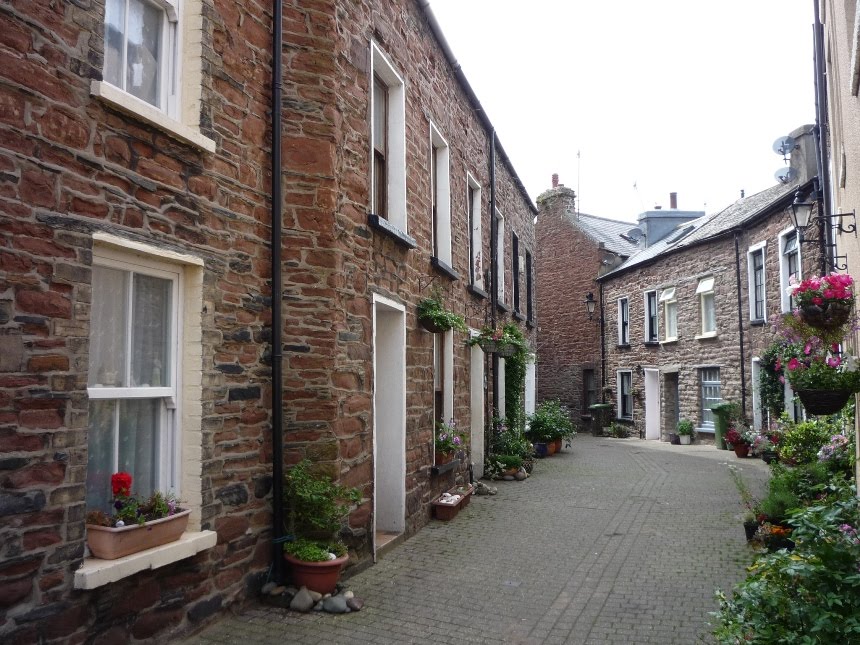
We ate our ice cream looking out on Peel beach, which was packed with people having typical British (or quasi-British) beach holidays. Parents were laid out on beach chairs and towels while their kids built sand castles or tried to dig to Australia with their little shovels. We wandered back into town and came across several gardens that were apparently part of some tour or competition. It was a rare chance to get to see some of the back gardens of Peel without having to climb a hill first. We also managed to find ourselves our own bottle of Manx Spirit and a sampler of Manx cheese, which is also supposed to be good.


Peel streets and gardens

From there, it was back to Footprint to prepare for the next day’s hopefully sunny and mild, downwind journey to England.