Monday, September 19, 2011

A forgotton land of wonder and plenty?

[Kyle]The cove at Dyros doesn’t have a village as such, just a few widely scattered buildings and an informal looking caravan park. The village of Dyros itself is at the top of the nearby ridge a couple of kilometers away. The big attraction here is the caves. Dyros has a very long and elaborate network of caves, all beautifully decorated in stalagmites, stalactites and other crystalline structures.
Even though we were tired as a result of having our sleep patterns messed up by the overnight sail, we couldn’t resist taking the dinghy over to see it as soon as we were settled.
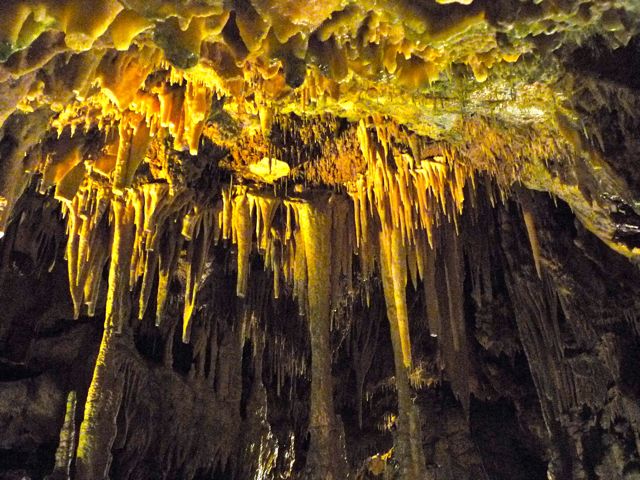

Exploring the caves by boat and foot

It was amazing for two reasons. One was that the cave itself was incredible. It was labyrinthine. It went on and on for miles both above and below the water and was covered with the most beautiful structures everywhere we looked. We’ve been in a few caves now, and this one definitely tops the list for being jaw-droppingly beautiful and impressive.

The second amazing thing was the tour. It was terrible. It was the worst tour of the coolest thing I have seen. The tour started with the ticket guy sitting us down in front of a long video and then disappearing. The video had the effect of making us feel the tour would be unnecessary since now we’ve seen it. There were, however, a couple of interesting bits where the film crew left the tour route to follow a team of cave divers into some really cool, remote parts of the cave.

Right in the middle of one of these parts of the video, the guy came back and told us and the other four people there the tour was starting. We were shown to a boat inside the cave and told where to sit. Then the guide boarded at the back and we took off. By using the tip of an oar, our guide skillfully punted the boat along the route through all of the tight twists and turns without bumping the sides of the boat hardly at all. The aggravating thing about it, though, was that he seemed to be going for some kind of record while doing it. With no more commentary than saying the names of four or five places along the way, we positively zinged through the cave. At the largest room of the cave there was a long straightaway. We actually got going fast enough to feel a breeze. By the time everybody readied his or her cameras for a shot, it was gone. The photos probably would have been blurry anyway from the speed. The trick seems to be to go and see it and not worry about photos. I can’t imagine what it must’ve been like in the old days. “I say, old boy, slow down. I haven’t had time to even set up my easel!” Other parts of the boat route were narrow and low enough to have us all ducking and breathing in.

At the end of the tour, the boatman banged us up to a dock and left – just vanished. We were still processing the boat tour when we noticed. The remaining 300m of the cave were on foot. We made a point of taking our time and being the last to leave. The cave was gorgeous, but what the hell was with that guy? He must have been trying to do the entire tour during a commercial break. Yeesh!

The next morning, we went ashore again to see the museum and adjacent cave. This cave was inhabited during Neolithic times from around 5200 B.C. until an earthquake in 4 B.C. caused a collapse of the entrance, closing the cave and killing the inhabitants by trapping them inside. The large cave was used as living quarters and storage area. It was the center of the obsidian trade all of the way from Milos in the Cyclades to the southern Ionian. We paid for two tickets and were shown to the small but well done exhibit room displaying artefacts found in the cave. When we were done with that, we were told the cave was closed. That was it. That was the whole thing: one room. That would have been nice to know before we bought the tickets.

Feeling like we had to redeem the trip somehow, we trudged in the unbelievable heat of the windless sun UP the hill to the town to have a look. The Maniot (or Mani) peninsula is a very wild, barren land. Cultivatable land is rare and for centuries was guarded ferociously. Because of this, feuding clans and families built fortified tower houses as protection from raids. These bare stone towers have become the architectural signature of the area, giving a much different look to other parts of Greece. The village of Pyrgos Dirou has a few of these old towers standing, with many newer versions filling out the rest of the town.


Picturesque village with a feuding history - Pyrgos Dirou

Maniot seems like a forgotten place. It’s not on the way to anywhere else (unless you’re on a boat). Tour buses don’t seem to come here. The place is left to itself. We walked the narrow, cobbled, empty streets pleased to have the whole place all to ourselves. Along the way, we grazed happily on an abundance of edible plants. There was more than anybody could eat, so most of it was left to ripen and then rot on the branch. We found and ate plenty of delicious figs, almonds, pomegranates, lemons, grapes and cactus fruit. There were also lots and lots of olives around, but these are not eaten directly off of the tree and must be processed first (and anyway, weren’t ripe yet).


Kyle finds, opens and enjoys Almonds among the bushes


Kyle munches on a ripe cactus fruit and pomegranates sit ripe for picking

The food was great, but wasn’t doing much for our thirst in the heat, so we stooped at one of the two local restaurants for lunch. There we had a good meal that stuffed us to capacity accompanied by a jug of cheap house wine that was tasted like it could also be used to clean engine parts. At least it was cheap.


Scenes from the walk - it's rare to see a cow in Greece

We walked off our lunch by returning to Footprint in the unrelenting afternoon sun. On route we passed a very nice looking hotel designed in keeping with the local villages. We soon realized it was closed, and presumed for the season, but as we took time for a closer look it seemed as if it had been abandoned quickly and some time ago. Wine and water bottles sat on tables, as if evacuated in a fire alarm and not returned for years since. It was sad to imagine the dreams and investments lost with the foresaken hotel.


An lonely, abandoned hotel

The first order of business back at the boat was to jump in for a cooling swim. Out of habit, I followed our chain on its winding path to the anchor. With no wind to speak of, Footprint had just bobbed around basically in the same spot. Our anchor and the first 15m of chain had been completely unnecessary. It was the weight of the second 15m that was keeping us in place as evidenced by the tight swirls of chain tracks in the sand where it first touched the bottom.

At the anchor, I got to see the cutest thing. As I approached, from under the back of the buried anchor blade, a couple of very nervous eyes peered at me over the edge. An octopus had made himself a little burrow there. As I hovered overhead, he tried tucking himself away as far as he could. I dove very slowly. As I approached, he changed color to try to match the silver anchor above and the sand below. By grabbing hold of the other end of the anchor, I was able to counter my buoyancy and stay right there watching him watching me. When the urge to breathe got too much, I surfaced and left the poor little guy alone in his new home. We were planning a middle of the night departure to the next place. I felt bad for taking his roof. When we left, I made a point of pulling up the anchor very slowly so he would be able to leave without getting hurt.


Plenty of sealife to entertain too

Leaving the Aegean

[Kyle]Around mid-morning we departed our beach anchorage on the south side of Kimolos. The wind had increased steadily all night as forecast and it was swinging us directly away from the beach by sunrise.

We pulled up the anchor and departed under sail alone. As the anchor came up, the bow swung to the east. We picked up enough speed for steerage and made a slow turn to the south and then west rounding the only other nearby boat like a pivot point.

Once we were clear of the protection of Kimolos, we were in the full force of the uninterrupted meltemi winds. We passed to the north of Milos and then made a slight turn just to the south of west for Cape Maleas on the Peloponessian mainland. Away from Milos, the meltemi veered slightly east of north, giving us a nice broad reach across the long, uninterrupted patch of the Aegean.

I had originally planned the passage to be 16 -20 hours, sailed mostly overnight, to the island of Elefenisos, just to the west of the cape, but the forecast was such that it seemed more prudent to carry on all of the way around the next cape, Cape Tainaro, and continue up the west coast of the Maniot peninsula to a little cove at Dyros (or Diros, depending on which book you read).


Passage to the Pelopennese

With the Meltemi pushing us, we made excellent time out of the Aegean. We rounded Cape Maleas just after midnight in the company of a lot of heavy shipping. We passed the anchorage at Elefenisos right at the 15-hour mark.

We were out of the Aegean and back in the Ionian Sea, no longer under the influence of the Meltemi. The winds died down and by the time we passed Cape Tainaro, Mainland Greece’s southernmost point, we had stowed the sails and were motoring along the coast toward Dyros.


Another Greek anchorage

A couple of hours later, we pulled into the bay and set the anchor in 3m of good sand just outside the range of the handful of people swimming on the beach. It was just past the 27 hour mark. Really big mountains that gradually steepened as they rose from the sea backed the horseshoe shaped cove edged by cliffs. We kept thinking that the scenery looked almost exactly like Scotland. The only thing that was different was that it was greener there and, of course, the weather’s not as nice.

Thursday, September 15, 2011

Off to Kimolos

[Kyle]Oh, finally, a short one!

We stayed long enough in Karavostasis on Folegandros to watch the morning programs. The guy who strung his line across the fishing fleet in Sikonos showed up, tried to block everybody in and ended up dragging his anchor all over the harbor. The “Water Boat” came in and kicked off everybody who was moored stern to the mole so it could lie alongside. The boat served as a mobile desalination plant that came in periodically comes in to refill the island’s reserves. We watched a few ferries come and go and then it was time to leave ourselves.

The sailing was pretty uneventful. We tacked back and forth for a while in light headwinds until we got past the chora, then we had to start the engine to make sure we would get to our anchorage by dark. Along the way we passed by many magnificent rocky anchorages that I was dying to live in for a day. Instead, I decided to opt for the more boring sandy beach (with good holding and protection) on the South side of Kimilos. The beach itself was a long pebbly affair, the entire thing offered great holding and protection against the forecast Multemi winds. There was already one boat anchored on one end, so we gave him his privacy and anchored towards the other end of the long beach. The beach would easy allow for four or five boats in-between each with full privacy.

Once we’d settled and dinner was served in the cockpit at sunset two more boats arrived. Rather than spread out as expected they both converged on Footprint and anchored inexplicably just outside of our turning circle. So much for privacy. One boat was a Dutch ketch occupied by a couple a little older than us (Bataver), the other a charter boat with four young guys (party boat). Oh well, I thought, we’ll just pretend it is a small crowded anchorage, I’m not moving. We continued to enjoy our dinner and wine when the Dutch couple decided to bathe – naked, right in full view of us. Soaping every nook and cranny it was hard to avert our eyes as they were in our direct line of sight. Maryanne and I enjoy dinner theatre, but we didn’t know we’d stumbled into the red light district. What an end to our last Cycladic island anchorage.


Views from our anchorage - the island across the channel in the top picture is Milos, where the famous Venus di Milo found by a farmer in rubble he was using to build a wall

Folegandros


Tortoise Rock? and other outcrops on route

[Kyle]We skipped the usual alarm call and woke when we were ready the next morning for the short journey to the island of Folegandros and Maryanne’s birthday. We roared along the southwest coast of Sikinos, pushed along by strong katabatic winds rushing down the islands steep hills. We crossed the small channel between the two islands, passing by many craggy islets along the way one of which looked very much like a tired giant turtle relieved to have reached shore.

At the port town of Karavostasis we considered mooring stern to the quay but the depths were such that we’d need a LOT of rode and opted instead for anchoring in the shallower bay. It too was a thin layer of sand over rocks but here they were large enough we were eventually able to get a good set on the second try.

We didn’t feel like going through the hassle of deploying the dinghy so we loaded a dry-bag with supplies and swam ashore. We found ourselves just in time for the next bus up the hill to the chora.


Folegandros

At the top we didn’t find the chora to be that interesting, just a regular-ish town plopped onto a plain. The buildings were perfect with their Greek island white walls, but seemed new and inauthentic somehow, just a little too boxy. It wasn’t until we stepped off the bus that we realized what the big draw was, the plain ended abruptly at the edge of the chora in an enormous cliff plunging vertically down into the sea. Eventually we did find the ‘old’ town and it had a very special character, including wooden balconies and unusual passageways meandering from shady square to shady square.


We climbed the smoothed out path up to the monastery for the views overlooking the chora and beyond. We could now see within the walled hotel compounds and spot swimming pools and relaxing tourists sat among the flowers. From there we climbed higher to the top of the tallest cliff on the island and were rewarded with amazing views of the chora and its little cliff below.


Kyle so loves a hill

After our walk we poked into the most attractive looking hotel and asked if it was OK for non-guests to use the outdoor bar. We sat sipping our beers overlooking the crashing ocean water from the cliff-top balcony.


Oh boy, what a life

Afterwards, we had a walk and found an agreeable little restaurant with an irresistibly friendly proprietor. It sat at the edge of a plaza made up of irregular angles. We found a table under a tree backed by a wall of flowers, where we had a selection of every local item on the menu that was vegetarian.

We ate our fill, using the excuse that it was Maryanne’s Birthday to try anything we wanted. Afterwards, we walked off our meal by skipping the bus and walking back down to Karavostasis.

By the end of the swim back to Footprint, we realized we were pretty exhausted, birthday or not, and called it an early night.