Friday, August 22, 2014

The Skunk Train

[Kyle]One of Maryanne’s little jokes that makes her chuckle to herself is her characterization of me as a train aficionado. She thinks she’s hilarious because the image she has in her mind is of me sitting at the edge of the tracks in a lawn chair under an umbrella dutifully writing down engine serial numbers and other impertinent minutiae on my little clipboard.

Hardee har har! I do not, and will never, do that.

That said. I do think trains are mildly cool. They are big, interesting pieces of machinery and I am interested in how most anything works. I also like that you can walk around on them when they are moving and that their tracks take up way less real estate than a big ugly road.

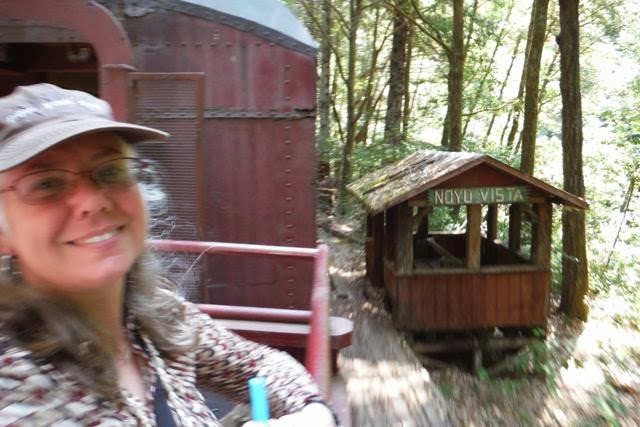
So, with that in mind, she booked us a couple of tickets on the Skunk Train, running from Fort Bragg to Northspur through the redwoods. {Maryanne: This was originally installed to bring lumber to the coast from the logging camps, it is quite the tourist highlight for the area, and with our timing there was only one option open to us which consisted of a return trip covering a full half of the track}

I tried to overcompensate by trying to be as ambivalent as a sullen teenager because I know she was watching me like a hawk for any signs of interest so she could start guffawing and making jokes about buying me train videos in the gift shop later. Then the train started moving and I may have let a crack of a smile cross my face. By the time we got to Northspur, I was singing along out loud with the guy playing train tunes on the guitar. Dammit!


While rushing through the redwoods we are entertained not only with the views, but with a dining car/bar, a running commentary on the scenery, and the talented on-board minstrel

At Northspur, we got off for forty-five minutes. I was keen to see the old growth redwoods nearby and was dragging her behind me like a kid at an amusement park. I was taking pictures of trees and hugging trees (Oh, I do that!). I turned around to find HER taking pictures of the engine being moved to the other end for the return trip. Hmmm…


Enjoying the trees and the train at Northspur logging camp

On the way back to Fort Bragg, she let me have my way and we got to ride in the open car the whole way. The weather was perfect and warm and it was great to stand out under the open sky and smell the big trees as we trundled by.


Afterward, we had a look at a model railroad they have in a disused train barn out back. Pretty cool. It reminds me of what my parents did to my room after I left to keep me from moving back, only bigger.


Entrance to the extensive model railroad was included in our ticket price

We found a restaurant attached to the local brewery across the street and had a sampler. This one was all twelve of their beers. Twelve sample portions still works out to a lot of beer for such a long walk home. I think we would have been okay, but our server forgot our food order and apologized by comping us a beer. Oof!


Relaxing with a sampler of local brewery offerings

Getting home wasn’t too bad. “Walking it off” had us feeling pretty human by the time we made it.


Fort Bragg

[Kyle]After sailing through the night and a brief nap to reset our internal clocks, we walked up the hill and over the bridge into Fort Bragg.

Actually, the main part of the town is about a mile further, so we walked there. It started a lot like Brookings, but picked up some charm as we went, although the first building we saw upon passing the sign that said “Welcome to Historic Downtown Fort Bragg” was a 1990s era bank with a drive-through. The sign was about three buildings too early.

Once we made it to the historic part of town, we decided to keep going to see the trestle over Pudding Creek. Well, we had to cross the trestle, which revealed a network of trails running along the cliff tops by the sea. A few “just to the next point” add-ons later, we finally had the sense to turn back home. We arrived sore and barely able to lift our poor feet. It was a really nice day, though.


After a hike through town we made it to the picturesque Pudding Creek and beyond for a cliff top exploration and more beautiful scenery!

Eureka to Fort Bragg

[Kyle]The tidal cycle had migrates about an hour forward a day. In the time we were in Eureka, it had gone far enough for the afternoon tide to be too late, meaning we had to switch to the previously too-early morning tide. This meant we had to go through the pain of getting up way earlier than we had become accustomed.

We left our grotty dock at the very first hint of morning twilight. The fog was fairly thick, so we felt our way out of the harbor squinting through the mist-covered plastic of our cockpit enclosure while relying heavily on our radar to do the real seeing.

Once we passed the end of the breakwater, the smooth water of Humboldt Bay gave way quickly to six-foot ocean swell. The swell was accompanied by no wind whatsoever. Since we were heading directly into the swell, which was really killing our speed, we kept an engine running to get through it.


After safely exiting Eureka, Kyle celebrated by eating a delicious cake (kindly provided at the tasting at 'Taste' from the night before

I was worried it wouldn’t materialize at all, but about a mile from making the big turn to the south to parallel the coast, the wind went from nuttin’ to sixteen knots. We shut down the engine and were able to easily make nine knots with even a couple of extra reefs in for good measure.

As we rounded Cape Mendocino, the wind gradually picked up into the low, and then the high twenties. The wind was almost dead astern, so we rolled up the jib to keep it from flapping around in the turbulent spot behind the mainsail. Damn, that’s annoying.

Maryanne went for a nap just as we approached the cape. We crossed Eel Canyon, then Mendocino and Mattole Canyons, each separated from the other by an underwater ridge. The ridges must have wreaked havoc with the underwater currents, forcing them upward to clash with the ones at the surface. The ocean was a fairly organized two-swell pattern in the deep water of the canyons, but a big washing machine full of pyramid-shaped waves coming seemingly from every direction at once over the ridges. My only consolation was that we were going nice and fast in the right direction.

The wind gradually picked up some more until it was regularly venturing into the low 30s. Since we were running away from it, we only saw 20s on board. Begonia was now spending most of her time above ten knots and was regularly surfing above fifteen. That was faster than the waves were moving, so I was getting the regular experience of watching the waves come from behind, pitch us forward, stop, and then go astern. A few of the crests were breaking, which caused us to slew around a lot and made the autopilot command the use of a lot of rudder. I’m afraid of that now, so I took the wheel and disconnected it.

The fastest I saw us get was 16.4 knots through the water, 18.8 over the seabed. We were probably above thirteen for a whole minute then. The bows both made huge, arcing waves that came through the trampoline and landed on the cabin top as we slowed down coasting up the back of the wave ahead.

Okay, this was too fast now. I wanted to get the mainsail down because I was worried about the slewing causing a crash jibe, but knew I wouldn’t be able to going downwind with it plastered against the mast. Rounding up would have made the wind over the sail jump to near forty and would require a turn across the steep seas. I knew this sort of thing happens around here and that it was probably a short-term local effect, so I just decided to ride it out sitting on the edge of my seat, watching the waves and trying to steer as straight a line as possible.

Maryanne had asked for coffee when she woke up. I had to get her in ten minutes, but I was afraid to leave the seat to wake her, much less make her some coffee. With five minutes to go, the wind fell into the teens and I cautiously engaged the autopilot so I could sprint down and wake her. When I got back, the wind was five. I put the kettle on and it was down to two from dead ahead by the time she came up the stairs. The big waves coming up from behind were now crumbling into breakers in their new headwind.

I was very wary of this. We were losing steerageway, but I wasn’t about to put up more sail only to have the wind go back up to thirty in ten minutes. I was hovering waiting for the hammer to fall. Maryanne told me to stop worrying and get some sleep. She would deal with it.

I must have been pretty tired, because I actually did fall asleep almost immediately. She waited an hour, then started putting up sail. An hour later, she took it all back down again. Not because the wind picked up again, but because the useless sails flapping in the still air were driving her crazy. A short while later, the vibra-bed started up as the engine below me was started. We had a couple of hours before we needed to resort to that, but since it was already going, I embraced it and the noise and vibration put me right back to sleep.

It turned out to be a good thing she started the engine when she did. A tropical storm by Mexico was sending big waves up the coast and causing a counter current near the shore that we ended up fighting. We spent most of the night struggling to maintain three and a half knots toward Fort Bragg. We barely made it to the entrance of the Noyo River at the tail end of the flood.

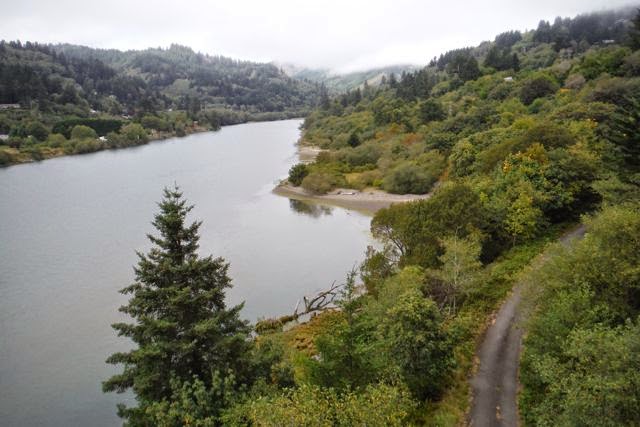
The entrance to the Noyo reveals itself as a tiny bay amongst the cliffs. At the back of the bay lies the very narrow slit covered by a high bridge. We rode the swell into the river, taking great care to stay on the very narrow beam of the tri-color entrance light. Once inside, we dodged the light, passed under the bridge and motored up a river that was perfectly flat and protected from the swell and weather outside. It was lined either side with fishing boats backed by all of the support structure for them: ice houses, wholesale buyers, processing plants, and restaurants. It suddenly felt like we were in a 1950s fishing village.

At the far end of the navigable part of the river lies Noyo Basin; the marina where we tied up behind one of the only other sailboats amongst a sea of commercial fishing boats.


Safely entering the Noyo River, Begonia finds a temporary home among the local fishing boats

Thursday, August 21, 2014

Eureka

[Kyle]Eureka was looking much more appealing the next morning. The light was bright and diffuse in the late morning fog. We started by walking away from the town center on the path that runs along the river-front.


The very grand (and private) Ingomar Club

The first thing we encountered was the grand and beautiful Ingomar Club – a place formerly known as the Carson Mansion that is home to a very posh and exclusive men’s club in a grand Victorian Mansion with lots of intricate gingerbread woodwork sitting atop a hill overlooking the town. We didn’t venture past the many ‘Private’ signs, but admired the grounds from the street nevertheless.


Beautiful 'Gingerbread' Victorian houses adorn the town (not all in the best of repair)

We then meandered off along a route that took in many of the towns lesser but also beautiful examples of the town’s penchant for Victorian architecture with a lot of intricate woodwork. The sun broke through the fog. Our tour of pretty houses became the underlying framework for a long walk in the sun talking about anything and everything that came to our minds without the pressure of time. It’s easy to fall into the habit of skipping time for real conversations about what makes you tick in favor of seemingly more pressing talks about day-to-day admin.


The Eureka Inn, recently renovated and reopened - Maryanne was hoping to take tea there, but being Sunday it was closed (along with the bar!)

Or tour of the town’s architecture culminated at the Eureka Inn, a grand old wooden structure in the center of town. One of the men at the front desk took note of our interest and was kind enough to show us around a bit even though we weren’t guests at the hotel. He seemed to enjoy showing the place off and was clearly proud of it.

We had wanted to have a meal at their beautiful restaurant, but it was closed, so we headed back to the part of the town we had seen the night before with all of the restaurants and pubs. We almost stopped in several of them, but managed to hold off until reaching the Tourism Center.


In addition to the usual stuff you would find in such a place, like brochures, souvenirs and advice on what’s good to do in the area, they also had a bar, which served lots of local food and drink from Humboldt County. We had a six-glass wine taster and a seven-glass beer taster as well as a sampler of four cheeses, all in a wonderful and friendly atmosphere. Maryanne also had one of their garlic and ginger kumamoto oysters. We left wishing we had found the place first. Our initial impression of Eureka would have been so much better.


The town is full of murals, a pleasure to discover as we wandered around

We went home for a dinner of pasta with the smoked salmon we bought from Brookings. We weren’t done yet, though. At the urging of the lovely staff at the Tourism Center, we returned afterwards for Cake Night.

One of the local high-end cake shops had brought out a free sampling of some of their absolutely delectable creations in little melt-in-your-mouth morsels. The chef was in attendance and she was more than happy to share her process as well as feeding us more than we strictly needed. It was a good thing we ate before coming back. It made it easier to avoid eating another dinner of macaroons and s’mores. (We were even given a couple of extra cakes to take home with us and enjoy at a later time.. Mmmm, we LOVE the cake!)

Wednesday, August 20, 2014

Passage to Eureka (California, here we come!)

[Kyle]The best time to cross the Chetco River bar at Brookings was in the afternoon. We had a guilt-free lie-in and then headed to the fish shop for a lunch of fresh-caught fish and chips before departing.


Leaving Brookings

The sea was pretty calm at the bar and the swell didn’t start building until we were a couple of miles away. We hoisted sail, turned south and picked up speed. Eureka was only ninety miles away and we had twenty-five hours before we could cross the bar into Humboldt Bay, so we were in no real hurry.

We ticked off the miles and then gradually reduced sail more and more as the night wore on to keep from arriving early. By the time Maryanne came on watch at sunrise, we had slowed down to three knots. I handed Begonia over to her and went below to get a few hours sleep. A few minutes later, before I had fallen asleep, she popped her head in, “We’ve got no sails up!”

Yep. We had been under bare poles for a couple of hours. The wind was strong and almost dead astern, so it was a real luxury to pull everything down. I no longer had to deal with moving flapping, temperamental sails from side to side with every minor shift in wind direction and the fear of a crash jibe was gone. All Maryanne had to do was stay awake and steer, at least until the wind died down.

When I took over a few hours later, she had unrolled about half of the jib to keep us moving. We were now both awake for the rest of the leg to the Humboldt Bay bar.

Maryanne was making breakfast while I was outside at the helm. Up ahead about two miles away, I spotted a big plume of steam. It was a blast from one of the members of a small pod of humpback whales. I was cautiously excited. Maryanne was distinctly more nervous. She has been on edge around whales since the collision.

This pod circled around us in the course of their feeding, but never got closer than a mile. They were very active, though, and we got to see several breeches. It is an impressive thing to see the teardrop shape of one of these massive animals come clear out of the water, pirouette slowly with the long flippers waving like a dancer’s arms and then crash back into the sea in an explosion of white water.

They left us when we sailed into shallower water near the coast. We were right at the right time to enter Humboldt Bay at an hour before slack water. As we approached, a Coast Guard cutter was leaving. They do this a couple of times a day to check bar conditions.

As we passed them, they started to circle back toward us. I got that feeling you get when you see a cop going the other way in your rear-view mirror suddenly hit the brakes. Perhaps they were just turning around now that they’ve seen the bar. Nope. They called us and asked how long it’s been since we’ve been boarded.

“By the U.S. Coast Guard? Several years”, I responded.

Our number was up. They told us they would meet us once we crossed the bar and launched a rib (rigid inflatable boat) to give chase.

Once inside, they came alongside and two men boarded us. They were both polite and efficient and conducted their inspection as we continued up the bay with the rib following us. Maryanne gave the tour and answered questions while I navigated.

They seemed to be actually impressed by Begonia’s compliment of safety gear. They told us we had better flares than they did. When one of the guys asked to see our fire extinguisher, Maryanne showed him all five. He stopped her before she could get out the fire blankets. Later, when the other guy asked if we had PFDs (life jackets), the first guy pointed out that we were wearing them and added, “I’m sure they’ve got lots more below.”

We do, as a matter of fact.

They bid us good day and left us with a form with all of the right boxes ticked that we could show to the next Coast Guard boarding party to encourage them to move along.

We proceeded up the river to the marina run by the city of Eureka. We found an empty space and were about to tie up when a fisherman in an old boat who appeared to be on the phone to the harbormaster ran us off.

“You need to go to the Flumpta Megulain dock, up the river.”

“I’m sorry, the what?”

The Osaiah Gesubub gas dock, up the river.”

“Where is it?

“It’s the Omega Hartunian dock, half mile up the river.”

Oh, of course. Half mile. That, we can work with. We’ll figure out what the hell the rest of that was on the way.

We tied up to a likely candidate near the town center. It looked good from the river, but once we were tied up, we noticed that we were under the constant watch of a few unsavory looking people who looked like they may have been in prison when we left Coos Bay.

We were just finishing up out arrival checklist and resigning ourselves to cowering inside our barricaded boat for the evening when the harbormaster called us to tell us we were at the wrong dock. We were supposed to be two docks further along (at the Bonnie Gool Dock).

We untied and headed up the river to a park on the edge of town. We pulled up to a dock covered with teenagers fishing. We approached slowly enough to let them get their lines out of the water, but they still only moved off reluctantly, leaving us a dock covered with bait, fish guts and bird droppings. This didn’t feel like much of a better deal than the last spot.

The kids seemed more concerned about fishing than about Begonia, so we felt a little safer leaving her unattended while we had a walk around town to get our bearings.

It didn’t start off well. Our initial path into town took us past a couple of homeless shelters and motels that rent by the hour. What had happened to Eureka since the last time I had seen it? I remembered it being so much nicer.

After a few more blocks, it started getting that way. Overgrown railroad tracks and crumbling buildings gave way to galleries, bistros, microbreweries and bookshops. We debated popping into one place or another for dinner or at least a drink, but we were too worn out from the adjustment from our sea routine to our land routine, so we just decided to go home and call it a night, ready to explore properly after a good night's rest.

Exploring Brookings (doesn’t take too long…)

[Kyle]For our first whole day in Brookings we set off in the general direction of town to see what’s around. With nothing in particular in mind we figured we’d simply enjoy the scenery along the way.

Many years ago I would occasionally fly freight into Brookings, so I had a passing familiarity with the place. It seems in the years since, the town hasn’t held up as well as I’d remembered. Don’t get me wrong, Brookings is a nice enough place, but I just remember it as being quaint and rustic back then, but to fair I was half asleep all the time.


Views from the 101 over Chetco River, Brookings

We started our exploration by making the uphill climb from the marina to cross the road bridge that takes US route 101 across the Chetco River. The marina was on the opposite side from town so the bridge couldn’t be avoided but the elevation provided spectacular views of the river valley and harbor. By the time we reached the other side of the bridge, and into town proper we were feeling a little puckish and stopped into the first coffee shop we saw where I had a delicious mocha and a giant and generous bowl of tortilla soup. Maryanne was given a cup of hot water for tea and a single slice of thin white bread toasted and cut in half. The poor woman looked quite the waif at my soup as she gnawed on the corners of her dry toast. {Maryanne: with our stove functioning down to just a single ring I can’t have toast aboard Begonia, so I’d really built up a craving for it. This was a really poor example of it that I could have done without, and it cost me almost as much as Kyle’s delicious soup. They didn’t even give me a knife for the butter! Sigh}

Back in the fresh air newly caffeinated and stuffed (at least one of us!), we spotted a brown tourist road sign directing us to Chetco Point and decided to amble in that direction. The route took us on back roads past industrial areas, non-descript apartment buildings and the generic edge of town stores. On about the 4th section of the route the signs vanished, and we were clearly not at any scenic outlook. We poked around a little and eventually found a gate chained shut with a sign saying the path to Chetco Point was closed (Sigh, again). By now our feet were feeling abused from the effort of walking after so long at sea, and Maryanne was not amused at so much effort for no reward. Back to the main road! Apart from the sea mist this part of Brookings was indistinguishable from any other American town. There was a big four-lane highway with few accommodations for pedestrians to either walk along or cross; either side lined with dated and dusty chain stores and strip malls. We kept passing places that seemed like they might have something or other we might ‘need’ for the boat, and we ended up spending more time that I would have cared to in hardware, electrical and grocery stores.


Harris Beach State Park

At the other edge of town we spotted a sign for a bicycle path that split away from the road headed into trees and a picturesque trail (finally!). Suddenly we were back in the nice part of Oregon, walking through woodland filled with the scent of pine and sea air. As an added bonus the trail was lined with loaded blackberry bushes and we were able to graze as we went along (giving us plenty of opportunity to rest our feet). A mile or so later we emerged from the trail into Harris Beach State Park perfectly swathed in a mist giving a dramatic sense to the already spectacular beach scene. We walked the trails and climbed the rocks and were amazed to see families playing in the surf of the frigid waters wearing swimsuits on such a cold and foggy day. We kept our distance from the ocean, remaining sensibly dry.


Grazing while hiking... Blackberry season!

Realizing we’d gone as far as our abused feet could be expected to take us, we retraced our route along the bike path and this time encountered several groups of people picking blackberries. Maryanne’s favorite was a group of young siblings with loaded sand-castle buckets, one of which had failed to commit the perfect crime; his bucket was empty but his face was covered with the stains from those blackberries that didn’t make his mouth in the rush to eat them without his industrious sisters noticing.

Back in the strip mall zone, we passed the distance by ducking into one shop after another and purchasing those things we hadn’t wanted to carry any further than necessary. Knowing we are most likely back to living at the dock, we purchased a toaster so Maryanne can again have all the toast she wants (provided we are plugged into shore power), and we picked up some bagels, good bread, and English muffins to test it out! We finally made it back to Begonia loaded down with new purchases, declining any further excursions, we turned to Netflix for entertainment as our beleaguered feet got a well deserved rest.

After a good night’s sleep we set off to explore the marina side of the bridge (the unincorporated town of Harbor), but on closer inspection couldn’t identify anything of any interest so we decided to head back across the bridge for one of the parks we’d ignored earlier. On route through the harbor buildings we came across the chamber of commerce’s tourist information office and excitedly went in to seek guidance on how to fill our day. They started off by explaining all the great things there were to do provided you had a car (after we’d explained we were on foot after arriving by boat). Maryanne enquired about any buses? (Nope!), how about a rental car? (Nope!). Harris Beach (not the best, they assured us) was the only local thing. A second attendant arrived and was equally stumped as to what anyone would do in Brookings if they didn’t have a car to get out of it! Maryanne pushed: any museums? “Ah, yes, there are lots of galleries, you can go to such and such café, or the tattoo parlor they both have galleries you can view”. Hmmmm. So we decided to ignore them and stick to our plan to visit the nearby park (Azalea Park).

We’d seen signs from the road pointing to the Park, and indicating hiking trails. Unfortunately the hiking trails were at a second park (15miles further away), Azalea park was a couple of baseball fields and a small amphitheater and giant kids play area all set in beautiful woodland but easily walked in 10 minutes. We stretched out tour to 20 minutes with another meal of freshly picked blackberries and set off to return via what looked like a small café near the entrance ‘Capella by the sea’. As we got closer to this interesting building we could see the front doors wide open and what looked like pews within. This steep A frame building with all glass ends was beautiful but looked like a church rather than the hoped for café. It sat atop a ridge and surrounded by redwood trees. Once inside we learned that it was designed as a place for contemplation, built by a famous movie producer in memory of his wife who he missed dearly after she passed away. We’d stumbled on the Taj Mahal of Brookings. Inside were two people. One making use of the amazing setting engaged in quiet meditation/contemplation; the other, a volunteer, desperate to engage in excited conversation, instantly breaking the peaceful spell. Karen, the volunteer docent, was indeed an amazing person. She’d hiked around the Middle and Far East in her 20’s (having her children as she went), and been active in the wooden boat scene of the pacific North West, living aboard in Washington state for a while. The other lady quietly slipped out as Karen chatted away. After conversing for a while, we took our leave and went in search of a quiet road along the river valley (and more blackberries). As we left the park we notice that other woman, the one we’d seen enjoying the quiet of the Capella, enjoying the sunshine sat on the grass.


The Capella-By-the-Sea at Brookings Azelea Park

Our new trail took us to a few dead ends and eventually we acknowledged that our feet deserved a break and we made our way back home, rewarding ourselves with a Zola’s pizza and a Slug-and-Stone ice cream on the way – both were excellent. We also picked up some local smoked salmon and smoked halibut for future dining in, it would be a crime to leave Oregon without any salmon!


Zola's may look like a dive from the outside, but it is not to be missed!

The following morning, before departing Brookings, Maryanne dragged me back to the nearby seafood store for a meal of fish and chips to sustain us on the passage on to California.