Sunday, March 11, 2018

Anniversary Road Trip - Lakes and Rivers

[Kyle]To get me up to Santiago for my flight, we decided to rent a car and make a mini vacation out of the journey. We had wanted to take a few days to rent a car and explore some of the country anyway, so the flight gave us at least one point in our itinerary. Also, our fifteenth anniversary was coming up and we wanted to do something special to mark the occasion.


The fog soon cleared as we pass along the scenic back roads
Los Lagos, Lake Rinihui, Lake Panguipulli


Lake Callofquen (SW end)


Lake Callofquen (N end at Licanray)

We started the first day with a drive up into the Lake District, Region de Los Lagos. Our route took us up into the foothills to an area with rolling hills of golden grasses interspersed with groves of tall trees. The road followed a series of riverbanks to their headwaters at giant alpine lakes. We passed by several and finally stopped at Villarrica.

Villarrica, a small town of 50,000 people, surprised us with how busy it was considering how sparse the roads had been on the drive up. The town sits on the western shore of a lake several miles across with the same name. The view from there is painfully pretty, looking across pine tufted islets to a view of the high Andes. Standing sentinel over the scene is Volcan Vollarrica, it's glaciers running down to fill the lake. From the waterside, the two adjacent volcanoes can also be seen.


So many great views of Lake Villarrica, even our hotel room looked over the lake

We were hungry from a long day of hiking and driving, but we hadn't yet booked anywhere to stay. A quick trip to the tourist office turned up two recommendations just steps away. One was a nice high rise hotel, the other was a somewhat dilapidated looking hostel. I was for going to the big hotel, seeing how it was a special occasion and all. Maryanne was less enthusiastic about forking over a bunch of dough and wanted to at least look at the hostel first.

We went inside and found the owner eating in the dining room with his family. On the inside, the place seemed clean and well kept. We asked to see a room and he showed us up endearingly creaky stairs to a small dormer room of golden wood gleaming brightly with many layers of shiny varnish. It was small, but clean and it had a great balcony overlooking the lake. I asked to look at a different room. He showed me two others, but we both agreed we like the first one best. We decided to skip the big hotel check in for the night here. Only when we had finished did I notice that there was no signs of any other guests. It was early, so I figured they must be showing up soon.

We dropped our bags and went out to find a nice restaurant with just the right romantic atmosphere. After a bit of searching, we found one that looked just perfect, except that it was closed. It must be one of those restaurants that closes between lunch and dinner. We did some more searching and found another, which was also closed. We carried on with our hunger increasing each minute. We found places to eat. There were a couple of fast food stalls and some snack bars, but none with the particular environment that I wanted.


One of the restaurants that Kyle rejected - too purple?

Eventually, we spent so much time searching that we found our way back to where we started. The place was still closed. Not just closed, but the lights were off and all of the chairs were on the tables. We checked our watches. According to the board outside on the sidewalk, it was the middle of Happy Hour - AND it was Saturday night. What the hell? We found several more like that, before we came upon a nice Italian restaurant that seemed to be doing a reasonable business. Well, of course they would be. They're the only one's open! It turned out to be very good and we got the atmosphere we had been looking for. We even got the bonus of a table by a roaring fire.

Saturday, March 10, 2018

Valdivia (first week or so)

[Kyle]During our first week in Valdivia, we took the bus into the main town and tramped all over what seemed like every road. We met some very nice people from other boats and spent several enjoyable evenings with most of them (finally we found foreign boats visiting Chile). One of the owners of a nearby Chilean boat was the manager of a nearby shipyard. He was a real source of information on how to get parts for our broken stuff. Unfortunately, it wasn't what we wanted to hear. He said sending anything through the post office would likely take up to eight weeks to get delivered. Apparently, stuff arrives in Chile pretty quickly, but they take their sweet time notifying Customs, so it takes forever to actually get anything. Because of this, most people here work around the post office by using private couriers or freight companies like FedEx. Going through the shipyard, he said we could probably get the stuff we need in about ten days. Great! But the problem is that the fees and duty would typically run about 200% of the cost of the items. That hurts for a $20 bag of shackles, but we need a $2000 windlass, plus some other non-trivial amount for rigging terminals and spares. We're having a hard time affording what we need without having to come up with $4,000-$6,000 in duty.

We went next door to Alwoplast. They are a yard that builds beautiful high-end catamarans. Rumor is that they are capable and don't mind taking on a little side work. The manager there was very nice and spoke vey good English. He initially said they were so busy, they couldn't do anything for us. Later he said he would try to see if he could cobble together some sort of fix for our shroud from parts he has around. (The catamarans they build have Kevlar rigging, so they don't have a lot of parts for stainless steel wire.)


A bit of sightseeing among the chores - Valdivia and the country side around the marina

{Maryanne: We kept trying to visit the local (to the Marina) restaurants, and craft breweries (for which the area is well known) only to find them closed. It seems tourist season is well and truly over after the 1st March! Still we got plenty of exercise and were able to munch on blackberries along the way.}

While they were perfectly confident it would stand a pacific crossing and more, "Cobbled together" is not a state that I want for our rig. That's fine for temporary repairs to get us to a continent, but I don't want to leave one that way. With rigging spares in short supply, and windlass un-fixable per the locals, it gradually became apparent that the only way we were going to get the parts to fix the boat properly was if I flew all the way back to the U.S. to collect them. This was no trivial matter. Each way would require a 750 mile drive and two flights totalling quite a bit more than 12 hours of flying. {Maryanne: but I was excited as I'd be able to get a new (to me) phone and be connected again, and oooh, all the other spares I could order with such an opportunity}.


We had some beautiful sunsets at the dock
And rainbows - even double ones

Once we became sure it was the only option, we booked the flights and then started a program of having not just the windlass and the rigging parts, but a bunch of other things we needed but couldn't find, shipped to my mother's house for retrieval.


A day trip to the nearby Niebla and its Spanish Fort

Friday, March 02, 2018

North from Hiuehue to Valdivia

[Kyle]To get the timing right for the current through Canal Chacao, we had to leave Hiuehue the moment the tide rose to one meter above datum. For the previous couple of days, we had scanned the area carefully with our best binoculars each time the tide fell to below datum. That allowed us to scout a route that would get us over all of the shallow spots on our way out with at least 1/2 meter to spare. Even armed with our plan, it's still a little unnerving to be going anything faster than a crawl when the bottom rises and the number on the depth sounder starts plummeting. There's always a little stab of panic that I drifted off course until the number stops and then starts increasing again.

Hiuehue is a big basin with a narrow entrance and the incoming tide was boiling and swirling as it rushed through the gap. Even with both engines pushing us through the water at six knots, we were barely making one through the water. Sometimes, when it's turbulent, our depth sounder has a hard time hearing the correct echo from the bottom and I was worried it would become unreliable just when I wanted it most, but it stayed consistent. A handful of locals who were on the beach stopped what they were doing and came down to the water to stare at us for the long time it took us to fight our way through the pass. I was hoping they weren't waiting for us to hit some rock that they knew about, like gawkers at a car race who really came to see a crash.

If they were, we disappointed them and made it through just fine. The scary part came after the bay opened up as we were passing by the mussel farm in the shallows. I carefully retraced the track we left coming in, and knew it would be deep enough, but the water was two meters deeper then, so the readout on the sounder wasn't so alarming every time we passed over a shallow spot.


As soon as we left the narrow entrance - we had dolphins come and play
Lots of leaping and tail slapping

Once we were clear, we shut down one engine and powered over the flat Gulf to Canal Chacao.

We arrived right at slack water. Within a few minutes, the falling tide flushed us with increasing rapidity toward the vast open Pacific. The calm we were in before morphed into a chilly eleven knot headwind. It was actually the same weather, we were just going through it at eleven knots. Woo, hoo!

Going westbound, the canal widens, but it also shallows as it passes over a bar, so the current stays fast. All of the fun ends suddenly at the edge of the shelf. The current pushes into the swell coming from the west and it makes a huge mess of steep standing waves whose tops break in whichever direction is dominant at the moment. The wind also died for us there, which made the sails less effective at dampening the motion. Even though the waves were only two meters or so, It felt like we were getting thrown around in a storm with waves twice that high. We were relieved when we cleared the area, everything stabilized and we were able to have a mild to medium downwind sail up the coast.


Once out at sea - Whales, birds and the sunset to enjoy

We made such good progress the first night that it looked like we would not need another for the trip as we had originally thought. We arrived at Bahia Corral, at the entrance to the Valdivia River right at low tide. I was hoping to get a good push from the flood, but the river always has enough fresh water flowing to be constantly in ebb - rising tide is just a milder ebb.


Once in the Valdivia Estuary - the place is littered with old Spanish forts (Corral, Niebla, Islan Mancera)

After dodging ferries and tour boats and fighting our way up-current to Marina Estancilla, we arrived in the last of the post-sunset twilight. We tied up to the empty end dock and had a good look around. It was a very pretty spot. The river splits and bends right near the marina, so we get long views up the valley past pine-studded islets. The place is damp and green and, except for an occasional vehicle passing on the distant road, the primary sound is of birdsong, some of which I recognize as being from the local parakeets. This looks like it will be a nice place to spend some time.


After the busy working boats in Valdivia River, we were soon moored in the peaceful Marina Estancilla

Wednesday, February 28, 2018

Heuihue

[Kyle]The anchorage at Mechuque/Añihue was idyllic, but it was finally time to leave the islands around Castro and start heading north with the sun. The days are getting shorter here and soon, cold for us is going to turn into cold for here.

We had to leave at first light because of the tides, The tide floods northwards in the Gulf of Ancud and our destination for the day at Heuihue can only be safely entered on the top half of the tide. That meant we had to leave at low tide which is at 6am, except that it doesn't get light out until seven, so we had to wait until then and keep our speed up.

We had a lovely easy downwind sail past the cliffs on the northeast side of Chiloe with the Andes filling out the view in the other direction. We arrived to a cove choked wall to wall with mussel farms and exposed to the wind and sea. Our goal was behind them in a basin distressingly marked on the chart as being behind a thin line of dry land. We checked our guides and the tides about five times and they all seemed to indicate it would be possible to use the high water to get to the protection within.

Maryanne went into the cabin and pulled up a charts from a different source on our laptop and interfaced it with our AIS GPS receiver so we had two different chart sources running from two independent GPS antennas. Then she was able to guide me while I alternated between the chartplotter at the helm and watching for obstructions in the water.

We found our way to the entrance, where we were relieved to find three other sailboat masts visible. Anchored directly in the middle of the narrow entrance however was a largish local fishing boat. We're not sure if it was intended to be a message or if the guy was just clueless, but what's the deal with fishermen acting like no one else is going to need to use that water?


Waiting for the right window to head North

We eased our way in by passing close enough to lob a beer can into his wheelhouse (had we been the type inclined to such antisocial behavior {Maryanne: an example of Kyle's unique "sense of humour"}). We found our way over to the vicinity of the other sailboats through water that would not be deep enough to let us out. Because of the timing in Canal Chacao, we would need to leave when the water was a full meter and a half lower. Fortunately for us, the next morning's low tide was even a meter lower than that, the same as our draft. All we had to do was make a point of getting up early and making note of a safe path out around all of the sand bars that had appeared overnight and we would be good.

There's not a whole lot to do in Heuihue other than enjoy the birds, the good protection from the weather and wait for a window to move on. The upside is that we have a decent phone signal and enough credit left to get somewhat caught up on internet stuff. We managed to get an email out to the guy who installed our rigging. He reassured us that the broken strands were not indicative of any bigger problem. The stay would just be 4.2% weaker. He also verified that the fix was pretty easy and would restore it to its design strength, so I can probably take that off the list of things that keep me awake at night.

We are now poised at the eastern end of Canal Chacao, waiting for a weather window to leave the Gulf of Ancud and start heading north along the open coast.

Monday, February 26, 2018

Mechuque & Añihue Islands

[Kyle]We awoke to a lovely still morning and clear blue skies without a cloud in sight. Our plan was to spend the day on Mechuque, but since we had changed our plan and not anchored there, we instead rowed over to the main village on Añihue, to which we were technically closer. The scenery was typical tranquil waterway. The highlight of the row for me was when we disturbed a flock of about a hundred parrots. They were pretty swift, so I was never able to figure out if they were smallish macaws or largish parakeets. Either way, they were adorable and it's nice to see large groups of them in the wild.


Rowing Ashore - headed for another church
we spy another steamer duck, but then Parrots!

At the town, such that it is, we found nothing going on. Both tiendas were shut and the small church had a ridiculously and what seemed unnecessarily stout padlock on the door. It was probably the sturdiest part of the whole structure. We found a couple of guys doing maintenance on their big fishing boat as it dried above the low tide line. Doing “yard” work on a boat is no fun, but theirs seemed to stretch for acres.


A typical local village

With nothing else to see, we took a road to see where it went. We found a sign for a restaurant, but no one was there. No people, anyway. We did meet the world's happiest dogs, two friends that chased each other from farm to farm, often breaking away to herd something. They would then come running over to us for a scratch and some validation from the new strangers before tumbling away in a multicolored ball, alternately tackling each other. What a life! They had the whole island on which to play.

Back at the dinghy, we decided to row over to Mechuque by going the long way around the intervening islet of Pelleullo. In the center, there was a large pasture occupied by cattle having a very lively discussion with each other. I imagine that it was a heated debate about the proper way for them to govern their society, but of course, I don't speak cow, so it could have been anything.


Enjoying a tour circumnavigating Pelleullo
(including a bit of wading)
More birds, including a steamer duck family and more penguins

It got a little shallow in the back, so we had to jettison some ballast to keep the Pudgy afloat in the falling tide, but we made it over. We rowed across to Mechuque and tied the dinghy to a fishing boat that was being painted.

We popped into the one of the local museums and had a look around at their rather interesting collection of household items. I imagined its origin could be traced to cleaning out somebody's over-full shed. In the museum was a map of every building in town, along with the names of the residents. I remarked to the caretaker surprise that there was a bridge in such a small town. She seemed amused by this. How could I not know about the bridge? Most tourists arrive on the ferry from Tenaun and have to walk over the bridge to get to the museum. We arrived by dinghy from the other side and stopped in because it was the second building we had encountered after stepping off the beach. I guess that's not the usual way.

After leaving the museum, we walked into the village and found the bridge just as the day's first load of ferry passengers found it from the other side. Now I got it. It is a pretty impressive bit of structure. Atop giant steel I-beams sits a wide wooden bridge. On top of that is an observation tower that was quickly filling with people who had beaten us to it from their end. The tide was still pretty low, so it spanned over an expanse of mud. It seemed a pretty disproportionate bit of architecture for a village of a few hundred to stay out of the mud, but it provided a great viewpoint for the palafitos on either side.


We explored Mechuque along with all the other tourists

After a couple more hours wandering around, we were feeling a bit peckish, so we decided to find somewhere to eat. There seemed to be better than average odds than we have been having on the islands lately of actually finding a place that was open. We spotted a place that looked reasonably busy, where we could see people sitting at tables behind the windows and headed over.

Every, one there seemed to be on some sort of organized tour. We were standing around trying to figure out how we could get a table or even if we could get a table, when we got swept up by a crowd being led by the owner toward some smoke. It seems as if we had arrived just by coincidence at the main event. It turns out all of the other tourists had been funneled into two or three local restaurants as part of their tours for the preparation of Curanto, Chiloe's traditional gastronomic bombshell.

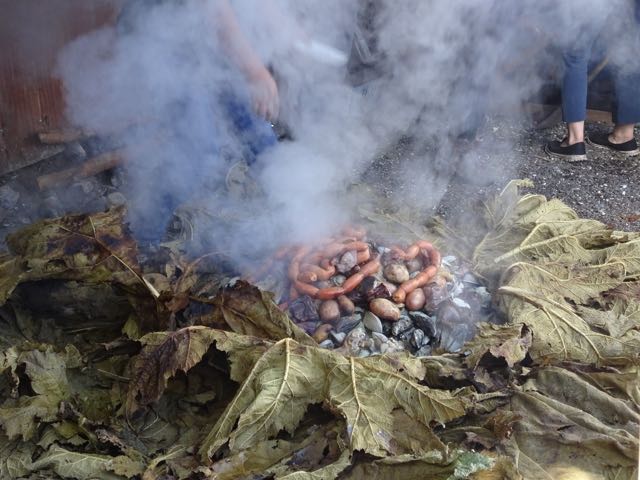
We had passed over a description somewhere, but it is not prepared in too many places, so we never thought we would find it and moved on. Now we were suddenly front row for the big unveiling. Curanto is prepared in a Polynesian-style earth oven dug into the ground. Sizzling hot rocks are put in, topped with clams and mussels. A layer of nalca leaves (a local rhubarb) is put on top. Then comes a layer of pork, nalca, chicken, nalca, potatoes, nalca, bread and more nalca. The whole thing is then left to simmer for two hours or so.

The owner and cook pulled off layer after layer of leaves, releasing a cloud of smoke and steam, and set them aside. He then scooped up bowl after bowl of steaming food, which was whisked into the kitchen for plating. By the time he reached last of the shellfish at the bottom, it was getting difficult to scoop, so he just invited everyone to pluck one out for a taste from the remainder. I tried a clam, Maryanne had that and a mussel. It was so hot, I couldn't tell you anything about the flavor.


Yes! We found the traditional Curanto!
A bit too much meat for poor Kyle - but I made him smile for the camera!

After finishing his dig, the owner looked at us and realized we weren't with the larger group. He asked us to wait a bit and after a little confusion with some of the other staff, we were showed upstairs to a table. Before we could even ask for a menu, two piping hot plates of Curanto arrived and were placed before us. Whoops, make that three. The shellfish came in a separate bowl. So that settles that – Curanto for lunch, then. Each item is basically a meal in itself, so we had something like seven before each of us. Even though Curanto is pretty heavy on the meat, I managed to nibble and taste my way through enough of it to leave a little beyond full. The nalca seems to impart a really nice mesquite-like smoky flavor to everything.

Cards are generally only accepted in cities. We were running a little low on pesos and had just been to a luau in Hawaii, so we were a little worried about the bill. We had been prepared for sandwiches. Just in case, Maryanne came up with a backup plan of running like hell while I grab a bottle of dish soap and a brush and ask where's the big sink. I offered to do the running, but she insisted it would be better her way.

The bill turned out to be 18,000 pesos after we threw in a tip. That's fourteen meals (and two beers) for about $25. It looks like I would get to go home with Maryanne after all.

After their meals were finished, the others proceeded en masse, parade-style, to their ferry and the island was then promptly shut. We took a short walk along the beach to a section on the other side of the bay where two large wooden fishing boats were being built plank by plank by a crew of men based in an adjacent shipping container. Their work was marvelous and daunting and they smiled and waved thanks at our appreciation. Taking the road back, we found miniature versions being built in the yard at the nearest house, presumably to be used as tenders.


Some genuine, serious boat building ashore

We had wondered if there might be some concern about our presence after the last ferry had pulled away. There is a rooming house on the island and we saw four tents set up on the grass near the beach, so it must not be unheard of for non-residents to be around after hours. The campers on the beach seemed to get quite a bit of entertainment from watching us row and row and row away toward nothing in particular before rounding a far off corner. They didn't seem to know about the catamaran we left hidden there.


And we return to Begonia, enjoing the views and birds on the way,
and some fresh flowers for the cockpit