Sunday, July 15, 2018

Passage to Huahine

[Kyle]The forecast for the overnight passage between Moorea and Huahine was for lots of rain and wind of such a strength and direction to keep both sails slatting back and forth maddeningly. That is, of course, if we hadn’t just had our spinnaker repaired in Papeete! It was time to test it out and give it a good fresh water rinse in the process.

Several of the other boats in the anchorage also came to the same conclusion about the weather and we all departed within minutes of each other. I was really looking forward to zipping past the slowest half of the fleet after clearing the pass and unfurling our secret weapon.

That totally would have happened if it had been a fair fight. Get ready. Here comes an Old Man Rant about how things are going to hell in a hand basket…

Back in the day, a lot of people who wanted to quit the rat race and go see the world would learn to sail, buy a boat, sell almost all of their stuff, simplify their lives, quit their jobs and head over the horizon.


Leaving Opunohu Bay (Moorea)

These days, such a path is becoming less and less common. A lot of cruisers are keeping their jobs, either working seasonally or online from home. This keeps the money flowing in, which means they can keep their houses and their cars and their second houses. It also means they can buy much bigger boats equipped with every convenience they have at home – no need to go without.

In the 1970s, a typical cruising boat was about 36 feet long overall, with 40 footers considered large. Now we see 55 to 75 foot boats everywhere. Sailing magazines unabashedly advertize million-dollar boats as “The perfect starter vessel for cruising”.

We’ve been aboard some of these boats and they are lovely, like little condominiums. Some are even nicer than condominiums. It makes us a little ashamed to show their owners around our boat with her dings and scratches. It feels a little pathetic to have nothing to boast about but our “water you get by pumping with your feet” and our “cushions with real foam”.

Most boat designs involve lots of compromises. Plush accommodation means wider and taller cabins, which means bigger hulls and thus more aerodynamic and hydrodynamic drag. More furnishings and more amenities means more weight, which means either floating lower in the water, or building even bigger hulls to provide more buoyancy. This means even more drag and so on.

That’s half of the problem. The other half is that dive compressors and laundry machines and dishwashers and watermakers and air conditioning and extra freezers and those floodlights for lighting up the pretty mast all night use a lot of power, which will deplete even the biggest battery banks within a couple of hours. The solution for all of this is to install a generator to run everything, which has to be used almost all of the time the engine is not running.

Since these boats tend to not sail so well, many need twenty-five knots of wind to make it even worth it to put up the sails. Actually, that’s not true. Most of them need twenty five knots of wind to get any use out of putting up the sails. It seems to be the norm, perhaps because that’s how it’s taught these days at sailing schools, that the mainsail always goes up no matter how far you’re going or which direction. I think this is deliberately intended as a dirty trick. Engine-driven vessels have to give way to vessels under sail and I think the policy of always raising a sail is a way of claiming right-of-way that doesn’t apply. A sailboat with its engine in gear is a power-driven vessel and is required to act accordingly, but a big sail is easy to see and exhaust coming out of a little pipe near the waterline isn’t. Technically, if you’re doing that, you’re supposed to display a day shape called a steaming cone, but nobody does this. We don’t even do it because I’m always operating on the belief that I’m about to shut down the engine(s). Even so, when we have the engines in gear, whether we have sail up or not, we follow the rules for power-driven vessels. We’ve seen way too many boats lately go plowing ahead of others they should have given way to, their mainsails flapping uselessly behind their mast like a flag fluttering in the wind. Such behavior is not cool and gives us all a bad name.

Wow! A bonus side rant to the original rant. Let’s get back on track, shall we? Since these boats are heavy and slow and their batteries will die without a generator running, the answer is to run the engine the whole time they’re underway. Since this is pretty much the normal mode of travel, they have big engines (more weight) that can make them go fast.

This annoys me for two reasons. The first is that we made the decision the other way. We bought a boat with more basic comforts so that we could have better than average sailing ability. The only time I get to feel like I made the right decision, which is important for my self-esteem, is when we unfurl the spinnaker, feather the props and leave all of those condos in our wake, which is hardly noticeable to them because of how effortlessly Begonia slices through the water.

When we left the pass at Moorea, our engines were pushing us along at about five and a half knots. When we shut them down and unfurled the spinnaker, we slowed to four, which was pretty good for five knots of wind from behind. I was looking forward to slowly leaving the fleet behind as the night progressed. It went the other way. By nightfall, they were all gone, over the horizon ahead of us. Those with AIS seemed to be managing the trick of going seven knots, which gave them a two knot headwind onboard. Sigh.

So after a whole night of some really impressive sailing performance, we arrived into Fare at Huahine dead last after the others had already taken restorative naps. Least comfortable and slowest. How demoralizing. So now all we have to make ourselves feel better is that we spent less money on fuel and we pollute less, both of which we try to do. The difference is something that has to be understood intellectually, since it’s not apparent on a day-to-day basis. Two boats on the horizon are flying full sail. One is harnessing the kinetic energy of clean air to move, the other is burning a liter of diesel for every mile. That’s the second thing that bugs me. Four miles per gallon is not low impact living, it’s obscene. Buy a Willie Nelson-sized RV. It’s better for the environment.

The U.S. Coast Guard classifies Begonia as an engine driven vessel with auxiliary sail. I used to get offended by that in much the same way that I did when someone referred to my state-of-the–art, 20 million-dollar jet as a Puddle Jumper. Wrong! We are a sail-driven vessel with an auxiliary engine. Our sails are by far our primary means of propulsion and we try to resort to use of our two small engines only when necessary.

Maybe the Coast Guard has it right after all. This year, even on beautiful days for sailing, nine out of ten boats that we have passed or been passed by that were flying sail turned out upon closer inspection to be running their engines at speed. Does no one sail anywhere anymore?

It seems that the elaborate sailing rigs on some types of boats (the type with masts) are meant more as a status symbol, categorizing the operator as a sailor, which everybody knows is better than a power boater (the power boaters see it exactly the opposite way, of course). The ten jerry cans of diesel they have lashed to each side of their decks tell me otherwise.

Saturday, July 14, 2018

Exploring more of Moorea

[Kyle]From Haapiti, we exited the pass, unfurled the jib and had a nice, slow sail up Moorea’s west coast. Once we rounded the northwest corner, the wind that had split in two directions as it encountered the southeast corner met each other again and we were given a thirty second lull before being hit with twenty knot headwinds and a one and a half knot current setting us backwards. Our options were to tack back and forth against it, which would require a lot of miles, maybe sailing four to five times the distance, and subjecting Begonia to a real beating, or we could motor directly into it, burning a lot of fuel and subjecting Begonia to a real beating. We chose the latter because it seemed like it would take less time and would therefore be a slightly shorter beating.

Once we had an engine going and were pounding into it, we weren’t so sure. It was three hours before dark and we gradually slowed to where we looked like we weren’t going to make it the four miles to the pass by then. At least going slow meant the waves were not hitting us that hard. With no choice left other than wait out the night at sea, I started the other engine to boost our speed. Our speed over the bottom shot (shot?) from 1.5 to 3.0, or even 3.5 knots. Now we would definitely get there by dark, but the waves were hitting us with four times the force. I don’t care for that.

We entered the pass at Opunohu Bay, the seas calmed and we sped up. Then we made a right turn downwind and we were zipping along at six and a half knots as we threaded our way through a marked channel to the ‘tiki’ anchorage off the village of Papetoa. A lot of people we have spoken with love this anchorage. We had tried coming the year before with our friends Geoff and Sarah, but it was packed, so we abandoned the idea and went somewhere else. This time, we found a space on the edge of the sand shelf and dropped anchor.


Enjoying Papetoa Reef - Eagle Rays, Eels, Sea Cucumbers, etc..

The anchorage here is really just a wide spot on the route, marked with stakes, between the Intercontinental hotel and the rest of the northern part of Moorea. It will fit about five boats if they’re spaced just right. Beyond it the channel is too shallow for anything except dinghies, shallow draft tour boats and jet skis. This provides ample opportunity for all three to display lots of impolite, self-absorbed behavior as they go zipping through the tight anchorage at full speed, passing only a meter or two from the anchored boats.

The dinghies should know better, although the modern contingent of cruisers seems to have an increasingly larger proportion of people who are unconcerned about anything beyond their own decks. The tour boats seem to think all of the water around here is really theirs and we’re just a nuisance and an obstruction (fair point). Some even seem to be speeding up as they go through to make some kind of point. Then there’s the jet skis. I just made up a statistic that 90% of all people on jet skis are riding one for the very first time ever. If it’s not true, I bet I’m not too far off. The other 10% are the guides, who clearly gave instructions to the others to follow his line as closely as possible. That would be somewhat reassuring if he wasn’t spending most of his time trying to impress the girl clinging for dear life to her ne’er do well boyfriend three jet skis back, whose daddy paid for the trip. It can only be a matter of time before one hits a wake, loses control and flies head first into someone’s bowsprit.

At nightfall, the jet skis stop, but a handful of tour boats still come plowing through at speed using a spotlight. We were glad we were not one of the boats on the centerline AND that we have so much SOLAS tape that Begonia lights up like a Christmas tree under spotlight.

In the morning, we were just about to head off for a snorkel when another boat came in. They found no space, and then pulled up close enough to us to be two slips over in a marina, maybe ten meters away. They then dropped their anchor until it touched bottom, plus another meter for good measure. Then they launched their dinghy, loaded it up and sped off. I was pretty outraged, but I forced myself to give them the benefit of the doubt and wait for a bit before letting them have it. Perhaps they were just having a brief stop and not staying the night. If it got to where it was looking like they were, I’d tell ‘em to move it.

We noticed a little while later that they had left someone aboard, which we presumed was to keep an eye on their boat while it sat on its lunch hook. That made us feel a little better as it was apparently his job to react if they started dragging or swinging the wrong way. He would occasionally pop out on deck and look at us. Ordinarily, I would say hi, but I was worried it would come out, “Hey Dickhead, what the f…”, so I didn’t. I did what he did. He gave a blank stare, I gave a blank stare back. He didn’t smile, I didn’t smile. I was fully prepared to, but it never came up. If he was a reasonable person, I’m sure he felt a little embarrassed about crowding us like that and may not have wanted to provoke me by doing anything either too friendly or too aggressive. I got that, so I decided to pretend to be nonchalant about it until three o’clock. That would give them time to make it to another anchorage by dark. In the mean time, Maryanne and I were going snorkeling.

Snorkeling was a stressful affair. We had to dart from boat to boat for cover until we were in water too shallow for even jet skis. A couple of times, we didn’t make it and Maryanne had to wave her bright orange safety float over her head to get them to make a last-second swerve around us.


Snorkeling Papetoa Tikis, more eagle rays and other mystery fish

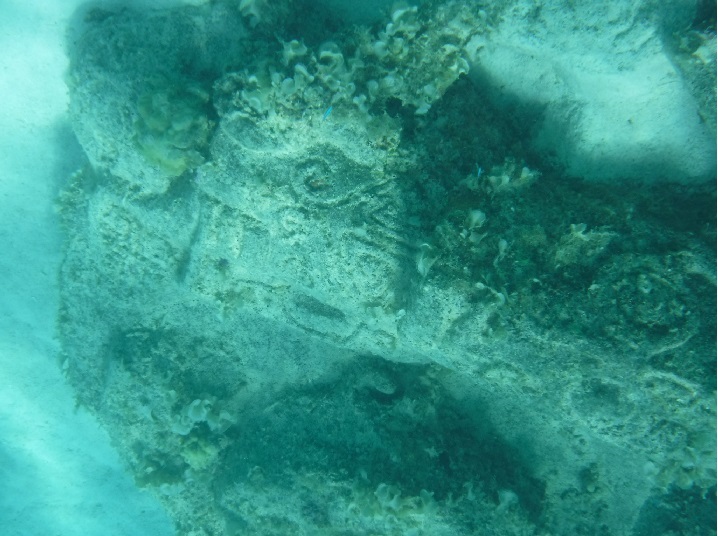
At the other corner of the anchorage, after a bit of aimless searching, we reached our goal: a handful of bommies that weren’t bommies, they were Tikis (we think modern style) - Hence the unofficial name of the anchorage. None of the research we did was able to provide a reason or a source for the tikis. They seem to be there as an unexpected surprise for those who know about them. Some of them were quite overgrown and hard to distinguish, but most were in reasonable condition – better than one would expect if they were from Polynesian prehistory. There was one statue in the iconic style. The rest were more abstract designs harder to interpret. My guess is that they were either rejects – crumpled pieces of paper in the waste bin – or that some local artist/entrepreneur snuck them in – probably some of each. The one in the best condition looked like it has only been underwater for a month.

After swimming the same gauntlet back to Begonia, we arrived just after our neighbor’s dinghy. One of the other boats had left and they hurriedly repositioned to their old space. No need for a conflict. After they left, forty jet skis and twenty tour boats came blasting through. We decided we weren’t spending another night there and headed around the corner to the head of Opunohu Bay, where the cul-de-sac and the larger space kept most of the jet skis and all of the tour boats at a safe distance. Plus, we had one of the most beautiful views in all of Polynesia.


Opunohu Bay

We were planning on hiking up to the Belvedere viewpoint the next day as Maryanne had skipped it the year before. When the day dawned, though, it was pouring rain with no sign of letting up soon. We waited and waited for it to clear, but eventually, it became clear that if we were to do the hike, it would be a miserable ordeal in which the main memory would not be the amazing views at the top, but instead miles of mud slipped on, squished through and carried home, mostly on the basketball sized blobs at the end of our legs. No thanks. Belvedere will have to wait for another time.

The forecast was for at least three more days of the same conditions, so we again decided to depart early. We left that afternoon for the overnight sail to our next stop, the island of Huahine.

Thursday, July 12, 2018

Passage to Moorea - Haapiti

[Kyle]Getting from Tahiti to Moorea ended up being a bit more arduous than expected. We had no wind at all to start, but still had to deal with short 3m seas wrapping around Tahiti, which slowed us to a crawl.

Halfway across, we left the lee of Tahiti and all of a sudden we were in thirty knots of wind. Great! Shut down the engine, unroll a little bit of jib and zoom!

The seas then built to four meters, which, according to our current logbook, are the largest we have seen since we started it eleven months ago. They were still not big enough to be a concern, except that we were about to try to enter a narrow pass and it was hard to see over them to tell if the surf had closed the entrance. We had to get pretty close to it to tell it was safe to go in.

Once inside, the waves stopped, but there was so much headwind, we could only make 2 ½ knots against it. We found a perfect little spot on the sand shelf on the edge of the reef and dropped anchor.


Ahh - anchored in beautiful, bommie free sand

Our first anchorage in Moorea was on the less popular southwest side. We deliberately picked it as a quiet break from Papeete. We were back to being where there’s no stores and only a couple of houses on the beach. We needed a day of having no long list of things to do. The water was that color you can’t help but want to jump into and the view of the spires topping the island takes our breaths away every time we look at it. We can even see a little bit of Tahiti just past the headland.


Clear waters, clear skies - perfect!

Tuesday, July 10, 2018

Tahiti (Papeete)

[Kyle]From Point Venus, we went into Papeete for the long and unpleasant list of “jobs” that have to be done every time we touch civilization properly.

The marina in the town center is in the best location and is well maintained, so it’s a great base to work from. They don’t take reservations, though, so getting in is always a crap shoot. There’s nowhere to anchor nearby, so if you can’t get in, you have to go back from where you came. When we arrived, we saw a boat that had come in just ahead of us leaving again. We had nobody behind us so we took our time looking through the whole marina and found THE last spot. The manager and several other people told us we were SO lucky to get it. The guy who left rejected it because it was too small for his boat. HA! I guess size DOES matter!

It seems to be a favorite theme of cruising guides to introduce the section on Papeete by complaining about how awful it is. It’s noisy and smelly and crowded and expensive. Yes, that’s because it has cars and car exhaust and people and stores that sell all of the stuff that you haven’t seen for months that you really want to buy, not just beach coconuts and nothing else.


Waterfront around sunset


Enjoying Tahiti Heiva - 2018

I like Papeete. It felt good being back in a familiar place. Sure, it’s not a deserted tropical atoll, it’s a city, but as cities go, it’s pretty nice. The people are friendly, the parks are beautiful and safe to walk around in twenty-four hours a day, the food is delicious, the beer is cold and they have all of the aforementioned stuff at hand. It is true that everything is really expensive, but that’s because if it’s not a coconut or a mango, it has to be shipped to the middle of the Pacific Ocean from anywhere. The Pacific is the biggest one. I think I’ve been clear on that.

Top of our list, of course, was shopping for all of the food we would need to get us through all of those islands where the only store only has two cans of okra to our next real store in New Zealand.

Provisioning in Papeete is not for those prone to fainting. Every trip to the store costs $300. It’s like Costco, except that we had to go once or twice a day for a week. Even worse than that, the bill is in Francs, which are about one to a penny, so every time we check out, the line at the bottom of the bill says something like, “Please pay: 32,458”. By our fifth trip, I was starting to panic, particularly considering the grocery store was not our only expense. There was the chandlery, the hardware store, the marina and, of course, the evening out eating the pizza we have been craving for months. I kept having to remind myself that we were buying months of supplies and that if it were evened out into normal weekly trips, it was only a little worse than living in California or New York, except that we don’t have jobs! Eventually, I got so used to it that when we found a guy who said he could fix our spinnaker and quoted us a number I’m more used to seeing on real estate flyers for small houses, I said, “Eh, what the hell..” and gave it to him to work on. “Remember”, I told myself, “Divide by a hundred. Divide by a hundred...”

The second largest block of our time was busy chasing internet. God, I am getting so sick of shitty internet. Most places we go don’t have it at all, so we don’t worry about it, but Papeete does and some of it is even not too bad. Most of it is, though, and I’m getting sick of wasting great big chunks of the beautiful day dealing with it.

To give an example: As a test, I started downloading a single thirty-minute audio podcast to see how fast the connection was. At the speed it was coming, it would have taken two hours to get, except that it didn’t because the system signed me out every five minutes and required navigating all of the password screens to log back in. This made the download start all over again from the beginning. Never mind that.

After much searching, we found a decent connection that didn’t automatically log us off, but it was far away and only available during business hours. We made a point of only doing the bare minimum; Make sure we’re not overdrawn, read the emails that look important, as long as they don’t have attachments, and do whatever software updates we need to keep our computers from locking up when we really need them not to. Then we wait and spend hours watching progress bars that never move or the dreaded Wheel of Death while the world cycles by on the path outside, bathed in the sunshine of paradise.

In the middle of our stay in Papeete, we gave ourselves a break from all of the chores by taking an evening to see the Heiva. We love the Heiva! It’s grand and unmistakably Polynesian. Going to it has the feel of attending an opera or the ballet, only it’s outside and the dancers aren’t doing it right unless they have shaken half of the flowers and palm fronds off of their costumes.

When our week in Papeete was done, we collected our repaired spinnaker, filled the water and fuel tanks and left for Moorea. Begonia was at full weight again, squatting down on her waterline like a duck with a quarter-million francs of canned goods and half of a metric ton of water on her back. Think Chilean Steamer Duck.

Monday, July 02, 2018

Passage to Tahiti & Hanging about at Point Venus

[Kyle]We left Rotoava on Fakarava at the same time as three other boats, which made me think for once we had all converged on the same time for high tide. It must have worked because we all got spat out of the lagoon by the current before the standing waves on the outside got too bad. We then all diverged on our respective courses.

The sail to Tahiti was just about the nicest one we’ve had in ages. There was enough wind to push us along, but not enough to have to be worried about needing to reef. The seas were mild enough that we barely had any motion other than forward. The skies were clear the whole time and there was just enough of a breeze to take the edge off of the sun’s heat during the day. Oh, if only every three-hundred mile stretch of ocean could be this way, crossing them would be a piece of pie!


Arriving in Tahiti for Sunset

As we approached the island, the party ended and the wind started freaking out like a wild animal that has just found itself trapped inside a small room. Our last hour turned into six and we arrived fed up and exhausted.

We decided to go the other way around the island this time around and anchored off the beach at Point Venus, Tahiti’s northernmost point. We couldn’t make out any bottom features as we nudged toward the beach. It looked like it could be mud, coral, weed or rock. The chart said ‘sand’, but we’ve noticed it says that a lot, presumably because it sounds more definitive than ‘other’. The ‘sand’ region was vague and seemed to overlap with other vague areas of ‘coral’. What to do? We decided to drop our anchor and hope for the best.

It WAS the best! When I dove on it later, I found an unbroken expanse of fine black sand. Our anchor had disappeared completely under it. We just found our new favorite anchorage in Tahiti.

We stayed at Point Venus for a couple of days. We rowed ashore for the requisite shopping expeditions, met other cruisers, enjoyed the park, walked the beach and ate at food trucks. We were there for a holiday weekend, so the beach was packed with families all doing beach stuff. The thing here, instead of building sand castles, seems to be digging bathtub-sized holes to sit the kids in and then waiting for the tide to come up and fill them.


The big event of the weekend was a series of va’a (outrigger) pre-races in preparation for the Heiva. We had front row seats as the fast trimarans raced through the anchorage. They have crews of three, one steering and two paddling, as well as a big sail. They paddle like hell even when the sails are pulling and they are REALLY fast. When we last saw them, they all meandered around the anchorage for a while and then lined up and headed in the direction of Bora Bora. I don’t think they were going to Bora Bora, because that’s two hundred miles away and it was late in the afternoon, but that’s the direction they were going. We figured they had some sort of mark out there they were going to round. They disappeared over the horizon within a few minutes and we never did see them return. Maybe they went out to do a lap around the nearby island of Moorea.

Tuesday, June 26, 2018

Rotoava Town (Fakarava)

[Kyle]Hirifa really filled up in the next day or so and was starting to take on a bit too much of a Disneyland feel. The megayacht arrived and disgorged a bunch of passengers on jet skis who used the anchored boats as pylons for their slalom course. Everyone wanted to be near the beached boat (so many cruisers came to their aid), which meant they were crammed in by us. Time to go.

We left the next morning for Rotoava, way up on the north side of the lagoon. It was a marvelous sail. We had 18 knots of wind just aft of the beam for the whole way up the marked channel on the inside of the lagoon. We were effortlessly going fast and watching motu after motu glide by without having to deal with being thrown around by any stupid waves. Oh, if it could always be like this..


A few short hours later, we arrived at the anchorage at Rotoava. What the hell? Last year, when Agnes drove us up from Pakakota, there were three boats here. Now there were at least twenty, filling all of the available space between the beach and the channel. We swung by one that we had met in Tahanea and he told us the bottom was all sand and his anchor bit right away. At least there was that.

After much searching, we found a spot wedged in between two other boats and dropped our anchor in blue water where there was no sign of the dark coral heads. When I dove on the anchor later, I discovered why. The water was filled with fine silt which obscures the bottom and reflects sunlight back upward as if it were white sand. After pulling myself down the anchor chain, I discovered the bottom was pretty much the same as it is in the South Pass. Our anchor had actually found the only sandy spot big enough for it, but just barely. The rest of our chain was draped over coral heads like tinsel on a Christmas tree. I untangled it as best as I could on a series of dives where each time I headed for the surface, I was convinced I had waited just a little too long, and then returned to Begonia to get a fistful of cable ties.


I returned to the chain and attached the ties to strategic locations. Then I cranked it all up by hand, Maryanne measured and attached floats at the ties, and then we dropped the whole thing back over again. Now all of our chain except the last meter or two by the anchor was safely above the coral.

As we were doing all of this, we noticed several people looking at us like we were being foolish for being unnecessarily cautious. Some seemed annoyed at our string of floats getting in their way as they went by in their dinghies. To them, we were “Those people” – probably a couple of newbies who don’t know you don’t have to use the float-the-chain trick on sand.

Later on as they left, I noticed most of them were having a devil of a time getting their anchors out of the ‘sand’.

Rotoava is one of those places whose diversions can all be experienced in a couple of hours. We did each twice for good measure and then parked ourselves at a creperie on the water in the hopes of using their wifi. It was virtually non-existent, which we expected, as that is par for the course, but they did make up for it by having real ice cream. Ice cream is worth its weight in gold here, which is how I think they came up with the price structure, but who cares? They have ice cream! The village was also supposed to have a place that made real pizza but, alas, that was shut down permanently, so that craving would have to keep waiting.

We were up super early for the next day’s provisioning, which was entirely because every store sells out of their fresh baguettes thirty minutes after they open. Fresh French bread makes everything better, but for the life of me, I have never been able to figure out why it has to be baked at four a.m. instead of something normal like noon. I have no problem making it to the bakery at the crack of two p.m., but dawn just hurts.