Showing posts with label Kyle's musings. Show all posts

Saturday, February 06, 2021

Western Australia - Swat's up with that!

[Kyle]I had mentioned in an earlier post that I was in danger of going on a digression about why South Australia is better than Western Australia. That's easy: Western Australia is terrible.

Don't misunderstand me. Western Australia has some spectacular scenery. Virtually everyone we met there was kind and warm-hearted. Perth is a clean, safe and vibrant city. The geology is fascinating. They make good wine. You can wear shorts year-round. It would practically be paradise except for one thing: Western Australia is home to the deadliest animal in the world.

I'm not talking about saltwater crocodiles or any of their many, many, many venomous snakes, of which they have many, by the way. I am talking, of course about the Fly.


The local wildlife accompany us everywhere in WA

The various varieties of Western Australian Fly do not usually bite, but they are a formidable foe nonetheless. They hate all of us humans and they aren't going to stop until they have the red soil of Western Australia all to themselves again.

They know they can't fight us directly with force, but they have numbers on their side, plus a deep well of patience and a willingness to sacrifice their individual selves for the greater goal. Their strategy is one of simple genius: harass us until we go away. Theirs is a war of attrition.

They have learned over generations that we use our hands to do things, but that we generally can't move them fast enough to be any real threat to them. Thus, they will wait until one, or even better, both hands are occupied and then go in for the attack. Their goal is the moist parts of the face: the mouth, the nose, the surface of the eyeball. All of their evolution has bred them to WANT to be in these places soooo badly.

They know that it is impossible for a motorist to drive in a straight line after a fly has landed on their upper lip and darted into a nostril, or for a hiker to see the clifftop trail when a fly is dancing around on their pupil. One insurance statistic that I just made up is that 90% of all cars insured in Western Australia are totaled within the first year. Also, only thirty percent of bush walkers ever return. It's carnage out there.

Queenslanders have a reputation for being a little 'out there', but it's the Western Australians that are truly nuts. Apologies to our friends from there, but deep down, you all know it's true. In Australia, they have what is known as “the Aussie wave”, where one's hand is waved in front of one's face to shoo away flies. In Western Australia, it is ubiquitous. You can tell when a Western Australian has fallen asleep when their arms stop moving. They do it out of habit, even in hermetically sealed environments where there are no flies.

The best defense against them is acceptance. Outsiders like us use head nets over our hats to keep them away from our faces. Eventually, one in twenty will find their way through and then the flailing starts. Those born here seem to have at least some ability to ignore them. It seems they have accepted the fact that each breath comes with a fly or two just like every ice cream cone at the beach is a little crunchy with sand.

On the Busselton Jetty, we saw a kid who wasn't quite acclimated. Busselton is a perfectly lovely town with a nice laid-back atmosphere that would be an ideal place to settle down, except for the flies. They can absolutely ruin any good outing. As soon as you step foot outside, they surround you like you were Justin Beiber and you had just walked into a junior high school.

The kid on the jetty was running in tormented spirals swinging his arms around his head and screaming in hoarse frustration. Those of us adults nearby (including his father) knew that such displays are not socially acceptable, but I guarantee that every single one of us had the same thing going on inside our heads as we tried to pretend we didn't notice the little monsters buzzing around our faces and body surfing in our eye juice. That sound you hear in the background as you walk the jetty isn't the surf, it's people falling in. The thought that kept going through my head (other than AAAAUUGGHHH!!!) was, who would want to live here?

Western Australians, that's who. They are all nuts!

On our first shore visit after leaving Western Australia (WA), on Kangaroo Island in South Australia, we also encountered flies. There were three of them. I named them Steve, Susan and Gerald (perhaps I've been in WA a little too long myself). Each of them was happy to leave us alone for the rest of the day after the first arm wave. On Kangaroo Island, at least, it seems like it would be perfectly possible to do things like eat dinner out on the patio, enjoying the sunset, while your inner voice lets out a big aaaahhhh...

Sunday, August 31, 2014

Sausalito, Back to the Birthplace of a Sailing Dream...

[Kyle]After Maryanne and I sailed under the Golden Gate Bridge, we headed to a very specific spot in Richardson Bay off Sausalito. I was pleased and surprised to find it unoccupied as well as most of the waterfront on either side. Most of the other boats were moored or anchored further into the bay by the marinas and the public dinghy docks. Maryanne quickly checked again to be sure we hadn’t missed some harbor rule about anchoring where we were. Our spot was a government anchorage available for use by private boats for up to 72 hours if not being used by government boats. There were none, so we were okay there.

As we were maneuvering around checking depths and getting our position right for our swing, we ran afoul of the Fishing Police. Some guy on shore whistled at us with one of those loud whistles some people can do by putting two fingers in their mouth. We looked over to see if that was meant for us. It was. He was waving at us to get back; very rudely in my opinion. I shrugged my shoulders melodramatically so my gesture could be seen over the distance. He held up his fishing pole in answer. Oh puh-leez, we happen to be able to measure our distance to shore quite accurately with the radar, which was on. We were 450 feet from the rock on which he was standing – about two city blocks. There was NO way anybody on shore had fishing lines near the surface that far out, especially since the strong current would have swept it away. I pointed Begonia into the wind and Maryanne dropped the anchor while we backed down. The guy kept trying to wave us off, apparently unaware that his jurisdiction did not apply to the government anchorage. Nevertheless, I decided that if he could hit ANY part of the boat with a lucky cast, I would leave without argument. He never even made it a third of the way. Even funnier was watching all of the ferries and tour boats that passed between the shore and us on their route past the Sausalito waterfront.

The next day, we did what I had come here to do: Have a meal at the Trident restaurant. The Trident is not particularly special. It is a medium upscale waterfront restaurant of the type that are a dime a dozen in these parts. The food is pretty good and the service is adequate and you pay about double what either are worth because of the great view of the bay, with Alcatraz and the San Francisco skyline in the distance.

The reason I wanted to go to the Trident specifically and the reason Begonia was anchored in front of it, instead of the equally nice restaurant next door had to do with a piece of my history whose importance I didn’t fully appreciate until years after it happened.

Many, many, many years ago, I got a vague idea in my head that it would be cool to live on a boat. This was unusual for a kid growing up in Denver, where the only boats you see are small ones on trailers. I think the idea first snuck into my head from a TV show called “Quincy M.E.” Quincy, the main character, lived on a boat. There was almost nothing made of it in the plot and the only hint of it was in the fast-edit title scenes. It wasn’t even until I’d seen about twenty episodes that I figured it out. I knew absolutely nothing about boats, but the idea had a strange hold on me.

Once I had seen San Francisco, with its beautiful bay and its relatively big boats, the idea seemed slightly more possible. I still had no idea how to go about doing it, so it remained a very vague, “someday it would be nice…” kind of a dream.

When I finished college and flying school and could finally move somewhere by choice, rather than necessity, the only place I thought of was San Francisco. The boat thing wasn’t even forefront in my mind. I just knew I liked it a lot and I really wanted to be there. My then new wife (not Maryanne) and I moved out there before we even had jobs.

It was while wandering the docks at Pier 39 a few months later that I saw a sign next to a boat detailing the various levels of sailing instruction available. Maybe that’s how I’d get started, I thought, still below a conscious level.

About a year later, which is now half a lifetime ago, my equally young wife and I took the ferry over for a day in Sausalito. We walked the docks at the marina with all of its pretty little boats. There my dream was ignited again.

We walked along the waterfront and popped into a restaurant. It turned out to be the Trident. While we sat there, I looked out over the water at a boat anchored nearby. There was a guy sitting in the cockpit looking at the city. Every now and then, he’d saunter up to the bow, fiddle with something, and then returned to enjoy the view. I was suddenly filled with envy. I wanted to be that guy SO badly.

I pointed the boat out and said, “Man, doesn’t that look like the life?” My wife at the time however was petrified at the thought of sailing, definitely NOT interested, and it was clear I’d never change her mind.

So, sailing was pretty much out. My vague, unformed dream was over before it even had a chance to take shape. Like Douglas Adams would have said: I put it in a sub basement in a locked filing cabinet with a sign on it saying, “Beware the Leopard”. I never expected it to come up again and busied myself with a life in the suburbs.

It wasn’t until many years later, after that marriage had ended, that I dusted off my old dream and brought it into the light of day for a look. It was a few years after that before I bought my first boat for $2,900 cash. THEN I learned how to sail so I knew what all of the ropes on my boat were supposed to be for.

That was the little 25-foot monohull (Baby Cakes) that Maryanne and I lived aboard for our first summer together. We’ve been liveaboard sailors the whole time we’ve known each other. It’s been many years and we’ve sailed tens of thousands of miles together since then. The sailing life that I thought would have started in San Francisco has taken me more places than I would have dared to dream back then. Instead of beginning the journey here, we’re passing through, as is our way now, sailing from one beautiful place to another.

Still, the first thing I wanted to do when I got here was anchor in front of the Trident, get a table on the balcony, and look out at my boat, remembering a world of places we have been and dreaming of a world yet to come. I still can’t believe it’s actually real.


Kyle finally has a boat anchored off the Trident - the dream is reality - we enjoy a meal in sight of Begonia and reminiscing about the lifestyle we have been lucky enough to share!

While we were there, lots of people who hadn’t seen us dinghy over were snapping pictures of Begonia, or of each other with Begonia in the background. We did it, too. For some, it was just scenery. For others, I saw a certain far-away look on their faces as they gazed out over the water.

Yeah, I know what that is.

The Trident said we could leave our dinghy there for a while, so we had a walk around the town. We looked up the hill and found the other side of the room where we stayed on our first night of marriage. We walked the docks and I still felt like I wished I had a boat that I could take places. Strange. What’s it been, a day?


Sailboats and houseboats are a major feature of Sausalito and some are very grand indeed!

We walked past all sorts of different craft, most notably a giant houseboat modeled after the Taj Mahal that was being repainted. As we continued on, the boats and marinas seemed to get more derelict. We found each of the town’s two proper non-Trident docks way on the north side and then turned to walk home along Bridgeway, the main road.

We returned to Begonia for an evening in the cockpit with not only the Trident’s fantastic views of the city, but also of Sausalito as well. This really is the life…


Pretty little town
[Maryanne]My biggest connection with Sausalito is as the place we spent our honeymoon night (a wonderful wedding gift). We arrived late, but managed to get up in time to explore the waterfront the following day before having to head off to the airport. It's a pretty town built into a hillside overlooking the San Francisco Bay and full or artists and other tourist attractions. It will always be a special place for the two of us and it is wonderful that we now live so close and can visit often. After dining at the Trident we again walked the waterfront, found ice cream, etc.. and eventually returned to Begonia to enjoy a drink in the cockpit for sunset. Beautiful.

Sunday, August 24, 2014

Passage to San Francisco Bay

[Kyle]The weather forecast for this leg had been causing us some concern. For most of the week before and after winds were forecast to be howling out of the north at a bit above our comfort level. The wind and seas weren’t so much our primary concern as being able to get out into the ocean across the Noyo River bar. The Noyo is very well protected (inside) but the entrance is narrow and notorious for being particularly dangerous in big swell. Inside everything is calm and sunny, even when ocean conditions are miserable with big seas, the river, with its protective cliffs and big bend just by the entrance protects us from any of that. The big winds forecast meant the swell would be in at least the 8-10ft range. We were hoping most of this would be dampened by the coastline and the intervening kelp fields but we were still worried.

To make things worse, when we tried to check conditions at the bar, the first thing that comes up on a Google search is a YouTube video showing local fishing boat being capsized at the entrance (and that is WITH local knowledge). It turned out that the bar report was not available on-line and the web cam set to view conditions was not working (bar report was available via phone call to the coastguard directly). We decided to go and take a look with the boat and make a decision to turn around if we didn’t like it on the day. It didn’t much matter either way (aside from the hassle of getting the boat underway) as there was much more to enjoy in the Fort Bragg area that we’d love to have time for, but we really ought to be getting on south if we can so Maryanne can interview for jobs.

The bar turned out to be calm, and crossing easy. We encountered some steep chop at the entrance to the bay, but only for a few minutes. The wind near the coast was almost non-existent and we had to motor almost five miles off shore before we could shut down the engines and begin to sail.

One bit of entertainment on the way out was watching a group (raft) of sea lions jostling for position atop one of the buoys. One buoy in particular had six in a space that would only fit 4 or 5, with 20 more in the water barking away and awaiting their chance for a place. The really like resting atop buoys, which seems strange given all the beaches and rocks nearby. Knowing their place, seagulls and cormorants occupy the top deck of the buoys (beside the solar panel).


Leaving the Noyo River, sea lions in line for their turn on the buoy

Once out in the wind we sailed for the rest of the day in only about half the wind that was forecast. We kept thinking we should shake out the reefs and fly full sail, but were worried about the wind suddenly appearing (as it did when we rounded Cape Mendocino en route to Fort Bragg). The timing of the tides for crossing the Noyo and the San Francisco Bars (in daylight) were such that we only needed an average speed of about 2.5 knots, so we were in no hurry. We were also lucky because the weather was uncharacteristically clear and we could see the cliffs and mountains of the coast the entire day (we even got a second look at Mendocino).

When Maryanne woke me at midnight for my watch it sounded as though we’d slowed down further; she told me to expect to be frustrated by the wind that had just begun to die. Ten minutes after she went to bed, I gybed, and 20 minutes after that I pulled down all the sails completely and reluctantly started the engine. Ten minutes later, the wind returned, only from completely the opposite direction - headwinds. Our one feeble motor was only able to make three knots against the wind and currents as we headed south. We continued this way for most of the day. The wind finally died down by late afternoon, allowing us to speed up, countered by us backing off on the engine rpm.

At midnight again on the second night we had only 16nm to go before reaching the bar so I was able to reduce power even further. While I’d slept, Maryanne had rounded Point Reyes. That meant now on watch, above the silhouette of the Marin headlands, I could see the top of the San Francisco skyline - including the south tower of the Golden Gate Bridge. At about 6am, just before sunrise, a light wind came in from the west and I was able to finally shut down the engine and let Maryanne sleep properly. Shipping traffic started to appear as we approached the San Francisco Bay shipping lanes and vessel separation schemes (which we were careful to avoid entering); I saw about five vessels going each way in about a 4 hour period. An under utilized pilot vessel seemed to mess with us. It kept relocating to a position directly in our path and forcing us to move. We’ve no idea why it acted in this way; we were outside of any shipping lanes, and clearly sailing (i.e. we had right of way). It had no obvious need to be ahead of us, and made no attempt to contact us on the radio. I was trying to let Maryanne sleep so I didn’t bother confronting him myself via radio, but simply kept diverting around him. If we are being generous, maybe he was curious about our boat, but it seemed more likely he was entertaining himself, inappropriately and at our expense.

Maryanne woke up just around 8am as we were turning inland to parallel the inbound shipping traffic lane to the Golden Gate Bridge. An announcement came over the VHF radio from the coastguard saying that the Napa lift bridge would be closed until further notice pending earthquake inspection. We weren’t planning on going that way, but our ears pricked up at the word ‘earthquake’. Maryanne did a quick search on her smart phone and discovered a 6.0 magnitude earthquake had hit the area about 3:20am – yikes. There were still fires raging, gas mains leaking and burst water pipes hampering firefighting. At sea earlier I had noticed a strange wake and been unable to determine the source – in hindsight this could well have been from the earthquakes and its aftershocks (but maybe not… I could just be making an association that wasn’t there).

I had expected when making this last leg of the journey that our Golden Gate Bridge story would end up being one of finding our way in by radar in the fog. We were lucky, and although there was a high overcast layer, the visibility was good and we had long views of the coastline all the way in.


Arriving at the Golden Gate Bridge, and anchoring in Sausalito

I cannot begin to tell how much pleasure it gave me to sail into San Francisco; it surprised even me. From the helm of Begonia I could see the motel where I spent my first night living in San Francisco with a U-Haul truck parked outside. I could see the beaches that I’d walked so many times, Golden Gate Park, the cliffs where I learned to paraglide, and of course, the Golden Gate Bridge itself that I have crossed so many times on foot, bicycle, rollerblade and car.

We sailed by Baker Beach, and childhood memories came flooding back; this was my first ever view of the ocean as a young child. I’d never before seen a body of water where I couldn’t also see the opposite shore. My Dad knelt beside me in the sand, looked out across the water with me and explained to me for the first time how big this ocean was – 100s of times further than I could see – to Japan on the other side. I was enthralled and terrified at the same time; one of those moments when my little childhood world got much, much larger. Now here I was, a grown man sailing his own boat past that very beach, not out of San Francisco to see the world, but into San Francisco after having sailed a very long way go get here! It is unbelievable to me every day that my life could ever have turned out like this.

We sailed under the big red “Golden Gate” bridge and for the first time in my life I looked up at it from the water instead of the other way around. People waving down to our little boat from above probably had no idea how momentous and emotional it was for me. They might have just imagined we’d poked out into the ocean to dip our bow into the Pacific waters and turned around. Still, it felt like a long road that had brought me back here to the place I first saw the ocean as a child.

The current assisted our ride under the bridge and we were able to turn and face it whilst still being pushed into the bay. Suddenly the sun burst out and the bay was alive with all sorts of traffic: ferries, sailboats and kayaks on the water, and traffic on the bridges and roads. We sailed into Richardson Bay and dropped anchor off Sausalito with views of Alcatraz, Angel Island, and the San Francisco skyline to admire; I could not believe we were actually here. Sausalito is where Maryanne and I spent our honeymoon and I remember watching the boats bobbing about from our hotel room window. So many memories are associated with this place, it’s going to be a great feeling of home for the next year or so.


Bringing back memories form the past: Kyle and I start our first full day of married life from the balcony of our honeymoon suite in Sausolito

Monday, September 05, 2011

The American Ex-pat Community in Turkey?


Delaware USA flagged boats - all over Turkey

[Kyle]When we arrived in KuÅŸadasi, we found out there was a large American ex-pat community there. Nearly a third of all of the boats in the marina were flying American flags. Even stranger, 90% of those had a hailing port of Delaware. Just plain Delaware. What are the odds? The U.S. Coast Guard, when documenting boats, requires a vessel to have the hailing port city and state clearly marked below the vessel’s name. Footprint’s is Portland, Oregon. It is a little known fact that there is a stand-alone city called Delaware in the U.S. They even have a professional sports franchise: The Delaware Fibbers. As a fellow American, I have made a point of going up, introducing myself, and asking what part of the city of Delaware they’re from. I’ve been getting a lot of blank stares. Usually this is because I am not funny, but lately it seems to be that none of the occupants speaks English. Now, I realize there are Americans who don’t speak English, like teenagers, but virtually the rest of us do to the exclusion of every other language in the world. This is very suspicious indeed.

Of course, the real story here is that it is a tax dodge. For $60, you can incorporate in Delaware, which then allows you to document a boat as American for what must be lots cheaper than the Turkish government allows. As a result, there are a lot of medium-sized powerboats available for charter over here that are not fit for the open sea and whose 100-gallon tanks wouldn’t get them a tenth of the way from “Delaware” to the next gas station in Bermuda.

This has really ruined it for us. We sailed here from America, thank you very much. It was a long damn way. Over 12,000 nautical miles has been put on our log since we left three years ago. We used to get automatic credit for knowing how to sail when we pulled into a harbor. Now, nobody seems to give us a second glance. The French, the Germans and the Brits, who have all come a very long way themselves, look at us with derision as yet more idiot charterers on one of those “Delaware” boats. No wonder they’re cutting our knots off and telling us how to cleat a line. They all seem shocked when they learn we actually sailed her here, particularly given her size.

There is one upside, though. On the sail from Tinos to Ikaria, we lost our flag. The little plastic clips that held it to the pole just broke sometime in the night, sending it fluttering into the sea. The Meltemi of Kate and Mark’s visit was too much for them. We replaced the flag with one of our worn out spares (we have spares for nearly everything) and attached it with some spare string, but were worried about finding a proper replacement. Well, you guessed it; the boat store in KuÅŸadasi sold enough of them to have plenty in stock.

Tuesday, June 07, 2011

Kyle Adds a Bit of Perspective

[Kyle]Firstly, in response to Maryanne's recent post of balance and thanks. Of course I’m not going to let Maryanne walk 2 hours with me on a dark road to the train station! She’d just have to turn around and walk another 2 to get back when almost everybody else in this part of the world is asleep.

I managed to escape the bulk of the rain this time. It started when I was about five blocks from the station. There were enough awnings and balconies to walk under that I wasn’t too wet when I got there.

The train ride was the worst I’ve ever had. The station was heavily populated with the sleeping lumps of the homeless, a few ranting drunks and one particularly scary fellow who seemed like he needed meds having a violent screaming match with himself. He didn’t hurt anyone, just yelled a lot. Everybody gave him a wide berth.

I was relieved when the train arrived. I shouldn’t have been. The inside of the train had a very seedy atmosphere. The lights were all out, presumably so people could sleep. The only lighting in the car was what came through the windows. from the station and a dim bulb at each end by the door. Each car was divided into compartments of six seats each with a narrow hallway down one side, like a cell block. As soon as I boarded, it became apparent that they had sold way more tickets than seats. Every bit of flat space was covered with people trying to sleep in the least uncomfortable position they could manage. I carefully squeezed by people standing while simultaneously trying to avoid stepping on the hands or hair of people sleeping on the floor. When I reached it, my compartment was a mass of bodies all stretched out horizontally with their feet on the opposite seats. My seat was occupied by someone who I would not have been able to disturb without waking up the whole compartment. I started to wonder if I had somehow boarded the wrong car. I was not about to re-climb my way back over the fifty people I had already disturbed and the train was leaving in a few seconds anyway. In the end, I stood until the next stop hoping my seat would clear then. It didn’t. I eventually found myself on a fold-down, backless seat in the aisle with my bag between my feet. At first, I would get up to let people squeeze by. By the end of the trip, I was just letting them rake over me with their luggage like everyone else was doing. I spent the three-hour and forty-five minute trip in a miserable state of half sleep alternating between balancing my head on my hands, my shoulder and a nearby handrail. Time has rarely passed so slowly for me.

I took the 2:15 train to avoid losing another precious half-day off and another €100 for a hotel. These days, we simply can’t spare either. If Calnited would give me back my flight benefits, I would have been able to take a 7:00 flight out of Pisa instead.

Maryanne’s right about the marinas, too. The +60% catamaran surcharge that seems to be common around here is killing us. In spite of the nice things she said about me preferring her in a marina, which I do for her safety and convenience, I think we’re going to have to go back to our old mode of finding a nearby anchorage and rowing in. Good anchorages that are well protected from all sides are few and far between on this coast, but we have to try something.

Maryanne has been really good about supporting me through my half of our lives. She’s been a great sport about doing everything she possibly can on her end so that all I’m left with when I finally do make it home is the long, overnight sails. We occasionally have a little conflict when she wants to really pile up the tourist itinerary but I just can’t spare the energy for the whole thing. She is super-sweet and she is only doing it because she doesn’t want me to miss anything. She doesn’t want me to feel like my life is all of the work and none of the fun. It’s possible to get so tired that I no longer care about missing some really neat museum in town, though. I just need to get a little rest – the real kind, not sitting up. She’s been getting better lately about looking into my glazed eyes and suggesting we take it easy this afternoon.

Friday, December 17, 2010

Haven’t heard form us for a while? What have we been up to?

[Kyle]We’ve been up to the decidedly less glamorous side of the cruising life.

I’m afraid life for us since arriving back in Preston from Conwy in August has been a bit of a long slog. I’ve been commuting across the Atlantic several times per month for work. Maryanne got a job in Manchester that, when combined with her commute, takes her away from the boat fourteen hours per day. We both arrive home exhausted with little motivation to tackle the long list of jobs hanging over our heads that need to be completed in preparation for any spring sailing along with more of the Irish Sea.

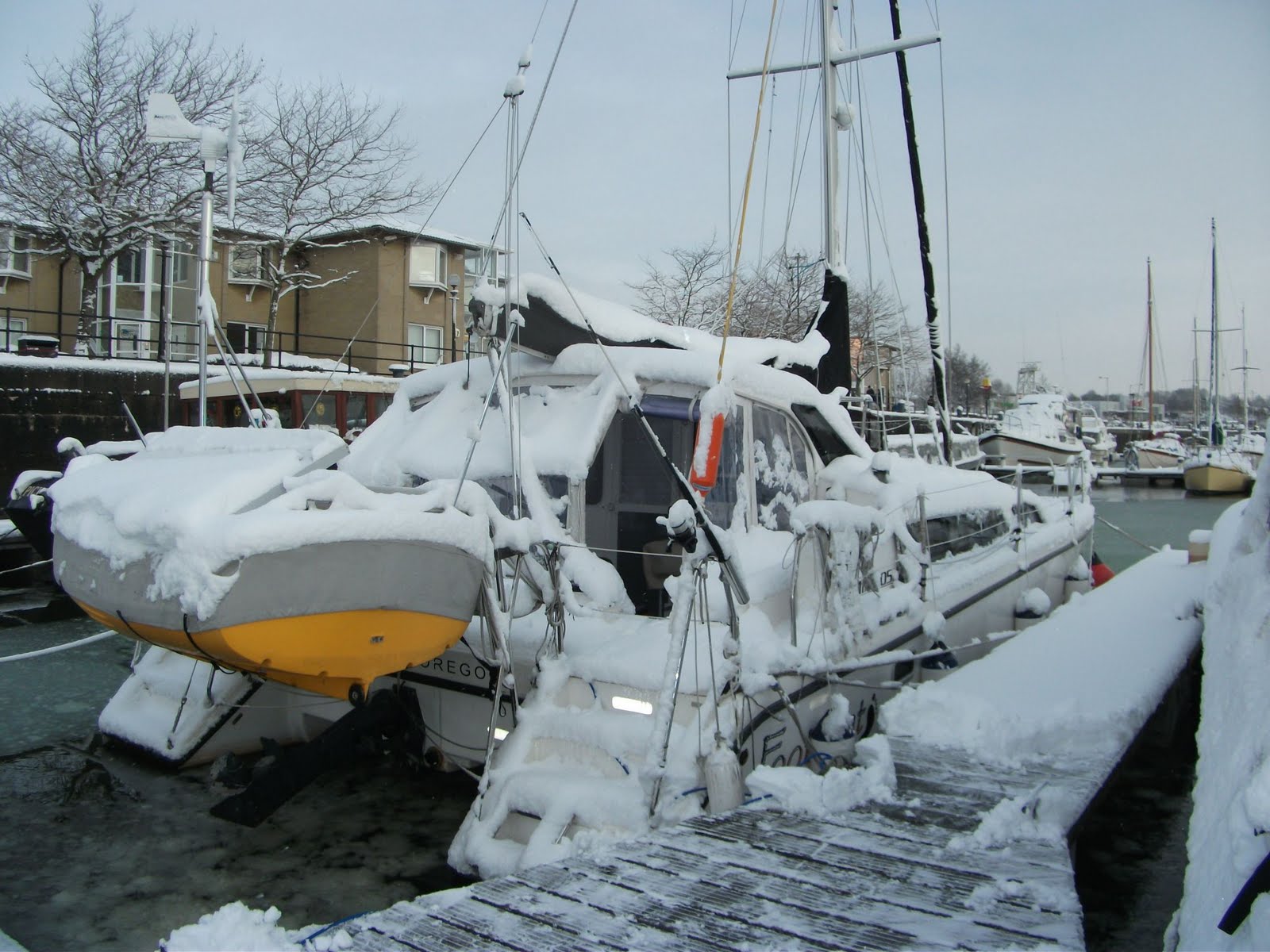
Plus, up here at 53° 45’ North, it is dark most of the day this time of the year. These days, the official sunrise isn’t until well after 8:00, and it’s back down again before 4:00. Even at its highest point, the Sun barely breaks 13° above the horizon, which even on clear days just clears the trees and buildings to the South, providing at best a heavily slanting light that offers no warmth as comfort. The small amount of useful daylight limits the amount we are able to do, especially outside. The other day after seeing Maryanne off to work in pitch dark, I waited for daylight and then went for a longish run. By the time I got back, showered and fed myself, there was less than three hours of daylight left. I was exhausted and could have used a couple of hours to recover a bit, but I couldn’t spare the time.


Marina full of ice and snow, but Christmas season well underway

Compounding this difficulty is that in early December, all of Britain suffered a polar cold snap, driving temperatures well below freezing. This, of course, made going out even during the brief hours of daylight unappealing.

Aboard Footprint, I am constantly reminded of the vigorous arguments I had with Tony Smith when we purchased her about the necessity of having heat. He insisted Scotland was not that cold (North of here, by the way), and that heating up a cup of tea on the stove would produce enough heat to take the chill off the cabin in the morning. Wrong, wrong, wrong! I’ve heated whole POTS of coffee and the most I’ve ever seen our digital thermometer rise is a tenth of a degree Celsius from such efforts. On days like that, our little space heater can’t keep up, but throw in the Espar heater and we can be nice and toasty.

A few days ago, Maryanne and I woke up all snug in our bed. I said good morning to her and she disappeared behind the fog of my breath. It hovered there for a few seconds and then turned to ice crystals, which fell lightly on her face.

We weren’t cold. We could probably survive a winter almost anywhere as long as we never had to leave the warmth of the bed. We’ve probably got a couple of quilts too many, but we refuse to remove them on principle. I mean, c’mon… ice crystals!

As is our normal practice (on those few days when I’m home), I was the first to get out of the warm cocoon of our bed to fire up the heaters and start the coffee. I checked our weather station before starting the heat: -.7°C (30°F) inside, -7°C (19°F) outside.

A couple of days before, the water in the basin started to freeze a thin layer at the water’s surface. It began in the fairways then spread toward the boats until only an inch or so remained around the hulls of the occupied boats with heat. Eventually, even that small space vanished. The ice grew thicker and thicker. Every now and then, I would go out and punch through it with a boathook to see how thick it was. This particular morning, while the Espar roared to life, it took a couple of serious jabs to penetrate the ice. It was almost an inch thick. Everything was covered in a heavy coat of frost, I stepped onto the dock, still barefoot, and walked along pushing and pulling on Footprint. The dock and the ice cracked and groaned with my weight, but the boat wouldn’t budge. Back inside, as I moved around, I could hear the ice cracking as Footprint settled on her new lines with the load shift.

This seems to have become our new normal condition. Some days we can wiggle the boat back forth a couple of inches, some days we can’t. One Saturday, we walked into Preston to see a Billy Bragg concert. It was wonderful, and afterwards, he even made the time to talk to Maryanne and me for a few minutes. He really is one of the good guys.


Billy Bragg - great evening, worth the treacherous journey home

By the time the evening was over and it was time to make the walk home, ice fog had been coating everything for hours and the entire surface of the city was slick. With every step, we could feel each foot smearing along the surface, never holding firm. Nothing was safe to grab for support. Lampposts were slippery, railings were slippery, the walls of the buildings were slippery, cars were slippery. A few times, out of instinct, we would grab for each other, which immediately led to a frightening and comical dance, where we jerkily circled each other as our legs and arms flailed around wildly while we tried to regain balance. Eventually, we had to agree to walk far enough apart that when one of us fell, we wouldn’t drag the other one down as well. It was a long walk home. Every single step had to be slow and small and taken with arms out for balance. It was so cold, but it was impossible to walk any faster than about 1/3rd speed without falling. By the time we finally made it back home, we were both sore and exhausted from straining every muscle along the way to keep our balance.

The cold also ran the risk of freezing the pipes to the docks, so the marina shut off the water. At first it wasn’t a big deal because we thought it was only going to be for a few days. Then we ran out of water. When it happened, there was no relief in sight from the weather, so we had to haul jugs from the tap at the marina office down to Footprint and fill the tanks with them. Of course, on the day, there wasn’t a dock cart to be found, so I made six increasingly long trips from the office with a 40lb jug of water in each hand. Next time, I’m definitely not going to wait until we’re dry before filling up again so I have the luxury of waiting for a cart. A few days later, with everybody else desperately low and a slightly above freezing day, the marina relented and turned on the water and found leaks everywhere. Now it looks like the water’s going to be off all winter. Ugh! The office said they’ll try to get something turned on as close to the docks as possible, so we don’t have to make the whole walk, but it looks like jugs are going to be our only source of water for a while.

The days of cruising in tropical breezes seems a long way away, both ahead and behind. I have never wanted a Winter to be over so badly in my life.


View from the office Kitchen

[Maryanne]I've settled into my job in central Manchester, and I'm pleased to report that I'm enjoying it, and that everyone is really nice (no, I don't expect they'll be reading this). I'm enjoying working in the big city; the company is an IT company, and very relaxed (Guitar Hero in the Kitchen for whenever you feel like kicking back!). We've had several really nice lunches out and a fantastic Christmas dinner too.

Of course moving back was not about work; it was about time to re-connect with my UK family and friends. Having a permanent base in the UK, and given my location, I've also been seeing plenty of my best friend Annie, who lives just outside Manchester with her family.. Even Kyle's spent some time there although he was thoroughly engrossed in a 3-D jigsaw puzzle of the earth (I never saw him as a jigsaw guy - but now I know how to keep him out of trouble!). I've met up in Central Manchester (for lunch, or dinner, how decadent) with several friends from times past. It's all been fun.


Kyle builds a new world, while I catch up with friends

Before starting work in early November, we took one last trip to the States for a friend's wedding, I've had visits from family members, and I'm off for the new year on an England Mega-circuit to see everyone (well, almost everyone) - so we're making the best of our new home in the UK and catching up with friends and family; it feels good. I've even had a Gemini boat friend from Bermuda come to visit (Thanks Mary!).


Kyle and Maryanne at Angie's Wedding

Wednesday, May 06, 2009

Farewell to the Caribbean

[Kyle]Memory can be a strange thing. At times it seems that Maryanne and I just arrived in the Caribbean, at others, it seems as if we have been here for a very long time. Mostly, it depends whether I think back to our arrival in Antigua directly or whether I try to remember it as a thread that passes through all of the places we have been and the things we have seen since then. In either case, it seems strange to think that our time here is already coming to an end.

There has been much about the Caribbean that has been an irritant or a disappointment. We have not, for the most part, found the people there to be particularly laid back and friendly, whether local or tourist. Locals seem to have the barest tolerance for us. Tourists, for the most part, seem to be just as self-absorbed and narcissistic down here as they must be back at home, as if somehow a week or two down here isn’t long enough to wind completely down from the dog eat dog world of their high-stress lives. It must be a terrible thing to come to such a place and know that just as you get a taste of it, it’s going to be time to leave. Most people seem to cope with this by engaging in a marathon of partying and never seem to learn to relax and just take in the place.

[Maryanne]Kyle is right that "for the most part" we have not found locals nor other cruisers that friendly. There have been some notable exceptions and for these we are grateful. I think we arrived at the Caribbean expecting the postcard / fairy tale version. It was a shock to find most islands import ALL their food from Miami (even the fish), and we experienced many other similar shocks. We've had a splendid time once we settled in, and have enjoyed empty beaches, and stunning sunsets - no regrets and 1000 new wonderful memories.

[Kyle]To be fair to the locals, the islands are pretty overrun with tourists during the season, many of whom act like they’re entitled to be waited on hand and foot by people they treat as nothing but servants. The most popular response to this seems to be to charge an arm and a leg for everything, even in excess of what would be reasonable considering that everything has to be imported.

In spite of this, though, the Caribbean is a stunningly beautiful place. The pictures in the magazines and the travel brochures are not faked. In fact, photographs, no matter how good, cannot do justice to what it feels like to stand in the place and have it fill your whole field of view, your toes in powdery sand and the sounds of surf and the trade winds rustling the palm fronds. And then there’s the water, hypnotic in its irresistible warmth and its other-worldly blueness.

Often, at the end of the day, as I watch the sun make its near-vertical plunge over the horizon, I sit in quiet amazement at the sheer beauty of the place. It still surprises and amazes me that we are actually here, that we actually made it and had the privilege to spend half a year down here, hopping from island to island.

Aboard Footprint, we have taken the time to sit back and enjoy the Caribbean. We’ve had a few late nights out but for the most part, we have avoided the crowds and the party spots and enjoyed being part of the nature unfolding around us. We’ve spent whole days trudging on empty islands. We’ve also had days where we’ve spent more of our time awake in the water than out. It’s like being kids again. We just can’t seem to stay out of the ‘pool’. There is so much cool stuff to see.

The signs that it is quickly approaching the time to leave are becoming harder to ignore. The airlines are starting to reduce their flights and the anchorages are slowly thinning out. The really noticeable thing for me is the change in the Sun. The days are barely longer than they were in the winter and the weather, for the most part, is as benign as ever. The thing that’s different is that the Sun is getting higher in the sky. Right now, it’s practically straight up at local Noon. Walking around, our shadows are little blobs hanging around our feet, and it’s hot.

I know we have other places to go and I am, of course, looking forward to them all. I will miss the Caribbean, though, with its reliable breezes and its water you can just jump into any time day or night.

Tuesday, April 28, 2009

Where are you from?

[Kyle]One of the odd juxtapositions of my job as an airline pilot is that even though I work in a large company with thousands of other flight crew members, almost every time I go to work for the week, I find myself working with other people who have also worked at the same company for years, but who I have never even seen before that day. Occasionally, I will recognize somebody’s face as one that I have exchanged nods or hellos with a few times, but that is the extent of our relationship. This is in part because none of us work the same hours and also because we are physically separated from each other by hundreds of miles most of the time.

This makes for a few awkward moments at the beginning of the week as we size each other up and try to figure out what the trip is going to be like. This process is prolonged by the fact that the time that the airplane is on the ground is a very busy time for each of us, with the pace of work being generally too hectic to partake in much socializing. I have to input the flight plan and do various systems checks, the First Officer also has to do system checks, plus the pre-flight inspection and the bulk of the paperwork. The Flight Attendant is busy checking the cabin safety equipment and then greeting the passengers. Several briefings are exchanged so that we can all be sure of being on the same page. What this often means is that the first time I am able to engage in any kind of small talk with the First Officer is toward the top of the climb, when things have quieted down a bit. For the Flight Attendant, we may be able to squeeze some small talk in during boarding but, usually, it’s on the van ride to our first hotel.

As I’m sure it is with other groups of people, airline crews have a few standard questions we ask each other to break the ice. The most common seem to be “How long have you worked here?”, “What did you do before this job?” and, “Where are you from?” This last one may seem odd to people who work in a fixed location with everybody living in the vicinity and as a matter of fact, I don’t recall hearing that question asked before I got this job except on rare occasions, such as meeting a new neighbor or hearing an unusual accent .

It is this last question that gives me trouble. I never have a good answer, or at least a reasonably short one. Like the question, “How are you doing?” People are expecting a short answer and not a long diatribe about your life. This question has a few variations, namely “Where do you live?” and “Do you commute?” For airline people, commuting specifically means by plane from another city, as opposed to driving to work, which we call driving. Airline people actually ask each other questions like, “Do you commute or do you drive?”

Most people I meet seem to have followed a standard pattern. They grow up in an area, move out of the house to somewhere in the same area, maybe they leave for a few years to go to University but they’re soon back in the same town getting a job, buying a house and raising a family. Occasionally, they grow up in one area and relocate to another, which eventually becomes the place they’re ‘from’. For most crews, working out of town is an aberration and the commute allows them to live in the place they consider home. If somebody says they commute from Greensboro, it is likely that they’ve spent the bulk of their lives in and around Greensboro and intend to keep doing so. My last First Officer, for example, grew up in the Washington, D.C. area but now lives in Charlotte, N.C. He’s not sure whether he’s going to stay in Charlotte permanently or if he’ll go back to D.C. My Flight Attendant grew up in Alabama but has decided to move to Nashville permanently.

I haven’t really followed that pattern. I did grow up in the Denver area. When I was young and imagining what my life would be like, I just assumed most of it would take place in Denver. This was less because of an attachment to Denver as home than it was just my not understanding that anything else was even a possibility. For what it’s worth, I feel no attachment to the Denver area and haven’t done so for a very long time. I spent most of my childhood there in and around the mountains to the west of Denver. Denver itself has become unrecognizable to me in the two decades since I lived there last. The place seems to be all McMansions and huge, sprawling malls. It could be any city of a certain size in the U.S.

I did spend a lot of time all over the mountains to the west of Denver and I do feel a special affinity for the American West. Any time I am where mountains reach into the sky, I do feel like I’m where I’m from. It matters not whether I’m in Arizona or Colorado or California or Oregon.

Since leaving the Western U.S., I’ve lived in lots of places that were just places to live but it still could legitimately be said that I lived there. Now that Maryanne and I are out cruising, we find ourselves in the strange position of living lots of places, just not officially. Right now, we ‘live’ in the BVI but we don’t have residency status within the country. To them, we’re just tourists who they think have stayed awfully long. Unlike a lot of cruisers who may have kept a house while they took a year or two off to go cruising, Maryanne and I don’t have another house. The only place that we have to live is aboard Footprint. For me, home is anywhere both Maryanne and the boat are. I’ll arrive at a place we’ve been for only a week and when I get on the boat with Maryanne, I feel the relief that anybody feels when they go through their front door at the end of the day and know they’re home.

The most accurate answer I’ve been able to come up with to the “Where do you live?” question is to say that I live on my boat. If the boat ‘lives’ somewhere, like when we had a contract for a slip in Portsmouth, it could be said by extension that we lived in Portsmouth. Now we just anchor a lot of places that we visit in the boat on which we live, so there’s no good answer, at least to those trying to figure out where to place my personality geographically.

The problem, I think, is that most of society is not made up of people who are nomadic and so the language we are used to using assumes that Maryanne and I live somewhere permanent or that we’re only out temporarily and will finish soon and go ‘home’. When we have been out with other cruisers, however, we get questions like “Which boat is yours?” and “Where have you been?” to which we do have quick, easy answers.

Thursday, January 08, 2009

A Study of Contrasts

[Kyle]It Looks like Maryanne has dusted off her Marine Biology degree.

Well, unlike my lovely wife, I am experiencing the full brunt of Winter in the northeast U.S. We're currently in the middle of a pretty big Winter storm. I am in Cleveland, Ohio at the moment, where it is cold and gray and gloomy and it has been snowing sideways all day. This morning I was in Manchester, New Hampshire and from my hotel room, I watched a guy spend half an hour scraping and chipping away at the snow and ice on his car so he could leave, his steamy breath being carried away by the wind. A snowplow was going back and forth trying to clear a path for the cars fishtailing their way out of the lot.

I tried to go for a run today and even though I was bundled up for it, the sidewalks hadn't been cleared and the roads were too icy to even stand on. I eventually resorted to the hotel treadmill - a tremendously more boring option.

I've got all of the photos of Maryanne and my adventures cycling through the screen saver on my laptop and that keeps me going until it's time to go home for a day. I realize that even though I am gone for long periods of time (so I can bunch up my days off), I'm lucky that I'm not commuting somewhere like Detroit.

Thursday, December 04, 2008

My life

[Kyle]After a trip in which I got to spend the night in the snow in Detroit (Ooooh, Detroit!) and Moncton, New Brunswick, I did get to go to the much warmer climate of Arizona for one day. Mom had apparently been waiting for me. There was potato soup, orange slices, fudge, oreos, cake, nuts and a big ol' bottle of tabasco. She was actually pretty good when I swore up and down that I could not eat all of that. I was so full by lunch that I had to beg her not to make anything for dinner, which she mercifully didn't. I'll go back in a couple of days and finish everything off.

For now I'm in Houston for a twice yearly simulator ride. The instructor tries to kill us, we try not to let him get away with it. It takes about six hours for the two of us (Captain and First Officer). It is not fun. I really should be trying to get some sleep.

Monday, October 20, 2008

Saying Farewell To Friends

[Maryanne]WOW! What a last week or so in Norfolk. Our friend Peter Y helped complete the fiberglass work for the emergency steering, before he himself had to rush off to take part in the 2008 Great Chesapeake Bay Schooner Race (From Baltimore to Portsmouth) - we were very grateful for his time, and that of his wife Sara for opening the workshop to allow us to pick up and finish off the dried project..


JD and Kyle at the Helm of Rimfaxe

We then took a 4 day trip to Richmond to visit with JD and family - and we set aside two days while there to sail with JD on his beautiful Morris 40 on the Rappahannock River. The weather did not cooperate for our original plan to sail the light-weight spinnaker (or even the heavier one) but we still had one day of great sailing, laughed plenty, and met new friends on the water. Rob (a South African) handled the BBQ (or Braai as the South Africans call it) Great memories!

Finally we managed to swing by and visit with Kate and Mark for our last Evening in the area. Kate cooked us a wonderful dinner, and we enjoyed hearing about their recent trip to Martha's Vineyard, and simply hanging out with good friends.

We ATE really well all weekend, each day we felt fuller than we ever had before. I'm kind of glad that we are going to be stuck on a boat for a few weeks, so I can attempt to cut down on the food intake (no complaints to the cooks though - it was GREAT food).

It's been strange saying goodbye to everyone (again) but this time not knowing when we may see everyone. We are determined to make sure we do return, and spend time with our friends here, but for now at least, we can't put a date or timeline to anything. Still, plenty of time to diet!

Saturday, May 24, 2008

Poor Maryanne

[Kyle]This is what it is like to be Maryanne....

Our first morning in Quahog Bay, I had a fit of industry and decided to clean the windows to better enjoy the view. Maryanne, in her own fit of industry, decided to ready the dinghy for a tour of the bay. The scene opens like this....

I hear a barely audible, cute English-sounding squeak. It says "help!". "Oh!" I think to myself, "Maryanne must need me to help her with the dinghy, I'll finish what I'm doing and get right there". One window later, I hear another slightly more audible (but still weak) "Ummm... Help!" "Yes dear", I say, "I'll be right there". I think to myself, "I'll go after this window". Halfway through that window, I hear "Help..... now". Exasperated, I say "OK, I'm on my way", and speed up finishing the window I was cleaning. Next I hear "A bit faster than that, please!" "I KNOW!" I bark. Jeez, I think to myself, "I'm almost done. What is her problem?".

"I've actually fallen in the water... I'm not completely in, but I'm still quite a bit in the water". "Yeah, yeah, yeah, I know - I said I'm coming".

"One of my legs is getting very numb, and I think something might be gnawing on it". "Alright already! I told you I'll be right there!" - Darn, another smudge I have to attend to...

"Ummm, I'm feeling a bit lightheaded, and I think I can see a light". "LOOK, I told you I'm on the way. I'm busy doing something, Just wait!".

"My", I think to myself, "It says streak-free on the bottle, but it really isn't, is it?".

"Honey", comes a little voice, "should I go to the light?". "Whatever! I'm kind of busy right now".

This whole thing didn't actually happen. I got to the dinghy after, "A bit faster than that please", and found Maryanne hanging face down, over the side of the dinghy, with one leg in the water. I grabbed the dinghy with one hand and Maryanne in the other, and shoved her into the dinghy. She flopped over and looked at me and said, "Where were you?".. "I was cleaning the windows, If you needed help, why didn't you scream, HELP?".

It turns out that Maryanne has a little trouble with expression of surprise and alarm. On more than one occasion, when sailing along, Maryanne will go inside the boat and let out a blood-curdling scream. Expecting to find her come running up and telling me there is 2 feet of water inside, or something is on fire, I scream, "What's wrong?" Then she will say "I dropped a box of tissues and it nearly hit my foot". Or she will come outside and look behind me, and with an expression of complete horror, scream "Holy Shit". I'll whirl around, expecting to see a ship about to run us down, find nothing, and say, "What? What's wrong?" She will say, "You're not wearing a hat. Aren't your ears cold?".

So, the problem is that she scares the crap out of me over nothing, and not when she should. She says, "Well, you're supposed to stay calm in an emergency". Poor wife.

[Maryanne]What actually happened here was that I was stepping from the main boat into the dinghy and found myself with a foot in each boat, quickly separating from each other. I dove for the dinghy, but didn't fully make it, and my balance was such I could not pull myself into the dingy! Kyle and I are now working on a more urgent call for help!

Kyle has found this whole incident incredibly funny, and continues to crack up for a full 5 minutes whenever he even thinks about my call for help.

Thursday, May 01, 2008

WARNING: Science content!

[Kyle] Maryanne explained it best on our main website when she talked about the name Footprint: "Our current boat – Purchased in 2007 and named with the conscientious travelers' saying "Leave only footprints, take only photographs" in mind. We hope to be mindful that we have an impact wherever we go, and wherever possible ensure that it is a positive one. After living on Baby Cakes and Prydwen, we learned quickly to have a small carbon (and other resources) "footprint", and although Footprint has many more facilities than we have ever had before (refrigerator, shower, pressure water), we also have solar and wind power generation options - so we hope to still be careful to limit our resource usage."

While walking the four miles from the boat to the Providence airport last week, I thought a lot about the impact Maryanne mentions above.

Footprint gets electricity from four sources: Solar panel, wind turbine, main engine-driven generator and shore power. She burns three types of petroleum in four different places: Propane for refrigeration and cooking, kerosene for heat and diesel for propulsion and electrical generation.

First, electricity. - Our primary ethic with regard to consumption is to keep it as low as possible in order to reduce the need for generation of any type. With Footprint not underway in the daytime, our electrical consumption is around 14 watts total. It is possible for us to reduce our load to less than that in the event of depleted batteries but this is essentially the boat's base load with everything operating normally. In a 24 hour day, this amounts to just over a third of a kilowatt hour. Underway at night in fog, with many of the systems up, this number can be as high as 100 watts for short periods, but more typically is about 40 watts continuous or about 3/4 kwh/day. Compare this to the average Maine resident (America's lowest electrical power user) who uses about 18kwh/day or Alabama (the highest) at 43kwh/day.

Our largest source of electricity is our 100 watt solar panel. Our solar panel produces (depending on battery need) between 1/5 kwh/day on a cloudy day up to about 1/2 kwh/day on a good, sunny day with zero carbon emissions (not including the energy used in the production of the panel itself).

Our wind generator produces a wildly variable amount of power. Our first two days out of Norfolk during the storm, the wind generator alone kept up with all of our needs, even with most systems on and the batteries stayed completely charged the whole time. A more typical daily contribution would probably amount to 0.15 kwh/day. Again, with zero carbon emmisions. Wind generator production tends to be better when sailing and on cloudy, stormy days so it compliments our solar panel nicely, even though its overall production is less.

Only under the combination of several days of high load and cloudy, low wind conditions have we found it necessary to resort to using the engine to provide our electricity. For several reasons, I will not use the engine solely to produce electricity, but instead will use it to serve the dual purpose of getting us somewhere while producing electricity. Generally, recharging our house battery bank from 50% (effectively dead) to fully charged takes between three and four hours running time while underway, while also running many of the systems as well. While underway under power, Footprint gets about 10 nautical miles per gallon at 6 knots.

While plugged into shore power in the winter, we use about 3kwh/day, which decreases to 1/2 kwh/day in the summer. We use more electricity when plugged in because using a space heater becomes an option and because the propane refrigerator runs off of electricity when the boat is plugged in.

Now for the Carbon part. A U.S gallon of diesel or kerosene weighs about 6.7 pounds (or 3 kilos) and, when combined with oxygen in the combustion process, produces just over 22 pounds (or 10 kilos) of CO2. Gasoline has less energy and has about 90% of those numbers. Liquid propane weighs just over 4 pounds (1.8 kilos) per U.S. gallon and produces 12.67 pounds (5.75 kilos) CO2 per U.S. gallon. At its peak output, our engine-driven generator puts out about 500 watts of electricity. This is probably more realistically half that number averaged over the battery charging cycle. If we use the diesel engine as an electrical generation plant and disregard its use as a propulsion engine, we find that it would take about 3 hours of engine run time to produce 1 kilowatt hour of electricity. This would use about 2 gallons of diesel and put 44lbs or 20 kilos of CO2 into the atmosphere at a cost of about $9.00. Contrast this with Narragansett Electric Co. (to which our shore power is currently connected), which produces 61% of its electricity from petroleum. NECs CO2 emmisions are .909lbs or .41 kilos per kilowatt hour at a cost of $0.15. The U.S. average is 1.363lbs/kwh and .62kilos/kwh respectively. This means that keeping Footprint's battery charged using the engine puts almost 50 times as much carbon into the atmosphere at a cost of 60 times (although, we know of many marinas that charge $10.00 to plug in a 30 amp shore power cord for one day which effectively makes the cost 100 times higher).

Since purchasing Footprint last year, we have used 100 gallons of diesel, 20 gallons of kerosene (for heat), 40 gallons of propane and around 1 megawatt-hour of shore power (mostly in Virginia). This has produced 2200lbs, 440lbs, 520lbs and 1146lbs (Virginia's CO2 emission rate is higher) of CO2 for a total of 4306lbs, or just under 2 metric tons (or 1 mt per capita). This contrasts with per capita amounts of 16.64 tons in the U.S., 9.15 in the U.K. and 1.05 in India. The world average is 4.44 tons per capita.

There are a few ways for us to offset our carbon production, the main two being carbon offsets and energy credits. Carbon offsets are basically a means of creating a means of absorbing and thus offsetting a given amount of CO2, like planting trees. Energy credits are involved in the process of converting a certain amount of energy production from carbon based to renewables, thus reducing emissions. The cost of purchasing carbon offsets or energy credits is generally in the neighborhood of $10.00 to about $35.00 per ton, with a good mix in the $20.00 range. This means that offsetting our carbon production for the last year will cost us around $50.00 (we've wasted more than that on one mediocre restaurant meal) The cost of our diesel and kerosene would go up 20 cents per U.S gallon (you know it's going to do that anyway, might as well get used to it), Propane would cost us another 10 cents per U.S gallon. At today's prices, that's about 5%. I also have the carbon cost of air travel as a passenger commuting and hotel rooms to consider at work. These should cost us less than I've been tipping hotel van drivers.

Our first priority is to reduce our carbon footprint through conservation, our next is to offset/credit the carbon that we do emit. All of this should give us a neutral carbon footprint. With all of this becoming a bigger issue globally, it is getting easier and more convenient to find ways for people to do this. As cruisers, we are naturally interested preserving the world we have gone to so much trouble to see as a way of life.

[Maryanne]Wow, Kyle, that was quite a bit of research! To put it in more human terms, I know we live an unusually low energy life, and don't expect many of our friends and family to have any thing as low as us! But we still made lots of little changes to reduce our energy consumption even more (LED lights, manual pump for water, etc). We also walk or cycle more (even when we have a car available). But, don't think we suffer at all, I turn the heating on when I'm cold and have a pretty comfortable life!

Here are some of the web sites Kyle found useful when researching his opus

  • CarbonCounter.Org gives calculators to calculate your carbon emissions, tips how to reduce, and even allows you to purchase offsets.
  • To see what energy sources each USA electric company is using : Renwables? Nuclear? Coal? see the USA EPA web site
  • Finally, nearly all airlines now have links with some kind of company where you can understand and offset your travel carbon usage - you can even add the cost of the offsets at the time you pay for your flight! Cool! Here is one example (the one that Continental use)

Thursday, March 27, 2008

So Very Tired

[Kyle] Well, quite unlike the haulout, the boatyard was ready to go at first light on the appointed day to put me back in the water. I had assumed that I would have two or three hours before they got around to anything, based on my previous experience. They all came charging over, eager to get me in the water just after I had applied wax to one side of one hull.

Fortunately, there was enough of a lag while they painted two coats of bottom paint on the parts that had been resting on blocks the rest of the week, that I was able to wax the rest of the hull in panic mode. I kept thinking that I would try to just get the next three feet done, then the next three feet. In the end, I got the entire surface of the boat below the rubrail done about a minute before she went in the water. I had no power tools so I had to do it Karate Kid style. Oof!

Once I got back to the dock at our marina, I found A LOT of water in the starboard bilge. It turns out that when I serviced the engine water seacock, I hadn't quite got one of the gaskets aligned properly when I reinstalled it. I was worried about taking on more water getting the boat to a lift, so I decided to fix it there. Most of the repair I did with one hand, while the other was over the 1 1/2" hole in the bottom of the boat. There was a period of about 10 seconds when I needed both hands for the assembly and had to let the water gush in. A 1 1/2" hole lets in a lot of water really fast and it's difficult to remain calm knowing the boat is sinking. I got the thing back together correctly (nothing like pressure!) and now it's completely dry. I went outside to look at the waterline before I pumped the bilge and the boat was 4" lower.

Since then, I've been busy with a million little chores that there's never enough time for, getting the boat ready to go. Last night I went to bed and slept 9 1/2 hours without so much as rolling over, I think. I finally feel ready to go, though. We just have a few small jobs and provisioning to do and then it's just a matter of getting a good weather window.

I saw my first northbound cruiser today during my run and was happy to think that in a few weeks, instead of watching them all go by, I would finally be joining in.

Tuesday, March 25, 2008

Mason's Tender

During Kyle's recent stay in Moncton in Canada, he had the time to visit the local ale house with entertainment! Since then he has been raving about a local band Mason's Tender. Here is more info if you want to know what gets Kyle up and singing.

Mason's Tender (Band) write-up

See Video live in Moncton

Sunday, March 23, 2008

The Great White North

[Kyle] I've been working up in Canada for the last few days, first in Quebec City then Moncton, New Brunswick. Even though it's officially Spring, Winter is definitely still in full swing up here.

In Quebec City, it's been too cold for snow to melt for ages and the accumulation is more than 10 feet in most places. The snow has all transformed into hard ice that completly obscures the ground floor of everything. The roofs on one story houses out of town just look like continuations of the pile in the front yard. Everywhere you go, there are trenches cut through the snow for roads and walkways by snow blowers. I saw one pile of now at the end of a small parking lot that was as high as the 4 story apartment building behind it. There was one point at which I was considering scurrying across the crust to save myself some considerable trench distance. Then I realized that if I fell through, I would be in over my head like an avalanche victim and that once I got to the other side, the jump would be too high to make anyway.

Moncton is slightly better with only about half the snow accumulation but it is still so very cold up here.

Every time I come up here, I get such respect for just how tough Canadians really are. To persist in building a society where the winters are this bad and this long really requires a special kind of fortitude. It makes the unpleasant boatyard chores go a little easier with some perspective. At least I won't have to put on six layers just to go outside and I don't have to dig my car out of anything when it rains, even if it's one of those awful cold rains.

Thursday, March 20, 2008

Boatyard Blues 2

[Kyle] The boat yard finally got me out of the water an hour before closing time on the last day I have off. I'll have to do this week's list next week and next week's list next week also. I'm starting to feel like the people who have to go to work to get some rest.

Tuesday, March 18, 2008

Boatyard Blues

[Kyle]I arrived at the boatyard this morning expecting to have the boat hauled out of the water for a fresh coat of antifouling paint. I had with me a whole list of jobs that I wanted to get done that the boat has to be out of the water for me to do. I was all ready to go. I had forgotten since our last haulout last July how boatyards work.

Almost every boatyard I have been to operates pretty much the same way. They know you need the work done. They know they're the only yard for maybe 20 miles (which is a long way on a 7 knot boat, slower with a foul bottom). They know that if they don't get to you when they said they would, you'll wait. The last time we brought the boat here, we waited three days for a two hour job.

I tracked down the yard manager, who is very good at wandering directly away from people while looking busy and avoiding any hint of recognition. He muttered something (while zipping around feverishly but doing nothing in particular) about probably tomorrow, definitely the next day. Why, I naively thought, did you allow me to make an appointment for this very day weeks ago if you weren't going to do it today? I could have done many other productive things with my life if I knew for sure that it wasn't going to happen today. Instead, I'm sitting on the boat at the fuel dock (no permanent place to go) in limbo. I need to be around in case there is a miraculous flurry of activity and they need the boat moved now. Of course, it never happens, but I would hate to go run three hours worth of errands and come back to find the boat resting on parts of the hull unsupported by bulkheads or that it wasn't levelled properly and is in torsion or any number of things that could have been easily prevented by having the knowledgeable owner on hand. Honestly, the only people who have enough experience to haul a Gemini without supervision is the factory. They're just too unusual for yards to treat them like a generic sailboat. So I'm stuck here until either something happens or they all go home for the night. Then I'll start the same routine tomorrow. They never seem to get that I'm a livaboard.

They say things like "Just leave the keys in it and we'll call you when it's done. Which month did you want it by?"

"No point," I say "I'll be there."

"Oh, okay" comes the response "We'll call you when something happens."

"Well, I would know when something happens. I'll be on the boat."

"Yeah, we'll call you."

Nevermind. It seems that the only strategy that really works is for me to get down to my last half day and then get visibly nervous about not getting done on time. Then things happen. I have to be looking at the boat in the lift thinking that I have to have the engine running and be backing out of the lift in 20 minutes or I'm no going to make it to work. Then stuff happens. The problem is that I apparently can't simulate the look without being in actual distress. I think even if I did, though, no yard is going to buy it on the day of the appointment. So I'll try again tomorrow.