Showing posts with label Scotland. Show all posts

Friday, June 25, 2010

Isle of Gigha (Last stop in Scotland)


More sailing

[Kyle]We woke to more low clouds interspersed with heavy rain. Avery time we would manage to get up the motivation to get up and at ‘em, rain would start pelting the cabin top. Yuck!

We had light headwinds forecast. I had done a couple of calculations and determined we didn’t have enough fuel to get to the next fuel stop so we would have to sail as far as possible. If we could get through the whole day, we would then have enough range to motor the rest of the way should it become necessary.

We got the sails up as soon as we cleared the sound, and I was pleased to find the wind angle was a little better than a direct headwind and it was stronger, so we were making decent speed. We would be able to get there with a series of very long tacks only about ten degrees off our course, and a few short tacks to get us at that angle.

Of course, it didn’t last. The wind shifted and we tacked west toward the Isle of Scarba. We tacked again to the south, crossing the Gulf of Corryvreckan – the 1 km wide channel between the northern end of Jura and the Isle of Scarba -at maximum ebb. We would not have dared enter the straight at this state of tide, or probably any other, to be honest, but crossing a fair distance from the entrance seemed okay.

The Corryvreckan whirlpool is one of the three most notorious in the world, the other two are the Maelstrom in Norway’s Lofoten Islands and The Old Sow in New Brunswick, Canada. It is caused by the funnel shape of the Sound of Jura, which causes the tide to “pile up” significantly more in the sound than out, making for a large elevation difference. Water can flow through the Gulf of Corryvreckan at up to 8 knots. Beneath the water a pinnacle rises from the 200m seabed to just 28m, forming white-capped breakers, standing waves, bulging boils and countless miniature whirlpools swirling around the main vortex. Corryvreckan is a fair sized tourist attraction. At maximum current, high-speed ribs can be seen speeding toward the show with their occupants dressed in immersion suits, just in case.

As soon as we passed by, we got shoved smartly an all directions, but mostly to the side, by the increasing current, requiring us to tack again to stay on our course. The wind picked up, we accelerated and between our boat speed and the current, we spent half an hour or so going over 11 knots over the bottom. At one point, we hit 12.4! Fun. We were glad we weren’t trying to go the other way. We would just have to hover in place for six hours until the current reversed.

The wind also started going crazy just then, and not just because we were getting shoved around by the current. The wind died down to nothing within about thirty seconds right as we were in a back eddy, giving us our minimum speed of -1.4 knots in the desired direction to compensate for the +12.4 from before. We just sat there drifting for a while before the wind steadily increased to 30, causing us to rush on deck and wrestle furiously flapping sails to a smaller size. No sooner would we get finished than the wind would start a precipitous decline and we’d have to undo everything. It did this over and over again for most of the day.

Scotland! In most of the rest of the world, being in the middle of a big high pressure system meant calm winds and cloudless skies. We were getting huge winds, rough seas and rain. Not fair. The same thing also happens in low pressure systems, only with more wind. It seems the only time the weather is really nice around here is for a short while before the arrival of the next low. It may be a couple of days, it may only be a few hours.

At one point, I was dismayed to find a guy in a 20 something foot monohull perform a horizon job on us. I had seen him come up from behind us and made a note of his presence. I then got busy trying to coax any motion at all from our limp sails. A few minutes later, I looked up and saw him zooming past at a distance of a couple of miles, heeled over and going really fast. I looked up at our useless sails – nothing. From the set of his sails, it seemed as if the wind where he sailed coming from the completely opposite direction as we were seeing and there was plenty of it. We had to get over there.

By the time I managed to get Footprint there about fifteen minutes later, he was gone, man. The last bit of his sail was descending over the horizon. How humiliating! Beaten by a monohull.

We did find the wind though, and it was good. We had to put a reef in each sail, but we were going fast in approximately the right direction. The monohull’s sail got bigger, then we could see the hull. We were gaining on him but the damage was done. He bore off to some other location before we even got close. Well done, monohull guy!

As we approached our anchorage at the Isle of Gigha (pronounced Ghee-a), the Jura current turned against us. Even with a good wind, we were crawling toward it. It had been an exhausting day. We got up really early (2am) after little sleep and the sailing all day was real work, not the brief flurry of activity to get everything up and trimmed, but constant manhandling of everything and figuring out strategies to get us where we needed to go. My hands were chafed and sore from pulling on wet lines all day. My back hurt. My legs hurt. My brain was tired from thinking. I just wanted to get there, but the cruel current was making us go slower and slower. We had to wait until the current started dying off again before we finally made it into Ardminish Bay. We got the anchor set the first time amid lichen-covered rocks with the occasional seal, which was a huge relief. It was also buried in sand, which would make getting it up a bit less messy the next day.

It was a shame, but we were both too exhausted to enjoy what will probably be our last Scottish anchorage. We had a quick dinner and collapsed into sleep, ready for our early day the next morning (you’ve got to go when the currents are going).

The skies had cleared overnight and we enjoyed a beautiful sunrise on a mirror sea. The forecast was for nothing (low coming), so we knew it would be another day of boring motoring, but it was at least clear and sunny and the alternator would provide enough power to charge everything full.


Farewell to Scotland

Our early start gave us a glorious sunrise; farewell to Scotland – next stop Northern Ireland.

It was clear enough that we could see the tops of Rathlin Island and the Antrim coast as soon as we were clear of Gigha.

Thursday, June 24, 2010

Cuan Sound

[Kyle]At Ballachulish, we woke to a world that had been drained of all color. Thick, heavy, drizzly clouds had moved in overnight. The cups on our anemometer stood motionless and the Footprint felt as if she were resting on concrete.

We pulled up the anchor and began motoring over the glassy water. The autopilot steered. Occasional drizzle covered the windows and the outside of the cockpit enclosure. We could see well enough to avoid hitting things, but not enough to enjoy the gray view. Venturing on deck into the cold drizzle wasn’t any fun. We spent all of our time just sitting there, waiting for the big excitement of the next turn. In a word, it was byoorun’ {Maryanne – let me translate for Kyle, that’s his current pronunciation of “boring”}.

Well, except for one thing. We did get to see some of the competitors for the Three Peaks Yacht race on their way to Fort William. In this race, runners climb the three highest peaks in Britain: Mt. Snowdon in Wales, that one in England {Scafell Pike} and Ben Nevis in Scotland. Between peaks, they sail. The finish line is at the Corpach sea lock at the end of the last run. The race is done by total time, so the faster they sail, the slower they have to run and vice versa.


Flat calm seas, not so good for a race so they break out the oars as well as the light wind sails

Ft. William had been in a flurry of preparation for their arrival the day before we left. We were told we would have to wait for the first group to lock up at the sea lock before we could lock down. The fleet had been beset by headwinds, calms and foul tides and were nowhere in sight the day we left the canal. It wasn’t until a day and a half later that we started seeing them near Oban. They were still at that point a day from Fort William.

As we motored down the Lynn of Lorn, we spotted a handful of spinnakers with barely enough wind in them to keep them filled. Each boat also had long oars set up with a person on each that they were using to help. The lead boat, in addition to its pair of oars, had jury-rigged a second set. I plotted them on radar and it looked like they were making about three knots. Ft William was still 35 miles away and the tide was about to turn on them.

We honked the horn and went on deck to cheer and yell encouragement as we passed each boat. We got back exhausted waves from crews who were clearly ready for the whole thing to be over. I imagine the last two or three nights of being frustrated by fluky winds was also wearing on them.

We arrived at Cuan Sound (of the world’s biggest mooring ball. See August 2009) an hour or so after the current began to shift. We crawled into the sound against a strong, whirling current and anchored in a nice, wide spot in the pretty bay.

Wednesday, June 23, 2010

Back at Sea

[Kyle]We got the first locking down out of the canal the next morning. Footprint was now back in sea water.

We made our way against moderate headwinds down Loch Linnhe, through the Corran Narrows and around the corner into Loch Leven. We went under the bridge at Ballachulish hoping we would get lucky enough to find the mooring ball we had used in April still free. It was not, so we did our best to find space between the tightly packed mooring balls. No luck.

We tried the next little bay over, closer to the bridge and the anchor dragged in idle reverse. We pulled it up to find it covered with kelp and a very surprised looking crab.

Next, we went up the loch one more little bay to the only other spot in the whole loch that looked shallow enough to anchor on the chart. There were no other boats or even moorings there, which made us suspect the holding must be pretty poor. We tried the anchor anyway and it held fast the first time. Whoo, hoo!

The anchorage was large and we were pretty far from shore but, for staying on the boat, it was a great spot. We were on a shallow bank in a wide stretch of water between two uncharacteristically low islands of gravel and grass that must be the remnants of a glacial moraine. The islands are full of nesting sea birds, mostly gulls, who wheel around crying to each other in the updrafts on the windward side. We had long views of the glens both up and down the stunning loch. The lack of protection from the wind kept our wind generator spinning. That and the bright sunshine meant the batteries stayed topped up and we had more power than we could use, like for writing blogs and such.


Sailing Scenes

We were now rich by cruising standards: Full fuel, full water, full fridge, clean laundry, a clean boat, three full tanks of propane and all the emission-free electricity we can use. We had a whole free afternoon to just potter around and enjoy the views of our new neighborhood.

Seems like the perfect kind of day for dinner in the cockpit.

Tuesday, June 22, 2010

Don’t Dilly Dally

[Kyle]I met the Laggan bridge tender as he showed up for work and asked for an opening. The poor guy hadn’t even managed his first sip of morning tea. Since it was early, there was only the occasional traffic and we managed to get through before any cars needed to stop.

From there, it was through a short and pretty section of canal before Laggan Locks, where we would start the drop back to sea level. We were now with two other rental boats, one with a couple on holiday, the other with a couple of staff from the rental company. Perhaps their company does one way rentals, perhaps somebody couldn’t take all of the bouncing off of everything anymore and gave up.

Our entertainment started after we had been lowered to the level of Loch Lochy and the lock doors were opened. The couple on the rental boat in front just kept standing there holding their lines, apparently waiting for something else to happen. We all sat patiently behind, engines idling, echoing their glug, glug, splash, splash noises off the chamber walls. We waited a bit more, exchanging the slightest of knowing smirks with the staff in the boat next to us. We chatted with the lock keeper to pass the time. Another couple of minutes passed and one of the guys on the other rental boat, with the well practiced manner of someone who is used to explaining the whole process to first-timers, went forward and quietly explained to them that the locking was done and that they could go now.

They looked a bit confused for a second, dropped their lines and went to start the engine. Then realizing they weren’t attached to anything, went and grabbed their lines again. Finally, they were ready to go and the lock keeper tossed them their lines with a smile and wished them a good holiday.


Maryanne manages the bow at the lochs, and fishes out a fellow boater's fender

About a mile or so later, we fished one of their fenders out of the loch, which we got back to them at Gairlochy, on the other side. They didn’t speak much English, but were all smiles and gratitude. They seemed to be having a great time in Scotland. The canal is a great way to see it. Later in the day, they came and watched us go through Neptune’s Staircase (rental boats aren’t allowed past the top).

We arrived at Neptune’s Staircase in Banavie around Noon and were told we’d go through after lunch. We passed the time by doing our laundry at the machines in the shower building on the quay. It isn’t all glamour. Footprint was still covered in big grains of salt from the North Sea crossing and I decided to give her a good rinse. We hadn’t had access to water anywhere else in the canal so far. Then I figured why not get out the soap and brush and give her a proper scrub? I’m not sure it changed her appearance much, but it made me feel better and it got the salt off. Those big salt grains act like ball bearings when walking on the decks.

After lunch, we were told they were going to lock another boat up before getting to us, so we had over another hour to kill. So…we gave the inside a good scrub as well and topped it off with long showers for ourselves, including, for me, my traditional Solstice haircut (sorry, Mom).

By the time the other boat made it through to the top, most of the onlookers had become bored with the process and wandered off, leaving us pretty much by ourselves for the process. Footprint was the only boat locking down. As we went further and further along, getting closer and closer to the main road, we gradually picked up more tourists.

With two or three locks to go, I heard a friendly “Hello”.

I looked up to see a man in perhaps his late sixties or early seventies with a shock of white hair and a very neatly trimmed beard and mustache that was each about ¼ inch thick. It was clear he spent a great deal of time every day with an assortment of specialty grooming tools. I’m always very suspicious of this. With a beard like this, you still have to go to the trouble of shaving most of your face every day while taking the additional time to make sure the edges of the pointless little line where your jawbone is supposed to be are perfectly even. Even though he was standing above me on the wall of the lock chamber, I could tell he was looking down his nose at me a greater distance than the actual one between us. He had a slight pompous smirk on his lips.

“Oh, Hello”, I responded.

He leaned in as far as he could. “I wonder if I could ask you to change your flag etiquette?”

“Oh…really? I was expecting to then be quite correctly admonished for the tattered state of our Saltire, which looked in serious danger of disintegrating before we made it out of Scotland. It was a neck and neck race. Instead, he went on a long and boring diatribe about how the correct courtesy flag was the British red ensign and the British red ensign ONLY.

“The French fly the Saltire to annoy us. The Danish don’t know any better….” he continued.

Maryanne interjected, “But isn’t it a courtesy flag?”

He snapped back at me, not even deigning to address Maryanne since, as everyone knows, women are pathetic…..at growing stupid little beards. “In France, you would be arrested for not flying the courtesy flag!”

Not true (and you can believe Maryanne researched this).They may be annoyed, but they wouldn’t arrest you.

I tried to change the subject by asking if he had a boat in the area. “Oh, I don’t sail much, but I do like to see things done PROPERLY.”

Oh, go away, you old bore! I did not like this guy. The absolute nerve of a man with an overly practiced posh English accent walking the locks of the Caledonian Canal insisting that people lower their Saltires! I could hardly imagine that any Scot would find it less courteous to fly their Saltire than the more generic British red ensign, which would also be appropriate. The courtesy flag is meant as a nod of thanks to the country visited. Most of the visiting yachts in Scotland fly the blue and white Saltire.

I suppose I would be denied sponsorship to join whatever posh Yacht Club this guy belongs to on the basis of our courtesy flag etiquette or the fact that we were overheard calling the galley the kitchen or some other such rubbish, missing my chance to exchange anecdotes about that time we took the boat out last year over overpriced tumblers of rum, but I could hardly care less. By my last count, we have flown over a dozen courtesy flags to his….oh….none.

I surprised even myself by expressing none of this to him. Instead I thanked him heartily for educating me and setting me straight, implying that the very next time I had a free hand, I would rectify the situation with haste. He could leave with the smug satisfaction of thinking he’s “converted another one”. Perhaps he’ll leave the next boat alone. Unless, of course, they’re obviously a bunch of dirty hippies!

By the last lock, there were perhaps a hundred people all snapping photos of us as we motored out toward the sea on the way to the basin just above the Sea Lock.

We still weren’t done with our chores. Once we were tied up at Corpach Basin, we took or propane tanks for a nice walk along Loch Linnhe on our little wheelie carts. (“Sir, please keep back. They don’t like strangers.”) Luckily, there were no other propanes around. We would have never got them to heel. We got them filled at an autogas station a couple of miles away. Our autogas adapter for the tanks is one of the best things we bought.


We really had stretched the life of our Saltire a few too many sails!

At the last locks before the basin, they let water run over the top of the lock gates for the night, making for nice waterfall noises in the basin, which we enjoyed with the Solstice sunset along with a nice dinner and, of course, a wee dram, still flying our Saltire.

Sunday, June 20, 2010

A whole lot of Fort Augustus

[Kyle]I had originally intended to get pretty far through the canal but I was foiled. First, it was sleep. We just couldn’t seem to get out of the bed until about 9:00, you know, because of all of the gravity. Then my computer played up and I had to disassemble the thing and put it back together before it was happy. By then, it was lunch and the lockkeepers were gone. Then they sent a whole fleet of boats going the other way through first. THEN there were too many boats for one lock, so we had to go second.


So many distractions gave us a late start to the day

We didn’t actually mind going second. That put us with three other rental boats instead of five. We had spent most of our time waiting being entertained by the antics of the holiday rental fleet. Those poor people seemed to have the most terrible time controlling their boats. I don’t know if the unfamiliar controls are just confusing or what. The rental fleet is all equipped with bow thrusters – little electric propellers that shove the bow one way or the other. I can only imagine that, during the original briefing with the nice man from the boat company, he says something like, “This is the bow thruster. Use it to turn at low speed.”


Fort Augustus

Every time one of these boats gets into a predicament in close quarters, which is A LOT, we can hear bow thrusters going crazy as the person at the helm vainly attempts to get the boat straight using just the bow thruster and nothing else. Usually, all that is really needed is to put the boat in reverse to keep it from hitting the thing in front of it, but in the panic, they seem to head for the bow thruster.

We came out of one lock and found a rental boat wedged in bow first into the tiny space between two other docked boats, perpendicular to them. Three sets of arms splayed out each side fending off while the skipper nuzzled his way further in with the bow thruster. One crew of a boat we locked through several times with seemed to have no control over their boat whatsoever. At first, it was amusing and a little worrying, but after a while, we started feeling for them. This was not the vacation they wanted. As they were untying from the dock, Maryanne went over and gave them a few simple pointers, like disconnect the leeward line first so the wind straightens the boat rather than sends it sideways. They were very grateful but, alas, after the next lock, we found them bow into the wall, thruster going crazy, each holding a line they couldn’t get to the wall from that position, looking forlorn. At least they weren’t making it any worse by yelling at each other.

We finally got away from the Fort Augustus flight at about four. Then we had to keep waiting in each lock for the slow rental boats to catch up. At the end of the day, we raced across Loch Oich to arrive ten minutes after the bridge tender had gone home for the night.

Total distance: 7.1 Nautical miles. Oh, well, Loch Oich is beautiful and the weather was nice and summery. Maryanne made a particularly yummy batch of soup, which we ate feeling pretty happy with our lot in life.

Saturday, June 19, 2010

Caledonian Canal ….Again


Back in the Locks and Lochs of the Caledonian Canal


[Kyle]After another night of only a couple hours of sleep (I’m sleeping less on vacation than I do at work). We got up early in order to enter the sea lock right at opening time. We had to because we were blocking the entrance to the lock and the tide would soon be too low to operate the lock and let us through.

We locked into the canal, paid our fees and tied up at the marina so that we could head off to the grocery store. We had deliberately stocked up before heading to Norway and now were running pretty low on a few things {Maryanne: It was also going to be a LONG time before we passed a good-sized supermarket again}. One thing led to another in there and we ended up buying about 200 pounds of groceries, coincidentally for about £200. I am sooo glad we have our little portable hand trucks for just such an occasion.

We got everything stowed and were soon ready to head up the canal. I called the bridge tender to ask about going through and was told the bridge was out of order for the foreseeable future. They didn’t even have an estimate for an opening time. The real killer is that it just happened. The fishing boat we had gone through the sea lock with had gone straight through and ended up being the last one before they discovered the bridge was broken.

I was devastated. We didn’t have either the time or a good forecast to go all the way around the top of Scotland. It was a Saturday just before lunch and, by all accounts, it looked like this was one of those things that needed it to be Monday before they could even order the part. My mind raced with contingency plans. My ambitious but not too unreasonable push southwards would need to became an awful marathon of long days and 24 hour-a -day sailing to make up for the loss. The other killer was that it was shaping up to be a really nice day. The sun was coming out and the wind was perfect for a downwind sail across Loch Ness. The forecast for the next couple of days was rain and headwinds. We were missing our chance.

Maryanne called the bridge tender on the radio after lunch. He said they found the problem and would be attempting an opening in the next few minutes. If it was successful, we could go through right after that. Well, we both stood on deck with bated breath watching for any signs of movement of the bridge. It opened, and then closed about halfway and stopped. Damn! Workmen in orange jumpsuits started crawling all over the place and after e few minutes more, the bridge shut and there was more crawling. This did not look good.

It wasn’t that bad. They called us a couple of minutes later and said we could go through. It turned out somebody had vandalized the bridge in some way that made it look like the problem was much more serious than it was. Once they figured out what was really wrong, it was a quick fix. We found out all of this as we were motoring through and never managed to get to what actually happened before we were out of earshot.

Next was the Muirtown flight. As it was Saturday, there were a lot of onlookers stopping by and asking questions. We talked with two American women for a few minutes before Maryanne acknowledged she recognized one (especially her voice). Since we don't have a television, Maryanne reads A LOT, but she also tries to catch her favorite lecture series on line when she has a decent internet signal (www.TED.com). One such lecture that she'd sent me recently and INSISTED I watch was by Jill Bolte Taylor. Jill is a leading American brain scientist that had the bad/good fortune to suffer a stroke, while being aware enough to understand the amazing impact the stroke event was having on her awareness of self and the world at large. She'd given a very emotional testimony on TED and is now a strong voice in the field of stroke recovery. Maryanne had been impressed with the strong emotions and the effort of reliving of such an experience. It was indeed Jill and her manager standing before us today - invited to the UK to give a talk to the National Health Service - asking about OUR lives. What a world!

If you are interested in seeing that same talk - here it is.


We got through the last bridge on the Inverness side of Loch Ness before the keeper went home for the night. This gave us the entire length of Loch Ness to sail before we came to the next lock at Port Augustus. It was marvelous! I would say it was pretty much the opposite of our last trip through Loch Ness going the other way. Instead of a freezing beat to windward in low cloud and rain, we unrolled the screacher and slid dead-downwind on a clear, warm sunny day. We could see the mountaintops this time! It was calmer on board that it is in most marinas and we were the only boat on the entire Loch. We made it to the other end at Port Augustus right as the sun was setting at 10pm. The light was beautiful on the hills.


Loch Ness

It had been a really long day and we were well overdue for a long night’s sleep.

Friday, June 18, 2010

Fuh-wha???


Leaving Bergen and Norway

[Kyle]We left Bergen in the bright dawn of midnight. Our route took us in light tailwinds along a pretty path that meandered through rocky islands for about twenty miles before we met the open sea. Once we got there and turned on our course to Inverness, the wind increased and we started moving fast. As we sailed out of the protection of the last island, the seas picked up dramatically. Within about five minutes, we went from flat water to 3 meter seas that rolled us uncomfortably as they broke on the beam, slewing us sideways. Based on our original forecast, I thought it would be necessary to head a little south of a direct course to keep from getting the full brunt of the strong winds and waves but we found we could actually keep to our course and keep moving fast.

About a third of the way across, a predicted change in the wind from northerly to southerly arrived so we tacked and slowly started getting pushed north of our course toward the northwest. The wind died and then came up again several times all while staying southwest and pushing us further northwest. {Maryanne: all typical sailing frustrations!}

In the middle of the night during one particular lull, we passed close by an oil rig, BP Harding well 93b. I can’t say it looks like a nice place to work, way out there in the middle of nowhere. That place is all business. I saw lots of rusty metal doors and the innards of machinery they didn’t need to cover, but no windows, no outdoor break area, no signs of life at all. I was glad to keep sailing by.

My original plan with regard to the period of southwest winds was to slowly head northwest until a frontal system brought in strong north winds that we could ride into Inverness. It turned out we were going a little faster than I had originally expected so while we were still about nine hours from the forecast wind shift, we came within sight of Fair Isle, itself about three hours off, and made the decision that it would be better to wait out the wind shift there than at sea and put into harbor.

I would have loved to stay longer, but we needed to catch the northerly winds as soon as they came. The forecast called for the winds to increase as far as Beaufort force 9 (41 to 47 knots - pretty appalling weather) within a day or so afterward, worse in the north and east. We needed to catch the winds while they were still a reasonable strength and use them to get south and west where they wouldn’t be so bad. A delay would mean we would be trapped for days and Fair Isle’s harbor is dangerously exposed toward the north.

I had intended to at least get out and have a look at the Puffins, but by the time we got done securing Footprint for the short night, we were pretty bushed. The wind was now swinging through west and was starting to blow pretty hard. Any reasonable Puffin would have been well buried in their burrow, so we decided to go for a couple of hours of sleep instead {after a quick call to UK immigration to let them know we'd arrived}.


Following procedures after arriving in Fair Isle, UK

We left just after Midnight. As soon as we were out of the harbor and made the turn southwest, we were grabbed by the wind and shoved smartly toward Inverness, enjoying the relative comfort of a fast downwind sail.

We made it the 150 miles to Inverness just after Midnight the next day and tied up to the piling at the Clachnaharry Sea Lock. Even though we were only a few hundred miles south of Norway and the Shetlands, the night was noticeably darker. We actually had to break out our headlamps while we tied up to see what we were doing.

Once again we crashed for a short sleep (too short), needing to be ready for an 8am opening.

Monday, May 31, 2010

Shetland Isles


Sights of Lerwick, capital of Shetland

[Maryanne]Shetland; the most northerly islands in the UK.

Fair Isle (between Ornkey and Shetland main Island) is technically part of Shetland, and we didn’t mention on our Fair Isle blog that it is famed for its sweaters. The “traditional” Fair Isle pattern, although relatively modern, was first knitted in the islands (from local wool) and soon taken up by royalty (in the 1920’s), making it rapidly popular world wide. Although a single pattern and garment may contain many, many colours, each kitted row, generally only contains two; that’s hard to realize unless you know and inspect the knit. Pretty cool. Knitting is so part of the Shetland culture, that it is still taught in local schools to all the kids (actually those classes are big news right now as the local education department plan to save costs by stopping the knitting lessons, such politics).

Links to Norway here are strong, in fact the islands were owned by Norway until a ruling king couldn’t find the cash for his daughters dowry and gifted Norway in lieu of funds to Scotland; he thought the gift was a temporary thing (until he could get the fund together) the Scottish thought otherwise and kept it. Given this history, there are lots of Norwegian sounding place names, plenty of Norwegian in the dialect, etc. A relationship not forgotten between the two nations was proven by the amazing support Shetlanders gave German occupied Norway during WWII – just look up the fantastic stories of the “Shetland Bus” for more details.


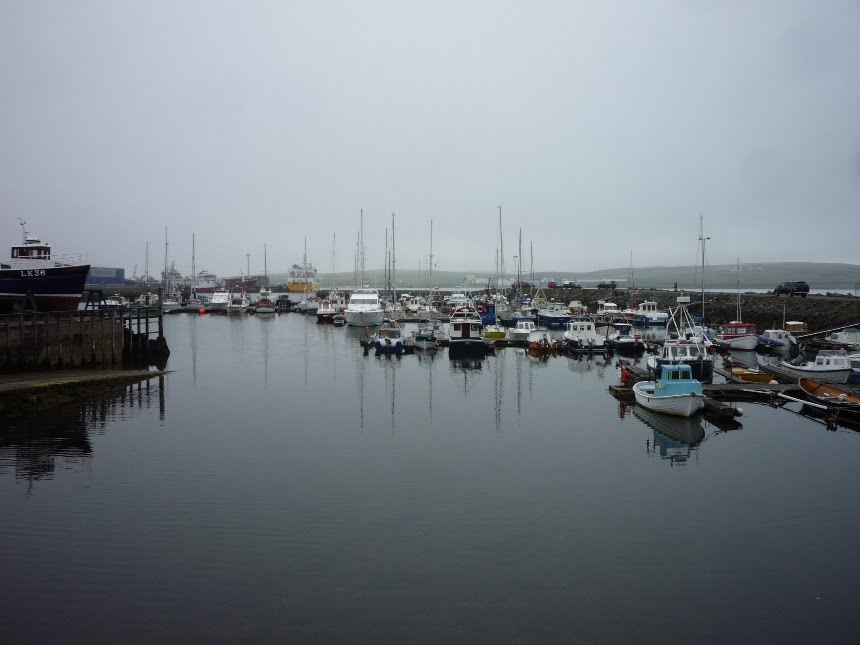
Gremista Marina and Lerwick town docks

So, we had arrived in Shetland and had only a short time before Kyle had to depart for work. We managed a bright sunny day together to tour Lerwick (the capital). Originally we docked in the town harbour, very convenient but with the boat club currently undergoing major renovation there were no real facilities. Since we had to stay for a while, it was suggested we contact the nearby Gremista marina (a community run facility for the locals) to see if they had space for us. Yes they did and at £15 a week it was a bargain despite being two miles out of town, and without shower or toilet facilities. Those two miles I would know intimately by the time Kyle finally returned from work; all good exercise!

Together we did a basic tour (wander) around Lerwick and managed to get a private tour of the Town Hall with its amazing ball room and stained glass features.

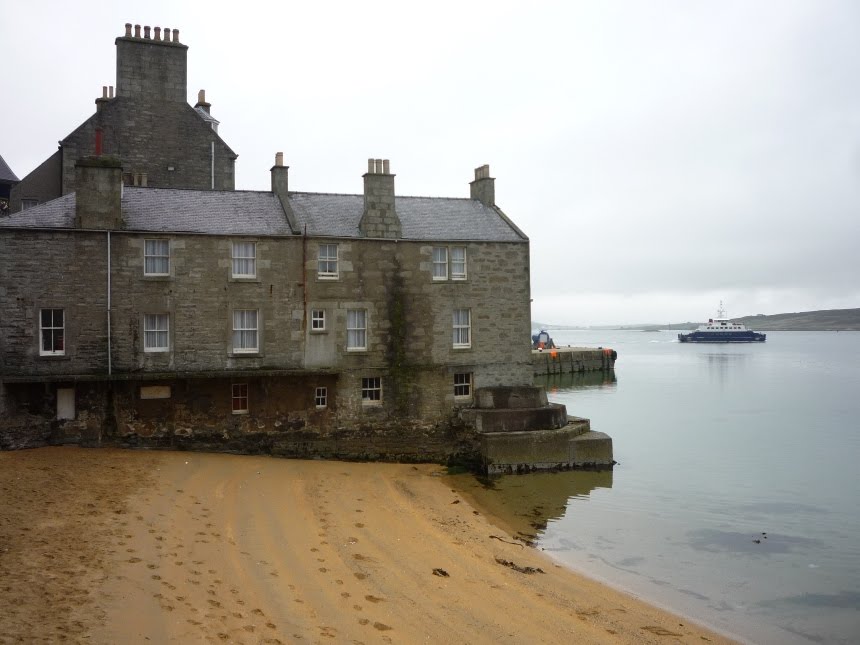
The picturesque “Lodberries” were built in the 17th and 18th century as landing areas for local merchants’ produce, with warehouses and dwellings they provided a (relatively deep draft) and a loading area for supply ships. They were designed to save the need to row produce to and from anchored boats in the bay. They were also heavily associated with smuggling to avoid customs duties, and more recent excavations in the area have discovered a significant number of tell-tale tunnels to support the legend.

As we explored the local fort, we found ourselves intruding on modern day military training for the local cadet force; it was a bit peculiar looking at ancient cannons with real machine guns in the vicinity. As we explored the town, we found ourselves in narrow alley ways, and climbing and descending a multiple of old stone steps, it was fun to explore without any particular aim, and we found ourselves disoriented (lost) several times, although it’s such a small town, that feeling never lasted too long.

We finished our day trip with a visit to the FANTASTIC Shetland museum, only 3 years old, it houses a fantastic collection of artifacts, with great story telling and information all to hand. It is also free, and has plenty of activities for young children to fully enjoy the experience too. To top the day, they have an excellent café/restaurant at which Kyle and I enjoyed a splendid lunch before exploring the museum until it closed. It’s the best museum I’ve been to in a long time and we thoroughly recommend it to any visitors. Some of the display boards included some beautiful poetry, and when I later enquired as to the poet the staff instantly knew who I was talking about and recommended to me a publication that includes his work. [Name: T A Robertson, Most famous work "Vagaland", Died 1959, and you can find his poems and others in a book (no longer published) called Shetland Anthology] Having researched further his work is in a heavy Shetland dialect, although the quotes in the museum didn’t seem to be.

I joined Kyle on his trip to the airport on the South end if the island, only for the pair of us to hang out all day awaiting fog to lift and hoping for space on any of many flights. Eventually we had to give up and Kyle had to return really early the next day, this time making his flights and connections without hassle. With Kyle safely off to work, I set about getting the boat ready for our next leg and 2 weeks in the very expensive Norway… Laundry, grocery shopping, and topping up our Propane and fuel – each requiring a hike of some distance; such fun! Of course it wasn’t all work for me, and I managed to do some exploring of my own, including meeting up with a couple of local gals for a nice Indian curry evening, and some great chat.


Clackimin Broch - Lerwick

Brochs are Iron-age, round, windowless, tall, double walled, dry stone, mutli-floor structures found throughout Scotland, especially on the islands to the west and north (are you following me so far?). The walls are often at least 3m thick and it is assumed these performed a defensive role, i.e. impressive buildings. Shetland is thought to have had 100’s, many in sight of several others, and most remain now as just a few feet high of wall structure (with nearby clear re-use of the original stones), many other grassy mounds are identified as most probably old brochs, but yet to be uncovered. The broch of Mousa (one of the Shetland Islands), is one of the best preserved anywhere and its walls still stand to 13m (44’), not bad for a 2000 year old building! In Lerwick, Clickimin Broch sits almost totally surrounded by a small lake and is open to anyone to wander in and explore, it was also directly in between the place I did the laundry and the Tesco store, so I had plenty of time to enjoy it.

Practically the nearest building to themarina is also a museum, the Gremista Böd (fishing hut), and impressive 2-story stone home used to store and process fish, and house the local record keeper. A local guy called Arthur Anderson was born here in 1792; he became the founder of P&O ferries and with no children of his own granted the Islands of Shetland a million kindnesses, indeed funds from his legacy to Lerwick live on to support modern day elderly. The highlight of the böd tour though is the salty character that is there to give you as much information as you need. Also (temporarily) housed in the böd is the textile museum, so I got to feel inferior all over again by the garments of both the ancient and the modern day knitters and lace makers.

Most of the time Kyle was away was filled with very drizzly days, not pleasant at all. Eventually my chores were finished and Kyle was due home in the late afternoon. I decided I’d head back to the south of the Island to meet with him, and spend some time in the morning exploring its tourist offerings on a rare sunny day.


Scatness

First I went to Scatness to see another broch. Evidence of the structure was unexpected discovered in 1975 during construction of the new airport access road. It was left until 1995 and was expertly excavated over 12 years revealing medieval, pictish and iron and bronze age structures on the site (even newer structures exist close by as croft houses, so clearly the site has its advantages whatever the era). The site alone is impressive enough, but the £4 ticket price includes an excellent guided tour by an professional and very knowledgeable archeologist (I had a personal tour as the only tourist at that moment), and various “living history” re-enactments of the crafts of those who may have live here long ago set in reconstructed buildings, based on those found at the site. It’s easy to spend a day there, but I was on a schedule.


Jarlshof

Jarlshof is another ancient multi period site(Stone Age, Bronze Age, Iron Age, Pictish, Norse and Medieval eras, right the way through to the 1600s), mostly uncovered after a severe storm. A similar site in Orkney (also discovered after a storm blew away the sand covering it) is Skara Brae, much more famous, but no more impressive than Jarlshof. This site visit comes with a audio tour allowing you to wander around at your own pace, and learn about the various sites (nice, but not as good as the personal tour in Scatness).


Sumburgh Head

The final attraction of the area is the lighthouse and bird observatory at Sumburgh Head (Sumburgh is pronounced sum-borough, just like Edinburgh). The Norse name for the headland translates to "The Head onto the Thunderous Noise", and it’s not sure if that refers to the pounding sea, or the masses of sea-birds that nest there. The Seabirds are so well known it is a bird observatory too, and home to great numbers of puffins, kittiwakes, razor bills and all the usual suspects of the region.

I just about made it to the airport before Kyle landed (it was a long walk and a close call), and since he arrived almost 2 hours before the bus north, I dragged him to just one site, Scatness, to enjoy a tour too. We again got an excellent private tour – such value!

That wraps up our brief tour of Shetland, but if you are still interested there follows a few more random tid-bits about the area and its history

We were not in Shetland at the right time of year, but others may know it for its famous “fire festival” in mid-January, the “Up Helly-Aa”. A pagan/Viking festival to welcome the longer days, a replica longboat is burned, torch processions march through the streets, and old fashioned entertainment abound in this 3 day long festival. Most of the Shetland towns hold a version of it, but Lerwik’s is the most (in)famous, and sexist of the lot – a great reason to visit in the winter.

Lerwick (actually Gremista) is also home to Europe’s largest pelagic fish factories, and there is a busy traffic of GIANT fishing trawlers. The fish processed here are exported all over the world and are (apparently) known as the best available.

Most of the boats visiting Lerwick stop in the town harbour, and the majority seem to be Norwegian. Granted they are relatively close to Norway, but the main attraction is the cheap booze! Norwegian alcohol purchases are heavily taxed and prices are about triple what a Brit (already relatively heavily taxed) might have to pay, for boats that sign a declaration that they are leaving the UK, alcohol is available to purchase duty-free at amazing rates, and this makes a trip to Shetland very attractive for the modern day smuggler (if they go over their limit, that is, which most happily do). We were very tempted by some of the duty-free rates, but also aware that we were already at our legal limit, so had to decline.. We may well regret that decision, ho, hum!

In 1886 Betty Mouat set out to Lerwick to sell knitted items. Roads then were not what they are today, so Betty (like most folks) travelled by boat (50 foot sailing boat, called the Columbine in this case). Unfortunately the skipper fell overboard en route, and the crew, who jumped in to save him, then lost contact with the boat. For eight days Betty Mouat lived on some ships biscuits and a bottle of milk, before the boat ran aground on the coast of Norway. Betty returned home a minor celebrity and was even sent a letter by Queen Victoria. We’d be thinking of Betty a lot on our pending trip to Norway.

The airport is one of only two in Europe where the runway crosses the main road (the other is in Gibraltar).

Lerwick seems unbelievably prosperous compared to the other highland and island towns we’ve visited. Indeed the whole of Shetland has been impacted by the discovery of North Sea oil, and the need for somewhere to bring that piped oil ashore. The Sullom Voe terminal was built in Shetland amid much local protest (the largest building site in Europe, ever! Excavating enough earth to cover London 1m deep). However the islanders were canny, and insisted on a share of the profits, these have been used to fund several separate community trusts (amenity, recreational, charitable). It is as a result of these trusts that Shetland has its great museums, leisure centers, etc. It also has half the unemployment rates of Scotland as a whole.

Still with me? Gees, then enjoy a wee dram and think of us :-) You deserve at least a good drink.

Thursday, May 20, 2010

Shetland - Main Island


Hitch-hiker on our way North on way to Shetland Mainland

Passing around 60 degrees North

[Kyle]We reluctantly left Fair Isle for Shetland the next morning. The wind started out as a brisk beat to weather on a port tack in sloppy seas. As the day wore on, the wind clocked around and died off until we were eventually ghosting into Lerwick harbor going dead downwind at only a couple knots. As we sailed up the east coast of the Shetland mainland, we passed a big milestone; 60 degrees north. That put us 2635 nautical miles north of the latitude of our southernmost point so far, Jacques Cousteau National Park in Guadeloupe.

Lerwick was pretty full when we arrived and we had to raft up to another boat to get ashore. We found two boats we had met in Fair Isle plus the Australians we had berthed next to in Wick. Perhaps a big reunion is in order, but for now, it’s been a long day so we’re off to sleep in the twilight of the short northern night.

Puffins!


Puffins

[Kyle]For day two in Fair Isle, we pretty much decided to see everything we hadn’t the day before. We started by going to an area known to have Puffins. Puffins like to nest in ex-rabbit holes at the top of cliffs with a view of the sea so they like the thin layer of dirt on top of the rocks preferred by other species. We were just strolling along on the perfectly manicured (by sheep) lawn at the top of one of the sea cliffs, when we saw a couple of Puffin heads poking above the edge with their adorable permanent look of surprise. We were able to slowly creep up to them and then sit on the grass as close to the edge as we dare and just watch them.

It always amazes me in this world of jet planes and internet just how agreeable it is to spend the day doing something slow and simple like sitting in the grass watching birds go through the process of building a nest just right or ambling through a pasture talking to each other and watching the lambs run after their mothers on clumsy legs.

One of the things I learned from sitting there that I never really appreciated was how hard it is to live on cliffs, even for birds. Puffins would fly off to get something to eat or some nice grass for the nest and then have to return. The gusty winds and the topography make this pretty difficult. After a while, we were able to tell who was more experienced at the art. I saw one little guy come zooming up the cliff face and bring himself to a complete stop an inch above his target rock. Then he just folded his wings, put out his feet and plopped right down. The next one tripped over a clump of grass and did a faceplant right into the cliff that was so loud we could hear the impact. Then he had to flap like crazy to keep from falling off the cliff backwards. At a different point, I accidentally flushed a gull off of her egg. She returned to it by landing at the top of the cliff and then doing this mad, stumbling fall to get back. It was the exact opposite of her grace and beauty in the air. She kept landing on her head and messing up her feathers by using her wings to catch herself. It looked like it really hurt. It also looked like that was probably the only way to get to that nest. I felt horrible.

Once we felt that we had disturbed the birds too long, we went to go see the lighthouse on the north end of the island with its enormous steerable foghorn perched on a high cliff. We then went to do what we usually do – climb the highest thing we could see. In this case it was Ward Hill, the highest point on the island at 217 meters (712 feet) From there we could see the southern Shetlands and with binoculars I could just make out Start Point light on Sanday in the Orkneys. I could also see that we were going to have company later; two boats were approaching from the Shetlands and one from Orkney.

We enjoyed the mostly downhill walk through the moorlands on the north side of the island, being occasionally dive-bombed by overprotective Skuas guarding nests we never did see. We arrived back at the harbor just in time to see a Norwegian boat (the one coming from Orkney), rafting up next to a British boat on his way to Norway. We introduced ourselves and offered to help take lines, etc. and in short order were invited aboard for drinks. We accepted, of course, and spent an enjoyable evening talking about boats, Norway, Scotland, each other and anything else that came to mind, all with the beautiful surroundings of Fair Isle in the background.


More Beautiful Fair Isle - including some traditional peat cutting for winter fuel