Tuesday, January 30, 2018

Passage from New Zealand to Chile

[Kyle]On the morning after my big birthday, we reset all of our onboard clocks to the time zone closest to the middle longitude of our passage. Since the new boat time was on the other side of the International Date Line, twenty-two hours ahead, I got to have a forty-six hour birthday!

Setting our clocks in this manner allows us to keep our circadian rhythms on one zone the whole way while allowing us to theoretically maximize the use of daylight for mealtimes (6:00-8:00 for breakfast, 4:00-6:00 for dinner). Since Begonia is battery powered, keeping the cabin lights off helps us make them last longer and it also makes it easier to see outside when it's dark. This usually works pretty well, but New Zealand to Chile is a VERY long way. Our passage crossed eight time zones. When we left, Maryanne was sitting most of her night watch in daylight and I was waking her up for her day watch an hour before it even started getting light out.


Leaving New Zealand

As soon as we left Whangarei we turned the wrong way. Since South America is way on the other side of the planet, the Great Circle route (the shortest path) plunged away to the southeast to pass within a few hundred miles of Antarctica. Not only is it very cold down there, but the weather can also be violent and unpredictable, so we had no plans to follow that shortest route. A nasty weather system with forty to fifty knot winds was coming from that direction, so we started our passage by going northeast and then north to avoid the worst of it.

Low pressure systems in the Southern Hemisphere turn clockwise, so letting ourselves get pushed along the farther northern side would add miles, but allow us to stay in tailwinds which have a much lower strain per mile on both us and Begonia. The system slowed down as it passed over New Zealand, allowing it to gain strength while we piled on as much sail as we could to keep ourselves moving away from the approaching center in the light winds on the far edge. It was difficult to be starting out on such a long sail so slowly and also watching our total distance to go increasing.

It took a couple of days for the wind to get to us. When it did, we had big seas and tailwinds of thirty knots for several days. With even stronger winds to the south, we angled yet further northward to ride the fine line between them and the calms to the north. At least we were going somewhat in the right direction. During the strongest of it, we were still making six to eight knots surfing down the waves without any sail up at all. The waves collapsing as they broke under Begonia always did so unevenly, causing one hull to drop before the other, which made for a pretty crazy ride. By the time the system had passed over us, we were ready for a break from both being thrown around and having to listen to all of the unsettling noises that accompany such motion.

We were hoping to be able to turn right and angle our way southwards on a more direct course, but the newest forecasts were predicting the development of a tropical storm that would plunge south into our path. To avoid it, we would have to abandon any plans to go east and get south as fast as we could into water that was too cold to support it. We spent over a week sailing into headwinds from the relatively warm waters just north of 30 South into the cold waters of the Roaring Forties. Every watch, about midway through, I would realize the pile of clothing I had worn the previous watch wasn't cutting it, so I'd go down below and find another couple of layers to add. After several days, I was wearing the same outfit I had worn in Antarctica. I was padded so comically that getting through the narrower parts of the boat required getting up a bit of momentum first. I was even wearing multiple hats.


We experienced a mix of weather on the passage, but Kyle's planning kept us from the worst of the systems

Once the tropical system fizzled out, we were finally able to ease the sheets and follow the wind in the direction we wanted to go. Again, we were trying to stay on the edge of a band of howling winds several hundred miles wide. We would have had a faster and shorter passage if we had plunged more deeply into it, but I was willing to sacrifice some speed for comfort and reduced chances of over stressing something on the boat. Every mile further we edged into the forties was unnerving as it increased the likelihood we would encounter rough and changeable weather. Our daily text forecasts were little more then paragraph after paragraph of gale and storm warnings. The Great Southern Ocean seems to be pretty much all gales all of the time. The Antarctic sections always had a horrible sounding blizzard or two - and this was the 'mild' Summer weather.

This was our fist passage since upgrading to the Iridium GO!, coupled with PredictWind, a kind of a wifi router to replace our satellite 'brick' phone, and giving us access to additional weather models. I have now firmly developed a love/hate relationship with it.

The love part is obvious. We now have access to a much broader range of weather data than we did before and our plan lets us connect as often as we like. On such a long passage, particularly in a somewhat scary part of the world like the higher latitudes of the South Pacific, it's good to be able to check different weather models against each other for consistency and then devise an informed plan. We often remarked to each other how much different it would be to be planning our strategy by making big inferences about tiny movements of the barometer needle. On the two occasions we encountered really rough weather, we had plenty of warning and were well-prepared when it finally arrived.


Birds at sea

What we hate about it is that it's a piece of technology like many others today with no obvious mechanism. It's a magic box and all we know is that something is supposed to be going on inside, but we can't know for sure. It is super slow and frustrating, It will drop four calls for every one that goes through, and it likes to do that annoying computer thing where it says it's doing something, but twenty minutes later, you realize it's not even trying and that a little piece of your life is now gone forever. Because of this, and the unlimited data plan, we changed the way we deal with weather downloads. Instead of doing it when we do our morning position reports, I just start it trying as soon as I come on watch so that I have hours to complete the task. Just to give an idea. At the typical speeds we see at sea, a thirty-minute audio file would take about twenty-four hours to download. Their routing software is also just plain stupid. Even if you tell it you want to avoid weather worse than a certain amount, it seems to try to route us on the quickest route to the very edge of the bad weather. I'm glad I have the experience to confidently ignore it most of the time, but I worry about people who would put too much faith in it.

We had a couple of weeks of reasonable weather, albeit a little cold for our tastes. We meandered left and right to stay in the best winds, but were always in the low forties latitude. This was the most remote part of our voyage. We passed only a few hundred miles from Point Nemo, the spot on Earth farthest from any land. We have now sailed in all three of the Earth's regions where it is possible to be more than a thousand miles from anything other than more water. For several days, our nearest land was Easter Island, itself one of the remotest places on Earth. We saw no other vessels either directly or on our AIS display. There wasn't even any static on the radio. The only wildlife we saw the whole time was a lone albatross that would circle nearby for a few hours a couple of times a day. It regularly came right up to the cockpit where I could study its markings. I'm reasonably sure it was the same individual each time. They're such efficient fliers that I only ever saw her flap twice.


Being at sea this long can be dull, but we keep ourselves busy
Fixing things, cooking, keeping our logbook, reading and enjoying the view


Sunsets and sunrises can be spectacular

We had now been at sea for over a month and still had more than two thousand miles to go. Two thousand miles is a pretty respectable distance to sail and here we were feeling like we were 'almost' there. Man, the Pacific Ocean is big!

Another strong weather system passed to the north of us in the tropics. It gave the South Pacific High a shove and pushed the edge of it in front of us. To keep our wind going, we had to go a few hundred miles even farther south. Now we were so far into the forties that it would take us days to get out if something happened.

Despite the gale warnings all around us, our weather remained relatively nice. Once we found our band of wind again, we resumed a great circle course and had almost direct tailwinds as a long swell rolled under us. At our furthest south, we actually deployed our spinnaker and flew it for a couple of days straight as the skies slowly cleared. Flying a spinnaker in the Roaring Forties – that's nuts! We got as far south as 45º 53'. At that latitude, there are only two pieces of land to interrupt the vast ocean: a few hundred miles of the skinny (but tall) part of South America, and just over a hundred miles of the South Island of New Zealand (also tall). We were thousands of miles from either. On our uncharacteristically calm patch, we had that lovely combination of a slow, smooth motion and exhilarating speeds to eat up some of the remaining miles.

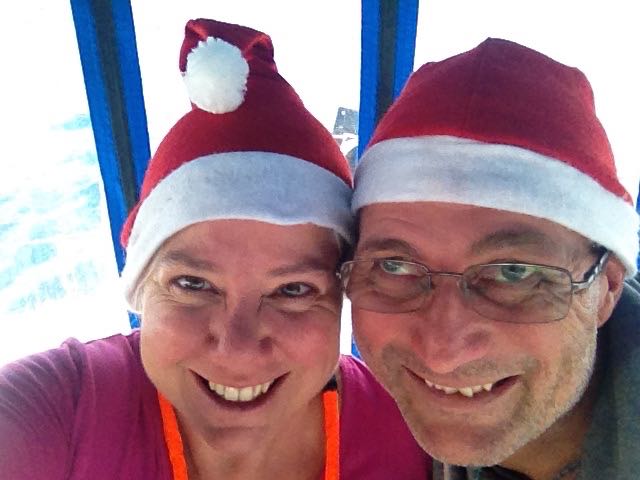
Apart from our regular wave sightings and visits by Bert, 'our' Albatross, we had a few events to break up the trip. First was Christmas. Maryanne woke me for my watch wearing a Santa hat and holding the one she was clearly expecting me to don. We opened our hidden stashes of gifts and Maryanne even produced a Christmas cake that she had pre-sliced at Norsand before we left with a borrowed chainsaw. To top it off, just at sunrise on Christmas day we were also visited by the only pod of dolphins we saw for the whole passage!

Christmas at sea started with a surprise visit from a pod of dolphins!

Next was New Year's, which really seemed like Monday since we had no real-time contact with the outside world and we were using a time zone for the passage that probably has the lowest population of any of them. It was just us and parts of Alaska. Maryanne woke me for my midnight watch by blowing a noisemaker. Unexpected noises are generally a bad way to wake up at sea, but it only took me a millisecond to realize that it was not one of our many scary alarms and was just Maryanne celebrating. Her beaming face made it impossible to be upset.

Next was my mother's 39th -again! We managed to patch a spotty satellite call through both before and after her big surprise party. The weather was pretty bad those days so between all of the background noises and the swinging antenna, we had a hard time staying connected, but I think she got the idea.

By the time we were closing in on the South American coast, we had sailed so far east that my night watch had very little night in it before the sun would start coming up. Finally, on day forty-six, Maryanne woke me with a report that she had just spotted land in the pre-dawn twilight. I emerged from our bunk to see the island of Chiloe, South America's second biggest island (behind Tierra del Fuego). Wow! That was a long damn way. Between the monotony of the big middle bit and the fact that the cold weather had not encouraged a lot of going out on deck to enjoy the clouds and the stars, it in some ways had felt even longer since we had seen anything but sea. Since we each do two watches a day, we had each brushed our teeth and climbed into bed ninety times between our last sight of New Zealand and our first look at South America.

Our first port, Puerto Montt, was still another twenty-four hours of sailing away. We had to pass through Canal Chacao, separating Chiloe from the mainland, We caught the current just at the wrong time and Maryanne spent a whole watch sailing hard just to crawl along as fishing boats, ferries and cargo ships maneuvered nearby. We hadn't seen another boat in weeks and now it seemed there were fleets of them to avoid. We also had sea lions and birds to entertain us in the whirlpool of a channel. On my watch, we accelerated through and got some breathing room for the overnight sail to Puerto Montt.


Land at last!
Once we were within the channels - the wildlife kept us entertained as we pushed against the strong current

ALL of the water in Chile is controlled by the Armada (Navy), not just selected areas, and the rules for navigating within them are both numerous and strict. One of the requirements is that all shipping has to give a detailed position reports to all manned light houses along their route. I was actually kind of looking forward to this as I had been studying Spanish diligently the whole way and had finally declared to Maryanne a few days earlier that I was now completely fluent.

I listened in on the report of the first ship passing through the channel ahead of us. Uh, oh. Between the crackly radio and the ridiculous speed of the exchange, I got maybe two words from each side. No tengo fluencia. My fluency did not appear to extend to the spoken language, which I think is supposed to be the point. What I have seems to be 'billboard fluency', which I'm pretty sure is not even a thing My exchange started okay, but then the lighthouse keeper was obviously so impressed with my command of his language that he went off on some rapid-fire tangent about how much cesium there was in underwater substrates and then he asked me a series of questions about which cookies I preferred as a child and I kind of lost him. As a favor to him so he could stay in practice, we finished in English, of which I also seemed to be losing my grip. Bienvenidos a Chile! The pre-school is that-a way.

Subsequent exchanges with other stations through the night revealed a pattern of just ignoring us once communication broke down. No second or third tries were offered. By the time we finally tied to the dock at Puerto Montt, we weren't sure the Armada had actually received the message that we were coming and were half expecting to be met by a group of angry soldiers. We weren't. Instead, the nice guy at the Marina said he'd call them in the morning and reminded us we were not to leave the boat until we had received clearance into the country. That was fine. We hadn't slept much in the excitement of our arrival and needed a good night's sleep anyway.

{Maryanne: Luckily we'd also emailed our position report and ETA details from about 300 miles off shore, the requirement is that you submit this from 200 miles out, but I was making extra sure!}

Overall, the passage had covered 6,380.5 nautical miles and taken 1,091 hours and 56 minutes. Even without sailing in a straight line, we had sailed well over halfway to the opposite side of the Earth in one sail and on only a portion of one ocean. It's difficult to overstate the size of this massive body of water. It is roughly the size of all of the world's other oceans combined and larger by far than the aggregate of every scrap of land. Sailing for weeks over it's surface gave us a rare glimpse of the very scale of it. That said, it was kind of a strange feeling to be here. It had been so long since we left that we had become used to the idea of it just going on forever. For most of the journey, we dared not think about landfall because it was so far ahead. Now we were here and it felt strangely – sudden.

{Maryanne: Before leaving Mexico a year ago, and again before leaving New Zealand, we'd worked really hard to be sure the boat was up to the strains of the Pacific crossings. We wanted to be sure she was able to look after herself (with help from us) as much as we could without access to external support. While we don't fuss too much over the cosmetics aboard, we do really invest in the critical stuff that might otherwise leave us in trouble, we have a ton of spares and manuals and backup systems aboard. This passage we did indeed have some new issues, but luckily nothing too serious. We had a few new leaks, our wind instrument became totally erratic and unreliable (we had a hand held backup, and would fix it once we could safely get up the mast), and a new bilge pump float switch failed (luckily Kyle found that out on one of his regular checks, it wasn't actually needed in action). Overall we had very little to worry about during the passage.}

We knew of two other boats that were making the same passage as us. The first, a French boat called Shana, we met during our last few days in the yard at Norsand. They had intended to leave a couple of weeks before us, but a valve issue followed by a family emergency had them postponing their departure until we were already about a third of the way across, making us the pathfinder instead of them. We had been sending messages and positions back and forth to keep track of each other. The other boat was one we hadn't met, but Shana knew them. They left the Chatham Islands for Ushuaia about the same time as Shana and the two boats spent much of their passages only a couple of days apart. We sent Shana a message informing them of our arrival as well as some tips on getting settled, etc. We were looking forward to giving them a big welcome. They sent a reply saying that they had very strong winds and that the other boat, which was a bit south of them in even heavier weather, had been hit by a wave and suffered a 360º roll. The boat was fine, but the guy at the helm when it happened had been killed. They were now coming to Puerto Montt instead of going to Ushuaia. We felt terrible and powerless to help. It made us each give the other an extra big hug for having made it.

After arriving at the marina, as we were tidying up, the growing twilight reminded us that our good night's sleep was not to be. In local time, it was already well into tomorrow and we only really had a couple of hours. We got just enough of a nap to feel even worse before a knock on the hull woke us. It was the marina manager coming to tell us the authorities were on their way. We poured some coffee down our throats and struggled to stay awake while we waited as we finished the tidying up jobs we had blown off the night before.

It was a few hours before someone came and summoned us to the marina's conference room. Along the way, I realized I hadn't walked more than five steps in a straight line for weeks. Stamp, stamp, stamp, and we were done with Customs. We went back to the boat for another couple of hours before repeating roughly the same five-minute process with Immigration. Last was SAG, the Agriculture and Wildlife Department. The SAG agent actually came to the boat, examined our stores (all the possibly suspect stuff Maryanne had pulled out and had ready to inspect), asked a few questions and then there was a whole flurry of stamping and signing before we were declared officially in the country and told we were now allowed out of the immediate vicinity of the marina.

One of the papers he had me sign turned out to be a citation for violating one of their rules along with a summons to appear at the SAG offices in two days time to make an official apology. Apparently, we were supposed to provide them twenty-four hours prior to our arrival a list of every port we had been to in the proceeding twenty-four months. We had pre-notified the Armada, but not the SAG office and not with the 24-month list. I guess it's a good thing we were planning on staying in town for a few days anyway.

{Maryanne: Each country has its own rules and regulations for visiting boats to adhere to. Arriving by boat means we have a lot more responsibility to do the right thing than when we arrive by plane and are pushed through the necessary bureaucracy at the airport. We make a huge effort to research the requirements, using cruiser web sites (like noonsite) and guide books, and any other resources we can find. This regulation isn't mentioned anywhere. After the SAG agent left, I hit the internet looking for what I might have missed. Nothing. Later contact with the author of the most recent guide book confirmed we were the only sail boat that he'd heard of being cited, and his research on the rules came to the same conclusion as mine – we were being cited for a failing to conform to a regulation that obviously didn't apply to us. But hey, we were now officially in Chile. Our neighbours, Ledda and Alejandra, came and generously delivered some home-made freshly-baked bread as a welcome and we could finally sleep. – all was good}

Thursday, December 14, 2017

Whangarei for Fun... eventually

[Kyle]Yay! We're back in the water!


Begonia splashing in - and the sun is shining!

The guys at Norsand lifted Begonia with the trailer and then towed us to the slipway. She was eased down the ramp until she was about half an inch above her waterline. Maryanne and I climbed aboard and checked to make sure we hadn't forgotten to re-secure all of our underwater openings. All was dry, so we gave starting the engines a go. Both cranked right up and we got cooling system output water right away from the port engine. Starboard was a little bit slower, but eventually we got a trickle coming out of its exhaust.

Honestly, I was surprised either of them worked. When this boat is hauled out, the seawater in the cooling system usually leaks out. The system loses its prime and the pump ends up flailing around uselessly in an air bubble. Sometimes we get lucky, though, and there's just enough water pressure trying to get in to re-prime the pump. When that doesn't work, the only solution is to bleed the system to get the air out. It's a pain and usually makes a big mess that I have to clean up later, so I like those one in five times that I don't have to do it.

The trailer was lowered the last little bit and then pulled away. We backed Begonia through the narrow channel leading to the river. As I went to sound the horn, I got nothing. Aaarrgghhh! I was just up the mast a couple of days earlier and everything checked out fine! I was really hoping the problem was at the lower, more easily fixable end. My plans for an afternoon of finally not having to fix something on the boat were dashed. I had just boxed up all of our tools and written DO NOT OPEN UNTIL 2022 on the box in permanent marker.

About half a mile later, as we were winding our way up the very narrow channel to town, It started to seem to me like the starboard exhaust was sounding a little throaty. Maryanne checked on it and reported no water coming out at all. It seems what we saw before was the last of the pre-haulout water being pushed out. I shut down the engine to keep it from overheating. The river was much too narrow to stop and the spot the marina had assigned us would require a lot of deft maneuvering to reach so...twelve minutes after triumphantly returning to the water in our better-than new boat, we dropped anchor across from the boatyard after having limped back on one engine. Boy, that new boat smell sure did fade fast!

Knowing that boat jobs are measured in swear words, I uttered the quickest hundred I could before diving head first into the engine compartment. That sped things up. I managed to bleed the sea water system and get it all reconnected before any more than five drops escaped. Usually, I do something like lose my grip on the hose. It blasts the glasses off of my face and then whips around like an unchecked fire hose, spraying water all over the whole room. That's when I start my hundred swear words. There must be a lesson to learn here, but I can't figure out what it is...

Six minutes after dropping anchor, we pulled it up and headed back to town with both engines running. With her clean and smooth new underbits, Begonia was almost ten percent faster than she had been on the trip to the yard.


The brige opens for us, and our first views of town from the boat

We threaded our way through the narrow channel past some very nervous-looking people on other boats who all turned out to be unnecessarily clutching fenders to their hulls as we passed. We found our slip and with a little help from some volunteer line catchers, landed without incident or drama. We were finally able able to relax in New Zealand.

Except that we weren't. We still had the horn to deal with.

I started with the obvious. I had been fiddling with lots of wires installing our AIS and I thought it might be possible that I had accidentally yanked one of the hailer wires out of a connection. Nope. My next suspect was one of the connections at the base of the mast. These are all buried under the settee behind where we keep a whole lot of our food.

An initial inspection with a light revealed nothing obvious. I could see it, but not reach it. The next step was to empty everything out so I could get in there with a multi-meter and start testing circuits. Even with everything out, it's too far to reach, so I have to climb in. The only way to do this is with kind of a twisting, sliding somersault that requires me to support most of my weight with my head for most of the maneuver. Once in, I can wiggle around into a reasonably comfortable position from which to start working.


Poor Kyle

It was a hot day, though. The temperature itself wasn't too bad, but our fridge had been working hard to keep itself cold. It does this by removing the heat and dumping it under the settee. So it was a little warmer under there, but the worst part was that in order for me to fit into the space, I ended up with my head resting on the compressor, which was REALLY hot and trying to turn my scalp into bacon.

I tested the voltage. There was some and fiddling with the wires made the radio buzz, but there wasn't enough to be sure. I then tested the wires going up the mast for resistance. Almost none would mean a short circuit. Lots could mean a broken wire. I got some, which could mean anything.

We talked about it for a bit and did some more tests, all with the same results. Eventually, we decided that maybe the horn had just gone bad. I would have to find one and replace it during the week. Grr.

Before I started the process of extracting myself, which is worse than going in because I have to push myself out with my burned head instead of just resting all of my weight on it like on the way in, Maryanne had one last go at fiddling with the radio's settings. She selected the horn and pushed the button. No sound. She told me which setting she was on and confirmed the volume was up.

“Which volume?”

“The radio volume.”

“What about the hailer volume?”

Pause, “There is no 'hailer volume' setting.”

I had more experience with this than she did, so I wriggled out of my hole with her pulling me hard by my legs. It was awful. Every ten seconds or so, I would get stuck so I couldn't move either way and I really did think I was going to have to break a bone or have the Fire Department cut me out to get free – maybe both.

Once I was done, I fell into a heap on the floor because I had been twisted into a pretzel for too long. Once I was done with that, I went to the radio and turned the hailer up. It worked just fine!

I then calmly climbed off of the boat onto the dock and then had a good, cathartic fifteen-seconds of jumping around punching the air and swearing a lot. Our neighbors seemed not the least bit concerned. They also have boats.

So here's what happened:

Almost every marine radio in the world has the capability to monitor more than one frequency at a time. Ours was supposed to, but never has. Maryanne decided to finally focus her considerable talents to address the problem. She found some engineer at the factory who talked her through some elaborate setup process. The fix worked, but then we lost our AIS (Vessel traffic display). When she fixed that, the dual watch stopped working again. After much more back and forth, she finally got told how to do the double secret factory reset. That fixed everything, but set the default hailer volume to zero. Not only that, but when the volume is at zero, the volume indicator disappears, so unless you are experienced with adjusting hailer volume, your only hope would be to happen on it by chance. Which rocket surgeon thought that one up?

So now we really are back to 100%, at least until tomorrow.

Time to enjoy life not in the yard. We hung out with other cruisers, attended a birthday party, (not mine) and attended a pot luck in the rain. We loaded up the boat with cartload after cartload of food on a multi-day provisioning trip. Most people are going to Opua, which is just up the coast, so we raised a few eyebrows as we put months of food aboard.


Pretty Whangarei

We took one day (and many part days) for being tourists. We took the trail up to Whangarei falls, which is reached via a path by the river. We had ridden the part of these wide, paved paths near the marina before, so I thought the trip would be a couple of hours by bike. We had just barely cleared the town when we encountered our first set of stairs. We abandoned our bikes and continued on foot.


Exploring the fern trails and waterfall


Begonia in the marina,and the beautiful Pōhutukawa (New Zealands 'Christmas' tree) is in bloom all over town

The trail turned out to be longer and steeper than I had expected. There were also lots of interesting side trails that switchbacked their way out of the steep canyon. The views were great. The forest was reminiscent of a Pacific Northwest rain forest, only with a lot of funny, Dr. Seuss plants. By the time we eventually made it back to the bikes many hours later than expected, we were all-over sore.


The city of Whangarei (most northerly in NZ)

Before we left Whangarei, we spent a couple of evenings with other boaters. One evening aboard 'Jadean' to celebrate Kim's birthday, and another evening with a nearby boat (Red Max) who had already visited Chile. They were great company and they gave us lots of good advice. Their photos of their trip really got us excited about going. The next morning, Red Max came over and gifted us their paper charts of the area as a send off.

{Maryanne: We filled up with provisions for Chile while in Whangarei (we could wheel the shopping cart from the grocerey store across the street right to the boat, so that was easy), but we also made time to do something fun every day. We had fish & chips, and a nice Thai meal out, we ambled and ate ice cream, and caught up with at least 10 other boats that we've seen in this years Pacific passage who happen to be in Whangarei at the same time.}

High tide was at sunrise, so we had to leave then. We went down the river to where it widens out by Norsand and had the anchor down by 7:00, glad to not be waiting for a haulout. It rained most of the day, so we were looking forward to some quiet time with not much to do.

Maryanne decided to do a quick sewing project and the thing mushroomed into a whole day affair of fixing and re-fixing the touchy machine. Five hours later, all we had to show for the effort was a canvas bucket cover. If she ever asks, remember; It's the most beautiful bucket cover you have ever seen. {Maryanne: Actually I made two, but Kyle isn't that observant.. ha!}


Morning calm at anchorage

Thursday, December 07, 2017

New Zealand - The Boat Yard Blues $$$$


Marsden to Whangarei is a beautiful sail

[Kyle]Instead of using a Travelift, which can be operated by one person, Norsand uses a submersible trailer and a bunch of other machinery operated by a whole team. The whole process is tremendously elaborate and labor-intensive. Since they have to compete with the Travelift guys, they charge about the same amount, which means every time a boat gets taken in or out of the water, they're taking a loss. At the end of the day, though, it's all peanuts. The haulout is just the cover charge that lets you in so you can really start spending, which is exactly what we did. Ouch!


Fancy haul out system (in the rain!)

When the Haulout Manager asked us when we wanted to go back into the water, we told him we were hoping we could do the whole thing in two and a half weeks. “Impossible”, he said “We have no availability to return you to the water for two MONTHS”

“That won't work for us. We're going to Chile. We need to leave by mid December”

“No worries. We'll just do the work while you're gone. When do you get back?”

“No, we're sailing to Chile. The boat has to go with us”

After a lot of staring at the big board and head scratching, he said he could put us in in two weeks. Yeesh! Nothing like a little pressure. Now we had to get moving.

Motivated by a reluctance to leave on the 5,500 mile passage to Chile with anything not in the best possible working order and knowing the passage needs to be done in the milder weather of summer, we met with Mark, the Yard Manager, and handed over their part of our long list. When we told him it all had to be done in two weeks, he remained perfectly sanguine and unperturbed.

Once we were dropped off in our spot in the yard, we began the process of dismantling in order to access the things we needed fixed. This inevitably revealed another layer of new things that needed addressing. We repeated this process until we were out of layers. We took our new, expanded list to Mark and he remained steadfast in his refusal to freak out. This was unacceptable to me as I was freaking out. I explained it to him again, but I still got the distinct feeling that we were the only ones that would be having boat maintenance nightmares that night.

As we arrived back at Begonia wondering if getting the yard to do any actual work was going to be like pulling teeth, we found three guys poking around at the first three things on Mark's list. Well, that was unexpected. In the next few days, I found that happened a lot. I would mention something to Mark, stop at the water fountain, go to the boat and find a worker who had already beat me there.

Without exception, every single guy they sent over was really friendly and seemed happy to help. We had decided it was time to strip all of the old layers of antifouling paint off and bring the bottom down to bare gelcoat. Case, the poor man assigned the lion's share of the initial scraping, acted as if he would be happy to be getting some real exercise. I picked up his scraper during his lunch hour and had a go at reducing our yard bill by spending a tiring fifteen minutes clearing off a one square-foot patch. When he returned, he was happy I had saved him the work. Fifteen minutes later, I emerged from whatever horrible job I was up to and found him already three feet further down the side of the hull he had been scraping. I think I may have reached the point where I am too old for some boat jobs.


The view across the river was quite something
That and the cats to fuss over sure helped balance out the work (kind-a)

We then fell into the all too familiar boatyard routine of getting up before dawn, so as not to waste any precious daylight, and working until dark, so as not to waste any precious daylight. Our plight was made much more tolerable by a box of goodies Mom had sent us. It was nice during a frustrating job to be able to pop in and sneak a cookie before getting back at it.


Kyle servicing the wind generator and atop the mast

I was rather insistent that we then clean up and put the boat interior back in order before having dinner in a relatively normal-looking boat. I don't mind shoving aside a pile of tools to find space to sit and climbing over boxes of parts to get into bed after a long day, but I HATE waking up to find the boat in that state in the morning. This gave us a short mental health break in the evening during which we are allowed not to be working on some project. In Panama, we used to try to carve out time for a short walk into the adjacent jungle to look at the monkeys. Here, the only thing adjacent is industry, so we try to wind down by watching a movie or something. Invariably, fifteen minutes in, one or the other of us will wake up, look over and find the other one asleep. Time to admit defeat and go to bed.

The workmen in the yard didn't put in the hours we did, but apart from their lunch and two tea breaks, they didn't stop moving until their shift was over. Progress was fast.

During the workday, Begonia became a real building site. Machinery noises came from every direction and the whole boat reverberated loudly with the vibrations of multiple power sanders. We had to shout to be heard over the noise. Things were definitely moving along quickly, but watching those guys was like looking at the ammeter while Maryanne goes around and turns on every single thing on the boat. At one point, we had five guys working on the boat at the same time. It took some real effort to keep it together while trying my hardest to not do the math in my head:

“Let's see...five guys working eight hours a day for three days... that's 120 hours... times their labour rate equals...AAAHH!!”

They worked hard, though. They had all pretty much sweated through their protective suits by quitting time. They did good work, too. We've often been in boatyards where the guy assigned our task was on his second try and did worse work than we would have. These guys seemed to really know what they were doing. We'd have to go through the whole learning curve all over again to do once in ten year jobs, but these guys do it three or four times a month and it really showed. When they finally had the last speck of paint removed, Begonia was gleaming white below the waterline. We were pleased and not a little bit relieved that the years of paint accumulation had not been covering up any underlying fibreglass or gel-coat issues. In fact, without the paint, the hulls both still looked brand new.

THE major unexpected issue that we had to deal with was our rudders. You may recall that having one of our rudders fail at sea, we had Fountaine Pajot build and send us two brand new rudders all the way to Hawaii from France. Since then, we have made a point of pulling them and checking them every haulout. We have even hauled out just to check them. Almost immediately, they began eroding at what seemed like a higher rate than we would have expected. In Mexico, we discovered water in both and had the yard there open them up, dry them out and rebuild them. This time, in New Zealand we found not only water dripping from the post/blade junction, but rusty water. It was most distressing. {Maryanne: A common reason for rudder failure like this is some kind of electrical connectivity, as soon as we had issues this was the first thing we tested. We were rigorous with this, but every test we did confirmed all is well on this front - but what the HECK was going on?}

Mark had a look at the rudders once we'd pulled them out and his first comment was that the posts appeared to have been built from the wrong grade of stainless. He guessed that it was 304 instead of marine grade 316. 304 is magnetic, 316 is not. We threw a magnet at one of the posts and it stuck. We were kicking ourselves for not having done that earlier, but we had assumed the boat manufacturer would use the right stuff and it never crossed our minds.

The yard's machinist took a look and made the same pronouncement as Mark. Both were amazed that our rudders were only three and a half years old. Then we met Ross,the New Zealand representative for Fountaine Pajot. He took one look at them and said the same thing.

At one point, Maryanne said, “We know mistakes happen...”, to which he responded, “This isn't a mistake. It's incompetence!”

We were obviously distressed about the rudders (and had been for the last 3 years), but it was some comfort to know we haven't been crazy this whole time and that they really are sub-standard for some very peculiar reason.

Kevin, the Machinist, dug around a bit and found corrosion that was about halfway from turning the solid post into Swiss cheese. No wonder the Mexicans couldn't seal them. The water was getting in through the posts themselves.

This was bad. Even if the rudders did survive our next ocean crossing, they wouldn't likely make it much further and there was no way I would get one good night's sleep with that knowledge in my head. After several unsuccessful attempts to get it out of my head, we decided we would have to suck it up and fix the rudders – again.

The yard in Hawaii where we installed them told us at the time that it would take them a month to fabricate new ones for us, which was one of the main reasons we had Fountaine Pajot start the work in France while we were still at sea. This time, we were due back in the water in nine days. We would never make it. I looked pleadingly at Mark, who just smiled calmly like he does. He said he could get it done in about a week – he would just have to find someone. How could he? They were all scraping paint off our boat.

On my next bathroom run, I looked in the shop. Neville, the fiberglass guy, already had both of our rudders opened up!

Ross stopped by and asked for some photos of the posts. When I couldn't find them, Mark directed me to the machine shop where the new ones were being fabricated. I rode my bike over. They are not set up for meeting customers – it's just a big building with garage doors on one side filled a whole lot of machines. They were really nice, though, and one of the guys there found our old posts for me. I took my photos and as I was leaving, Derek, the Manager, intercepted me. He told me they couldn't get any 316 stainless in time. That vein in my head was filling. He said they were going to use 2205 Duplex instead. It's twice as resistant to corrosion as 316 and also has twice the tensile strength. The shafts were also of slightly larger diameter than they were supposed to be, so he was going to machine our new bearings to fit the larger posts. Our new rudders would be super strong and hopefully worry-free for decades. “Great! How long will it take to get the the 2205?”

“It's right here”, he said, and pointed to two cardboard tubes on the floor with our names on them. I checked the label and it did indeed say 2205, not something else. When I got home, Maryanne, my favo(u)rite researcher, checked up on Derek's claims about 2205 Duplex and verified all of them to be accurate - 2205 is considered even better than 316 for rudder posts... Perfect!

Ross contacted Fountaine Pajot on our behalf and was told that since our boat was originally sold by the French division of the company and not the New Zealand division, he had no jurisdiction and should butt out (at least we think it was something like that.. ha!). We'd had to deal with France directly ourselves.

We contacted them and were brusquely told our rudder problems were our own fault because we were naive enough to trust them. After insulting us for insulting their quality, they offered to sell us replacement metal posts. They would cover the cost of fabricating the blades. We could split the shipping.

I began my response email with an 'F' (For Fountaine Pajot. What did you think I meant?). The gist of it was that they have lost our trust and we would never be buying anything except hard-to-find cosmetic items from them ever again. Honestly, at this point, if we're going to have rudders made and shipped from halfway around the world, we might as well have them built in New Zealand.

Everybody, including us, was working furiously to meet our launch date. No one told us explicitly that they were putting in overtime, but we couldn't help but notice that the din from our boat seemed to be starting earlier and finishing later than that from the others.

At some point, it became clear that the rudders would not be quite done in time. We got the posts back from the machine shop pretty quickly, but rebuilding the fiberglass blades required cure time between every layer. Once that was done, there was drying times between primer and paint to comply with. We added up all of those numbers and came up with five more days to get them ready to go in the water.

The haulout guy moved us into the next available slot two and a half weeks later. This apparently got out at some morning staff meeting and work on Begonia coasted to a quick stop. We had to spend a couple of days insisting to everybody that we were still aiming for the first possible date and begging to be first in line if an earlier spot opened up. We checked several times a day to keep it in the forefront of their minds. A couple of days later, we got on the schedule a week earlier. We could have used even a couple more days, but the deadline now seemed comfortable.


This time we shared the Yard fun with others

We slowed down by allowing ourselves to get up at dawn and eat dinner at dusk, which gave us an hour or so on either end of the day. The yard finished their list. Apart from painting a daily coat on our new rudders, our list moved into jobs we had planned to do after going into the water. A few days after that, we were done with even those.

Whew! We knew the bill (which we hadn't seen yet) was going to be a few steps beyond painful, but Begonia is in the best condition she has been since we have known her, including when she was spiffed up for us, the new owners. Everything has had a proper job of refurbishing and repair and it feels (almost) as if we have a new boat.

It did seem a shame that most of the effort in the yard was to put the boat back into prime condition. Everything that's been bugging us for a while has been fixed, but we had very little in the form of new toys to play with. Mom chipped in (a LOT) for us to upgrade our nine-year-old satellite communications system. We finally put in an AIS transponder (we were previously receive-only), so now we should show up on other's AIS displays. We also bypassed our useless and annoying deck light with one that reliably turns night into day. I'm reasonably sure we now have the best-equipped Athena 38 in the world.

A couple of days before our launch date, Maryanne booked us for a 'meet and greet' held for cruisers by the marine version of the local chamber of commerce. She insisted we were overdue a bit of a social life and it would be good for us to have something to look forward to. We took our bicyles into town leaving the boat early to give us some time to check out the marina and have a look around the town. We left our bikes at the marina with the plan of intercepting them again when we went in the water and moved up the river into the town centre. Wow! Whangarei is really nice! As we were strolling around, I realized this had been my first chance to walk around in the grass and just enjoy the scenery since we got to the yard.

At the 'meet and greet' we bumped into a lot of the sailors we haven't seen for a few thousand miles and had a great evening catching up with them and meeting others. They also fed us and a local kid's group put on some traditional singing and even a haka for us. It was terrible because they were awkward little kids fidgeting in their costumes, but it was also adorable for the same reason.


Entertainment from the local Kids - Adorable


Our first sight of the beautiful downtown,
and some of the Yard staff were at the Meet & Greet

We were planning on walking back to the yard, but the owners gave us a ride. They are such nice people. They're getting to the point in their lives where they are looking for a partner so they can dial back, but they've been very slow about it because they know all of their employees are depending on them for their livelihoods and they want to make sure they will all be secure in their incomes. They seem to take their responsibility to them very seriously. The yard really does have the feel of a big extended family.

The next morning, we slept in. Aaahhh, that feels good. Time to tidy up to get ready to go in the water.

{Maryanne} Kyle's blog post has barely touched on the jobs that we got done, and there have been so many even I have forgotten most of them. Everything that was due for a service of any kind got one (even the winch handles), things were checked and inspected, replaced where necessary, and we even upgraded and installed a few new items. Aside from our own work (sewing projects, up and down the mast, etc), we had help from the yard, the local Yanmar specialists, and the metal fabricators. The yard has a supplies store, there is a good chandler just a block away, tens of specialist metal fabricators are also within a couple of blocks, and pizza can be delivered. Most boat work is in tight quarters and Kyle has to squeeze himself into tight spaces and around sharp corners constantly. The yard was quite nice (as yards go) to be living aboard on the hard. They even had a little outdoor seating area and BBQ for the residents to use, laundry machines worked, and everyone was happy to help with the constant stream of requests we made. The other boat owners in the yard were sociable and friendly, tools were swapped about and jobs got done. It wasn't all bad, but we are always ready for it to be over, and we're hoping for some light spending over the next few months (thankfully we'll be at sea, so that should be easy!)

Here are just a handful of the jobs we managed this time around, we should be set for a while.

  • New engine Start motor, relay, and fresh terminals on starter cable
  • Filter and Oil changes all around (motors and drive legs)
  • Impeller and zinc changes all around
  • Sail pack - install new zipper, add some chafe protection patches, install new jack lines
  • New seat cushion and covers at helm
  • Jib sail patches for chafe areas
  • Full rig inspection
  • Apply fresh Non-Slip paint to cockpit and entry areas (that stuff we did in Panama was not working for us)
  • Install AIS transponder (now other boats can see us in yet another way!)
  • Service/install new pump in head
  • Install new tricolour light - with a much better anchor light at last
  • Install new AM/FM stereo, and replace a speaker outside
  • Install cupboard lighting in under-sink cupboard
  • Install new gasket on all the port lights (it turns out that these were leaking primarily since the old gasket wasn't the correct type!!)
  • Install new gasket in the escape hatches (again, old gasket wasn't the correct type!)
  • Install new deck flood light
  • Inspect/Replace radar mount rivets
  • Adjust headstay foil screws (for smoother track)
  • install teflon washers in headstay toggle (after inspection and OK by yard rigger)
  • repair stern step leak, and refix/rebed stern step rubrail
  • Service all winches (and winch handles)
  • Service/refurbish annemometer
  • Wax all gelcoat (top, below, and on hulls)
  • Replace rudder posts
  • Install new sea water tap at galley sink - the new one we put in earlier this year was rusting!
  • remove old bottom paint, epoxy hull, and put new anti-foul paint on (We had the yard to this job)
  • Replace sail drive covers
  • Replace float switches in both engine compartments
  • service wind generator
  • Rebed any loose hardware
  • Lubricate steering, adjust for any slack
  • Weld helm seat support at post (it had a crack)
  • Install new stern anchor reel
  • Install new 12v sockets for charging things (at helm and at nav station)
  • fix gel coat dings
  • Install and setup Iridium Go (another way to get weather and contact folks from the middle of nowhere)
  • etc...