Showing posts with label Isle of Man. Show all posts

Friday, July 16, 2010

NOT a Fan of the Irish Sea


Leaving Peel and the Isle of Man

[Kyle]The morning we left Peel, it was gorgeous. The sky was clear, it was nice and warm and there was hardly a breath of wind.

At high tide, we left the harbor with half a dozen other boats. We all rounded the break wall, hoisted sail, and headed off on our diverging courses. We headed north for our rounding of the island. A light breeze had filled in and we were chugging along in flat water under main and screacher close enough to shore to sight-see. I was a lovely day, just perfect for sailing.

That lasted about four hours. The very minute that Maryanne went off watch to get a nap, the wind reversed, bending our course 90° directly toward shore. I tacked and found the strong unfavorable current was keeping us from making any sort of forward progress. Our track away from shore was exactly along our track toward shore. Further out, the strength of the current increased and we actually crossed our path going backwards. I was so sick of motoring from the trip to Peel that I just decided to wait it out until the current reversed. By the time Maryanne was back up, I was able to boast over two miles of progress since she had gone to bed four hours earlier.

Maryanne's watch was much more productive. The current was mostly favorable, and swept us past the northern tip of the island in a wind that had frustrated her by dying down to less than a knot by the time I was back up. We didn’t even have enough steerage way to point in the direction we were trying to go.

It was time for the foul current again. We got swept backwards for a couple of miles before a light wind started filling in. I was able to hold our own against it, and then gradually started making progress.

The wind strengthened and strengthened as it veered around to a direct headwind, bending our course due south toward the Welsh coast. Our forecast had called for headwinds of 8-10 knots for the last half of the trip. I wasn’t really looking forward to that, but upwind in 10 knots isn’t too bad as the seas are pretty mild.

As the Irish Sea started to empty on the falling tide, the current swept us back away from Wales and back toward the Isle of Man. The wind kept increasing until it was just over 20 knots, turning the shallow sea into a mess of closely spaced steep waves. Just the sort to instantly lose any forward momentum the boat does achieve. We would fall off the top of a wave and crash to a stop in the trough before the next. We did this tens of thousands of times. The poor boat seemed less a means of travel than a way to pick up water just like a bathing bird using its head to fling water on its back. Everything forward of the mast was regularly awash. The boat shook and reverberated as we slammed into waves that felt less like water than concrete blocks. It was abject misery; a state that soon encourages you to change tactics. {Maryanne} Normally in such conditions a slight change of course can make for a much more pleasant ride and often a just as quick arrival at the destination. With currents, wave and wind conditions this was not the case on this passage unfortunately, so we put up with it very unhappily. We picked the most comfortable sailing direction to also gain any progress at all, and we suffered. Better would have been to wait, or pull in somewhere and rest up - neither was an option for this trip (we left not expecting such conditions, and once we were in them, there were no suitable alternative harbours - so we just carried on)}.

[Kyle]With Footprint straining to make headway in the chop with all of the extra water weight on deck, we had no hope of making headway against the current. Maryanne came back on as the tide started coming back in, bringing us back toward land, but nowhere near where we were trying to go. The current running against the wind set up an even steeper sea. It was impossible to get more than a few minutes sleep on the off-watch. We would each fall into exhausted sleep after flopping into the bed, but it would never last. Soon, we would be slammed awake. After that, every creak and bang sent our minds racing with worry about how and whether the boat was holding up (of course it was fine, it was just us that were suffering). After twenty-four hours of this, I had a splitting headache from the combination of noise, pounding, little sleep, dehydration and lack of anything substantial to eat.

We came within sight of the Welsh coast (too far south) in poor visibility and then executed another backwards tack. It started to rain hard and the wind started gusting above thirty. Maryanne took over again and I tried in vain to get some sleep. Still, it was good to get a mental break from being “in charge”. Conditions were getting worse and worse and it was starting to seem like we would never make it out of this bloody sea.

Even though my off-watch wasn’t over until Midnight, by 9:30 I couldn’t take the futility of trying to sleep anymore and just got up. Maryanne had managed to get us within 15 nautical miles of the entrance to the Ribble River, our goal. Beyond the entrance, the marina at Preston is another 15 miles further. High tide was in four hours. Tides in this part of England have a range of just under ten meters. The coast is so shallow that the sea retreats for miles each low tide. If we timed it wrong, it was possible that we could end up dried out on the middle of a sandbank where we couldn’t even see the edges.

To miss the tide would mean being stuck out there for another 12 ½ hours. While I was getting to where I would welcome drying out as a relief from the incessant pounding, the more prudent thing to do was to get over the bar so as to not run the risk of drying out on an errant rock or shopping trolley.

We started the engine and made a beeline for the entrance buoy. Footprint was very hard to steer. The wind kept trying to blow the bows downwind and our slow speed made the rudders less effective than usual. As the depth rose from twenty meters to six or so, the waves turned from steep chop to breaking surf. Spray was flying everywhere. It was impossible to poke a head out of the cockpit enclosure and not get drenched. The only thing reassuring was the knowledge that the closer we got to land, the less fetch (room for waves to form) there would be. Because the tide was up and the water was so far inland, we would have to wait another three hours before the seas finally smoothed noticeably.

To compound this, it was dark, really dark. It was midnight during a new moon in the rain dark. The narrow channel up the river is “guided” by a pair of training walls that are partially submerged at high tide. The walls are marked every now and then with posts. Some are lit, some are not. We were very glad the radar didn’t care that it was night and had no trouble seeing obstructions we couldn’t acquire visually until we were right on top of them. Just to make things even scarier, we couldn’t slow down to allow more reaction time because we were racing the tide. By the time we finally sighted the doors of the Preston lock at about 02:30, we were both sooo ready not to be underway anymore.

We tied up to the deep water holding area on the wall outside the entrance, did a quick once-over to make sure everything important was done and collapsed. Footprint was a shambles, and we didn't care!

Sunday, July 11, 2010

More of the Isle of…..Man

[Kyle]The rain stopped! The rain stopped! We awoke to actual blue skies and headed to Peel Castle for a tour. The Castle was actually a large site of roofless ruins contained within a large curtain wall mostly dating back to the 14th century with later defensive additions added up until the early 19th century. The site covers most of St Patrick’s Island, which was separate from the main island at all but low tide until a causeway was built in the late 18th century linking the two together. Underneath the main part of the site, ruins from a 6th century Celtic roundhouse have been excavated. The site has been used for a long time, indeed.


Peel Castle Ruins

The inside of the wall was very park like, with well manicured grass interspersed with the ruins. Every so often, there was a little stake in the ground with a number for use with the well done audio tour. The tour was narrated by none other than God himself, although in this instance, he was much less annoying.


Oh look, a Hill to climb!


A view from a hill

Since the weather was so much brighter, we decided to climb back up the same bloody hill we had ascended the day before for a better view now that the sun was gleaming off everything. Maryanne did her usual moaning on the way up about having to repeat the same old hill again. She’s all talk. I had fully expected to be turning around and descending into town once we made it to the top, or at least the local top. No sooner did we make it to the viewpoint than she was headed further upwards toward a distant tower that the day before had been obscured by the mists of…..


Climb Peel Hill for a close up of Corrin's tower

I love this woman! Maryanne turned out to know the whole story of the tower. Apparently, it was built in 1806 by a local man as a getaway from all of the hustle and bustle of Peel so he could read and write in peace with a view of the sea. He would often go up there for days at a time. Eventually, the islanders made him brick over all of the windows facing out to sea since ships kept mistaking the tower for a lighthouse. The tower now sits alone on the hill with his family buried nearby.

Much to my astonishment, my adventurous wife agreed to continue in the original direction, i.e. away from town, on a trail we hoped would curve down the back side of the hill. It did, and in short order, we were walking along a wide, tree covered path along the river Neb, listening to the burbling water and the songs of birds. The path runs on the abandoned railway line that used to run the ten miles between Peel and the capital, Douglas. Eventually, the Neb runs under a bridge and then widens to become Peel harbor, before plunging over the water retention flap and the adjacent weir into the Irish Sea.


The River Neb

Nearing the harbour, we came across the Transport Museum, home to lots of obscure Manx transport minutiae and an example of the world’s smallest road legal car ever produced, the Peel P50, built on the Isle of Man in the 1960s. It has one seat, is powered by a motorcycle engine and weighs only 130lbs – less than our dinghy in lifeboat mode. It doesn’t have reverse, just a handle you pick it up with to swing it around and it is claimed to get better than 100 miles per gallon. Only 200 were built, so now obtaining one will run around £30,000. So much for that idea.


A 1965 version of the Peel P50 - The World's smallest road approved car
Photo from WikiCommons Media - original by Philip (flip) Kromer

We went past the boat to the waterfront and treated ourselves to a couple of delicious ice cream cones from Davison’s Award Winning Luxury Manx Ice Cream Parlour. Apparently, they’re world famous on the island. They should be. That’s some good ice cream.

We ate our ice cream looking out on Peel beach, which was packed with people having typical British (or quasi-British) beach holidays. Parents were laid out on beach chairs and towels while their kids built sand castles or tried to dig to Australia with their little shovels. We wandered back into town and came across several gardens that were apparently part of some tour or competition. It was a rare chance to get to see some of the back gardens of Peel without having to climb a hill first. We also managed to find ourselves our own bottle of Manx Spirit and a sampler of Manx cheese, which is also supposed to be good.


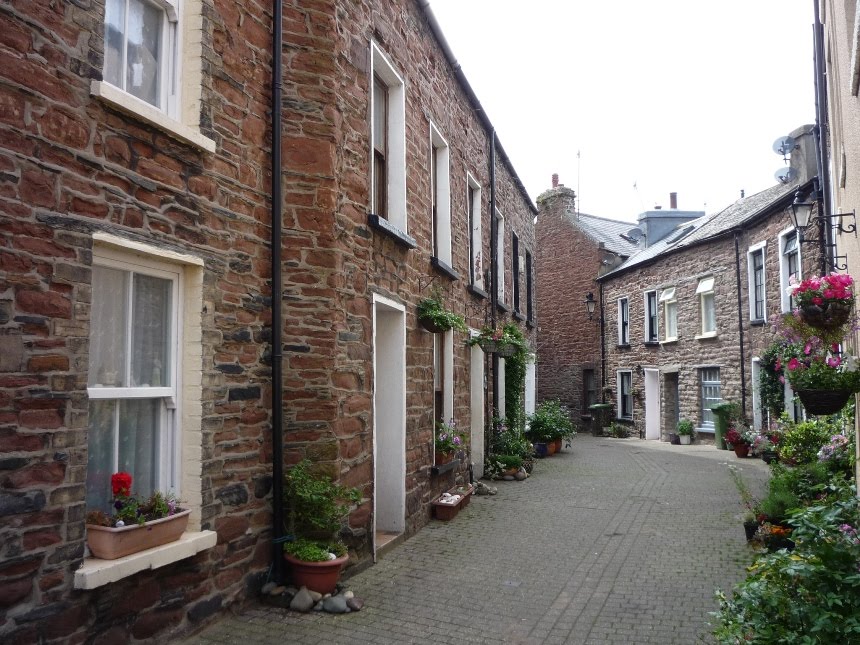
Peel streets and gardens

From there, it was back to Footprint to prepare for the next day’s hopefully sunny and mild, downwind journey to England.

Peel


Peel, the only city, but not the capital of the Isle of Man

[Kyle]It rained all night. It rained so hard it was all we could hear. Big drops, little drops, more big drops, it did this all night as if we were in Seattle in the winter. A little low on motivation, we finally ventured out around Noon. By then, the wind had picked up. It swirled around buildings in such a way that it made the flying spray come from every direction at once. This meant that even though we were both wearing the full offshore outfit, it was impossible to keep our faces, and more importantly, our glasses dry by turning away from it.

We ducked into the Isle of Man Heritage Museum, deposited a couple of gallons of rainwater each on the floor in front of the cashier and bought two tickets. The museum, like most British museums, was really well done. It covered the history of Mann, as the locals call it, from the early Celts all the way to the present day. One of the displays was a replica Viking ship that had actually been sailed to Mann from Norway by a joint Manx/Norwegian crew. The display showed a re-creation of a Viking landing and even had the detail of real water with a swell created by a wave machine. At other parts of the museum, smells were apparently piped in. The general store smelled like perfume, the fish smoker smelled like smoked fish and the fish cleaning room smelled like raw fish. They also had people in period costume explaining various things they were doing, like weaving and rope-making.


The Story of Mann museum and the traditional smoke house

The only downside was the videos. Actually, the videos, which were placed here and there within the exhibits, were pretty good, with action in Viking Norwegian and Manx Gaelic. The downside was the narrator, who was taking his role as God of the island a little too seriously. From him, we learned the proper pronunciation of the island: Talk to the person to whom you are speaking in a normal voice. As you approach the end of the sentence, make your voice louder and more forceful as you say, “The Island of…..”, then pause, turn your head ninety degrees, look toward the horizon majestically and in a deep, booming voice say, “MANN!” That’s the only way he ever said it. “They came to…….MANN!” They raised families and built towns on…….MANN!” “I just got a job narrating films on…….MANN!” It reminded me of the Middleton distillery tour where they claimed John Middleton single-handedly invented Western Civilization by opening a whiskey distillery in Ireland.

Actually, even though Mann is pretty much equidistant from Ireland, Scotland, England and Wales, the Manx accent sounds very Scottish to me.

We emerged from the museum to find the rain had stopped! What to do? I’ll tell you what; climb a hill, that’s what. We made tracks for a path out of town. Along the way, we passed by a kipper smokehouse and noticed the sign said the free tour was in two minutes, so in we went.


A walk! What a surprise

There was one guy working in the whole place. He seemed less than enthusiastic about dropping everything to give a tour, but then a bunch of other people showed up, so he knew he pretty much had to. In spite of the frequent interruptions to go ring up a sale at the shop, he actually gave a good tour once he started. The building smelled smoky and delicious. Like the others, that was enough to send us over to the shop for our own purchase.

We walked up to the top of the nearby hill and were rewarded with expansive views of the countryside, with Peel in the middle and the castle guarding the entrance to the harbour.

We descended into town and had another aimless amble until the errant raindrops started to grow closer together and more persistent. We ducked into a pub where we watched a quarter of the Uruguay/Germany match while sampling the local drinks. I had an O’Kell’s bitter, which was actually quite smooth and Maryanne had a Manx Spirit, a very respectably good whisky-like substance (apparently, they had lost a law suit and could not call it whisky, or whiskey).

Satisfied, we made it back to the boat before the wind and rain picked up again. No wonder the Isle of Man is so green.

[Maryanne]The Isle of Man has a strange status, and we've found it impossible to really determine if it is part of the United Kingdom or not? Apparently "true" Isle of Man natives are not entitled to a UK passport (unless they can prove a mainland link), but any UK citizen is allowed to have an Isle of Man passport. The IOM is NOT part of the EU, they use the pound but print their own money - so many differences, while feeling so "British". We called the UK immigration center to determine if we had to clear out of the UK to visit the Isle of Man (after several holds, they decided yes), we called the IOM immigration folks and asked the same question - did we need to clear IN to the IOM? - there answer was NO - what do you do? Everyone we ask gives a different answer. It's not surprising that we are confused as to the status, the locals are too. Kyle says the best answer he's had is they are British when it suits them.

It's mostly known as the home of the annual and internationally famous Tourist Trophy (TT) races - a motorbike race through the roads of the island. Also famous for the native Manx cat - the one with either no, or a very short stub of a tail. If you've heard of the Isle of Man at all, it is probably one of these two things. Our trip is confined to Peel, the only city but not the capital of the Island, but there is so much more to do, and if the weather had been kinder we no doubt would have seen more.

A Rough Passage

[Kyle]Everything started out all right. We left just after Midnight and hoisted the sails for a fast reach out of Belfast Lough. For the first time in a long while, we were sailing in the dark. So dark was it, in fact, under the thick overcast that it was impossible to see anything forward of the instruments. I kept having the unsettling thought that if there were a big tree adrift right in front of us, I’d never see it. We of course have done all of our long passages except to and from Norway with a significant amount of pitch-blackness, but it’s been a while and it takes a while to regain the faith that there’s probably nothing out there harder than jellyfish or seaweed – probably.

It started to rain, which increased the feeling of closeness by providing something to see out of the windows that was no further than their far surface. As we sped along the southern shore of the lough, Mew light came into view, marking the boundary with the Irish Sea. It was an impressive sight. Its four bright beams shot out into the rain and fog like searchlights. The light reflected brightly, creating an even greater contrast with the black night. As we got closer, the light got brighter and brighter until nothing could be seen but those four beams sweeping the sky like spokes on a giant wheel. I checked and rechecked our position to make sure we were as far away as we should be but without any other outside references, that light looked pretty close indeed. As we passed, I got a bit of an uneasy feeling when I realized I was looking up at the light and that I could make out individual panes in the glass. I couldn’t hear waves breaking. That was good. The depth sounder never went below 45 meters. I was glad to see that light fall astern.

Once into the Irish Sea, we hardened up on the wind and turned southeast bound. We were pointing pretty close to the Isle of Man, but the strong north setting ebb current made our actual track almost due east. My plan was to wait it out until the flood pushed us south, but it never materialized. By the time the tide started coming in, we were most of the way across to the Mull of Galloway in Scotland and were finding ourselves in a north-setting back eddy. A tack would have taken us right back toward Belfast – at least for a while. Even when we met with the south current, we would be still going well the wrong way, so we decided to pack it in and motor.

Motoring is not my favorite and motoring upwind into a steep chop is even worse. At our normal cruising rpm, we were making about three knots through the water, even less at times. The current took another half knot off of that. It was slow, miserable going and we both just wanted to get it over with. To compound this, we also had a deadline for our arrival that it was looking more and more like we were going to miss. Our destination, Peel Harbour, is only accessible within two hours of high tide, only one of which was during business hours. This would mean we would basically lose an entire day if we were late. As Peel was still the only suitable harbor for a long way, we pressed on, resigning ourselves to waiting on a mooring in the slop for a day.

When we got close enough, Maryanne phoned the harbour master and was told we could tie up at the sea wall used by the fishing fleet until they opened the water-retention flap for the harbour and swung the footbridge over it. Since the next high tide wasn’t too far out of business hours, they would have a special opening at 8pm. Great! We wouldn’t lose a day after all and would be able to wander around town while we waited for the tide.

Approaching the island, we could see nothing through the rain and mist until we were maybe a mile away. I had hoped the closer we got, the calmer it would get, but the seas wouldn’t die down. When we finally chugged past the protection of the breakwater, the seas flattened instantly, as if we had just gone from a rutted dirt road to fresh, new asphalt.


We could not enter until the tide was high enough to open the gate, in the mean time we get to wonder around Peel

We tied up, met the harbour master and had a brief wander around the perimeter of the castle and then into the town. What a pretty place Peel is! Like Lerwick in the Shetlands, it bustles out of proportion to its modest size. We wandered up and down narrow, winding streets and alleys lined with tidy houses freshly painted and sprouting flower boxes. We returned to Footprint for an early dinner and found the outer harbor quickly filling up with newly arrived boats, including two large Royal Navy boats. It seems others were more successful at arriving on time than we had been.

Word came over the radio that the bridge was now open and the flap was down. In the space of a few minutes, the outer harbor was empty and everybody was busily securing to their assigned berths. It was late and it had been a long trip over, so we called it a night right then and there.