
We had a brief orientation walk around the Malecon (waterfront) to get our bearings. At the end, we went into one of the many tour companies and booked ourselves a trip into the highlands for the afternoon.


The main town of Puerto Ayora is bustling and pleasant, full of restaurants and tour companies, and with plenty of sea lions and iguanas hanging with the tourists and locals
A 4WD taxi picked us up and drove us to Los Gemelos, a pair of 'craters', which are actually collapsed lava cavities. The whole area round Los Gemelos is Scalisia forest, one of the endemic tree types. Here, We got to see the first of many Galápagos finches. Honestly, they don't look like much – they're "little brown birds" (nearer to black) – but they are cool because they are the ones who got Charles Darwin started with his thoughts on evolution. One of the first finches we saw was the species that has adapted to use a stick to collect the grubs it feeds upon. It did a little demonstration for us.


Los Gemelos 'craters' in the cooler highlands, with a pleasant shaded loop trail to see them both (and the odd bird and giant tortoise!)
As we were returning to our awaiting taxi, we very nearly tripped over a big rock in the middle of the trail when it dodged us in an unexpected direction. Our first Giant Tortoise! It was just lying in the grass, half on/half off the path. You wouldn't expect something like that to just be wandering around in the wild, but then, of course you would! This is the Galápagos. That's what they do here.
From Los Gemelos (which translates to the twins), our driver then took us to El Chato II, a 'ranch', one of several in the area that are a popular hang out for more wild tortoises and is also home to a few accessible lava tunnels, where cooling rivers of lava contracted, leaving behind large air spaces as caves and tunnels. The land owners learned long ago that the tourism money is way easier than any actual ranch work. Here, we learned that tortoises can walk up to three miles per day as they graze the island. They can also go up to a year without food or water!


Giant tortoises at El Chato II Ranch


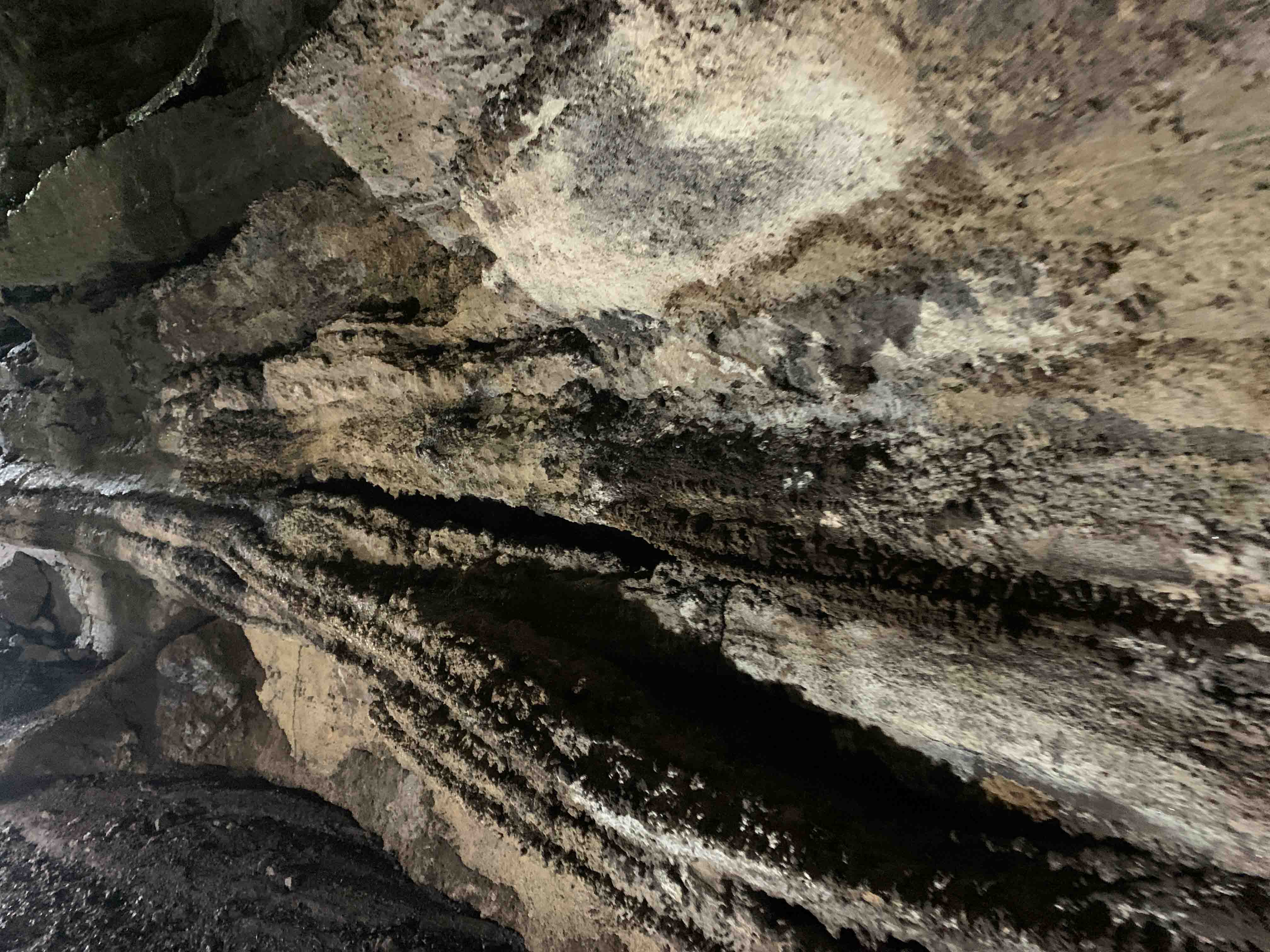


Lava tube/tunnels at El Chato II Ranch. These tubes form when flowing lava cools on the surface and solidifies (making a ceiling/roof), while the inner flowing lava drains out and ends up elsewhere
As we were driving back toward the main road, we were playing 'spot the tortoise' amongst the rocks in the fields, which were mostly tortoises after all, when I pointed out one near the side of the road. About a second later, our driver hit the brakes and announced, "Tortuga in problema."


Our taxi driver helps rescue one of the wild roaming tortises that was snagged on some low barbed-wire
Anyone who is not qualified as a ranger or guide is not supposed to get any closer to a tortoise than two meters and certainly not supposed to touch them. Like almost all locals, our taxi driver was also a qualified guide (I think the training may be part of the high school curriculum here).
Barbed wire fencing in the islands has a big gap between the ground and the lowest string in order to allow tortoises space to get under during their roaming. Our particular tortoise had the misfortune of trying to get under a string of barbed wire that was attached to a post that had fallen, leaving too small a gap. After unsuccessfully trying to lift the barbed wire out of the way while tickling the tortoise's tail to try to encourage it along, our driver deputized me to help him lift the tortoise and carry it to safety. That was pretty cool. They are very dense animals. That one may have weighed as much as I do. I doubt I could have lifted it myself from the position of one foot on the road, one in a muddy rut.
Back in Puerto Ayora, we completed our reconnaissance of the town with a visit to the Charles Darwin Research Station, where we were given a walking tour of the facility. The site acts as a nature preserve, interpretive center and botanic garden, but mostly is dedicated to raising young tortoises until they are sufficiently big to be reintroduced to the wild, which generally takes seven years or so.


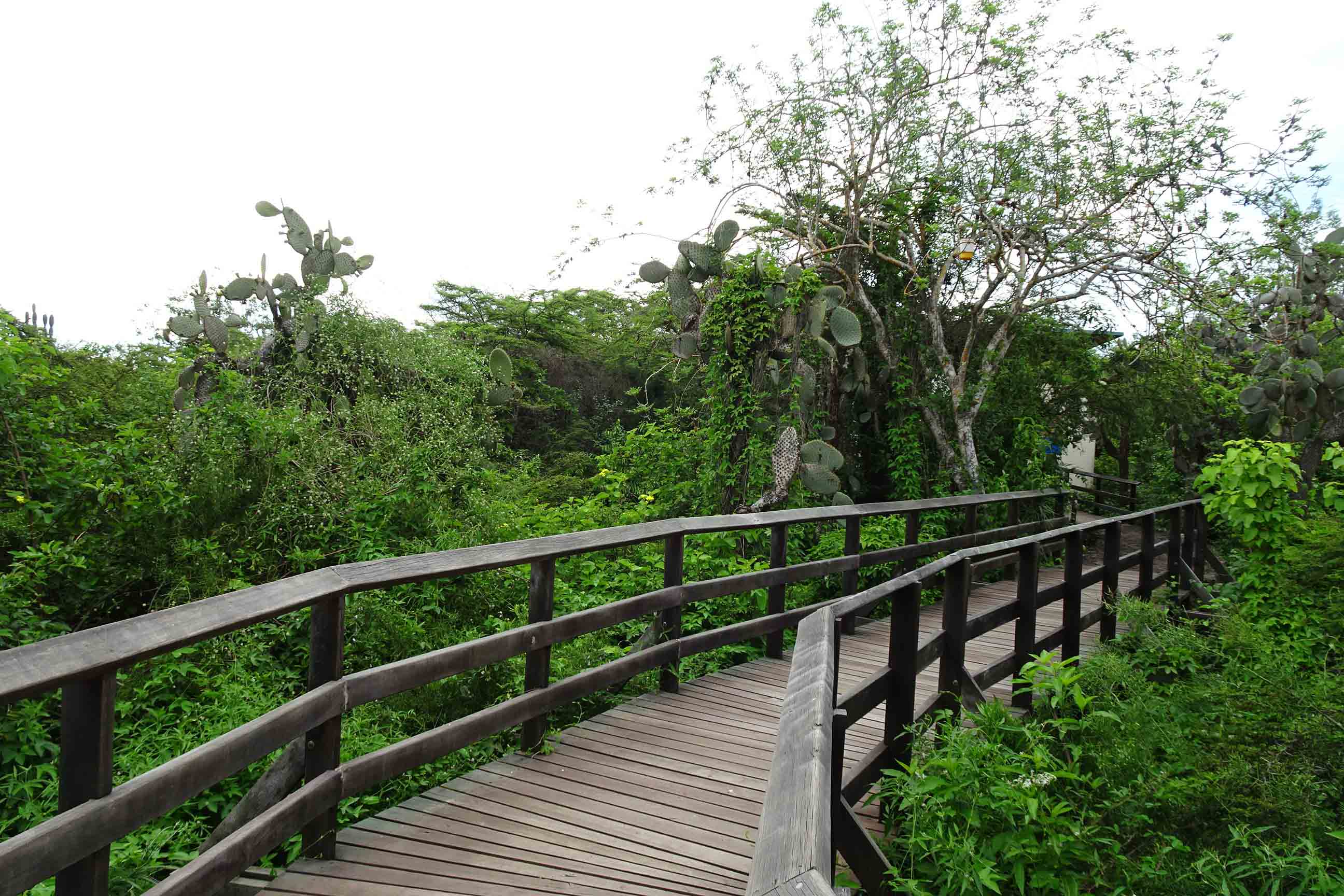


The Charles Darwin Research Station where various species of giant tortoise are hatched and protected until big enough to release back into the wild. Also more of Darwin's finches - I think the one in this picture is likely to be a Cactus finch, but to be honest they all look incredibly similar!
One tidbit from the tour that I thought was interesting was about the endemic Opuntia Cactus. Tortoises love to eat them, spines and all, so the cactus has evolved to grow a hard trunk, appearing bark-like just like a tree, keeping its sensitive bits high enough to be out of reach. The tortoises hang out below until the pads fall off naturally, which protects the plant above, but still gives the it the benefit of having its seeds spread by the roaming tortoises.
We then had a nice dinner on the way back to our water taxi home. A nice dinner is one of those things in the Galápagos that feels so surreal to me. I'm sure it's from watching countless nature documentaries that quite correctly expound upon what rare and scientifically important gems each island in the archipelago is. In my mind, even after being here the first time, I still expect the human part of the Galápagos to be primarily occupied by austere structures that are all about function over form, like scientific research stations in Antarctica. In fact, the 10% or so of the islands that aren't protected areas are what seems to me to be to be unusually nice.
It makes sense of course. People DO live here, some for their entire lives. Also, not everyone who has saved up for the big trip to the Galápagos might be that keen on sharing a bunkroom in a converted shipping container when, percentagewise, a little bit more will get them a private room in a boutique hotel that has an infinity pool overlooking the water. Puerto Ayora has plenty of these, as well as high-end art shops, cafés, a couple of microbreweries, rooftop bars and dozens of really good restaurants. If it weren't for the giant, undeveloped, amazing natural areas outside of the human settlements, this place could easily be mistaken for the Mediterranean or any other place in the world in a hot climate where the best thing to do is hang out at an open-air bistro all day and watch the world go by. Note also that we didn't spot a single chain restaurant or hotel in our whole time in the Galapagos (there must be some rule), and that made things even more agreeable.


Dining out was quite the adventure!
Doing that here would, of course, be a huge waste of both time and money. That's why Puerto Ayora is so quiet between the rush hours of just after dawn and just before sunset. Most visitors are out on a tour, as were we bright and early the next morning.


Normally Kyle and I would sail to such places and enjoy them at our own pace, in the Galapagos such things are illegal - so we joined the crowds and partook in a paid tour provided with a local boat and an official Galapagos tour guide
We presented ourselves at the pier in the orange light of the new day and were then led by our guide to the minibus that was to take us over the island to our waiting tour boat. There, we were handed life jackets, not so much for our benefit as the Armada observer who was there to make sure our fifteen second transit in the inflatable tender to the main boat (through waist-deep water) was executed in accordance with all relevant maritime regulations. Once we were aboard, the jackets were all stowed away until the even shorter transfer at the far end of the day. Then we were off to the island of Bartholomé, about two hours northwest of Santa Cruz.
Bartholomé is a small island off the much bigger island of San Salvador. Our first order of business there was to climb to the viewpoint at the top to observe the surrounding scenery. The island is young and volcanic and has only the barest covering of the various varieties of colonizer plants, whose seeds arrived with the wind once the island cooled.
The change from the boat ride was stark. Previously, we had been sitting in the shade in an engine-generated breeze on a 35˚C sea that was mostly absorbing the near-overhead sunshine. Now, a dozen steps into our shore excursion, we were surrounded by dark-colored rocks that absorbed the shadeless heat and then re-radiated it around us at 60˚C. It was pretty brutal.


It was a LONG boat ride (but much faster than we would have made it!), with some obvious volcanic scenery along the way and as we approached Bartholomé (oh, and more birds, this picture being a Frigatebird; they don't have waterproof feathers so mostly get their food by harrassing other birds to give theirs up).
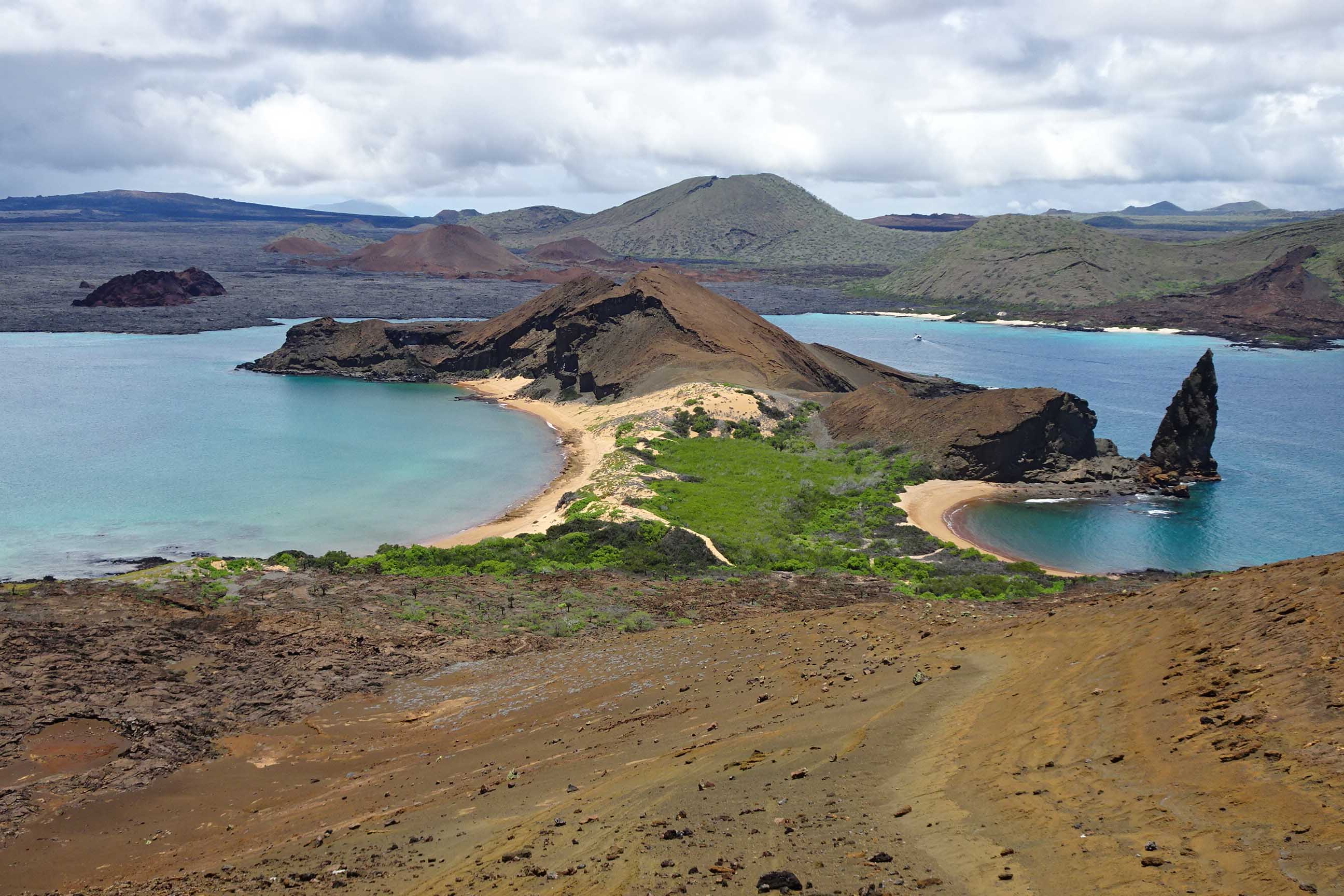


This beautiful view once atop the hill on Bartholomé Island is in many of the guide books. The island itself a reminder of the relatively 'new' state of the islands (just a handful of millions of years, and some areas still actively growing. Bartholomé is thought to be about 1.5-2 million years old). Despite the relentless heat and lack of soil, patches of various plant and lichens are to be found
It was about that time that Maryanne and I noticed that we seemed to be among the youngest, and possibly fittest, guests in the crowd. This initially seemed like a welcome thing, because we could maintain an easy uphill pace without beating ourselves up in an unconscious attempt to not look out of shape. This also meant the we ended up spending a lot more time in the big oven than we might otherwise have, while we waited for those with mobility issues to recover enough for their next push. With everyone pitching in where they could, the whole group was rewarded with the absolutely amazing views from the top. Everyone agreed it was worth the effort, then also agreed that we were all ready to go back.
Back at the boat, we went a short distance, snorkel gear was passed out, and we all dove in. Wow, what a relief being in lukewarm water is. We all instantly felt new again.
The snorkel did not turn out to be too interesting. It was primarily billed as a time-filler before lunch. The good snorkel would be later, you will all love it. Our guide was very nice, with plenty of enthusiasm, but seemed to be stretching a bit by pointing out things like a lone sea cucumber on an otherwise featureless patch of sand as a find. Well, I guess if you've never seen a sea cucumber in person before... Still, it was nice to get wet.


The snorkel was a welcome relief from the heat
Back on the boat, everyone was surprised to find a previously unseen crew member milling about. It turned out he was the chef and he had been busy in the boat's tiny little galley the whole time. The food was all excellent. Several of the other guests who had been on other tours assured us this was not typical, with more normal offerings being things like bologna sandwiches and a bag of chips.


We were well looked after aboard the boat, they even had Starlink for superfast Wifi!
Things got a bit confusing after lunch when our boat started speeding smartly back in the direction of Santa Cruz. Maryanne asked about this and was told that, unfortunately, since we had lost so much time on the hike, we were going to have to skip the last, good, snorkeling stop that she had especially been looking forward to doing.
In order to keep their impact on the environment down, all local boats are given strict, staggered time windows at various places. Our window was closing and the next set of overnight tour boats was approaching. We now wished we hadn't taken all of the, "take all your time, it's not a race" advice so much to heart on the hike. Anyway, it was a lovely day and we ended up being worn out enough by the end to be happy to give another of Puerto Aroya's fine restaurants our custom, rather than having to do the work ourselves at home.
We intended to make our next day on Santa Cruz an easy, local one. It didn't work out that way, of course. Our first big mistake was to sleep in a little. That meant that by the time our water taxi delivered us to the waterfront, the sun was way above the horizon and getting higher. It was then that we started our short walk to the local beach, Tortuga Bay. The beach, while practically visible from Begonia's anchorage, is not actually that close to town. Instead, it is accessed by about a two-and-a-half mile walk on a concrete trail through the Opuntia forest. Opuntia is beautiful, but it offers little in the way of shade against a vertical sun. By the time we made it to the water, we were dying to dive in and submerge ourselves, hiding from our heat bubbles as if they were a swarm of angry bees.
Aaaahh! That's better!


Tortoga Bay has a beautiful long sandy beach and as we walked to the snorkel area beyond, we passed a LOT of marine Iguana, many making the same treck


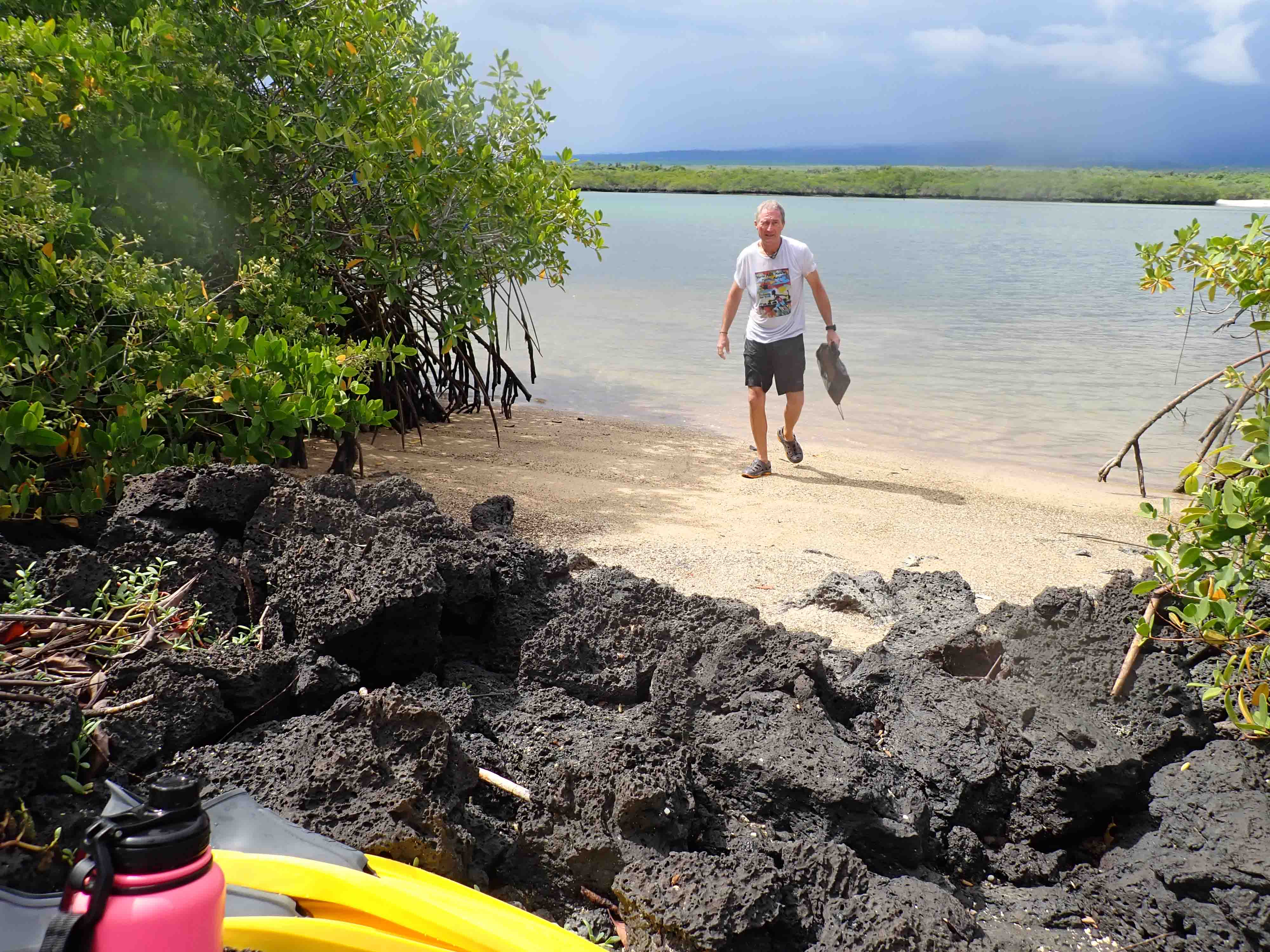

The snorkelling in the lagoon beyond was a little murky, but fun. On exiting the water we took a stroll among the "Prickly Pear" cactus (Opuntia Cactus on the point between the beach and the lagoon
We only saw a few turtles at Tortuga Bay (Spanish uses the same word, Tortuga, to mean sea turtles or land tortoises), but the most numerous local fauna there are the marine iguanas. It's cool to be strolling along the beach amongst iguanas who are doing the same thing. You don't see that anywhere else.
Further along, we crossed a small isthmus to a more protected bay, ringed by mangroves. We reentered the water to have a look around and were lucky enough to have several iguanas swim either with, or past us on their foraging. You don't see that anywhere else.
We made sure we were dripping wet for the start of our walk back to Puerto Ayora. That way, the sun could expend its heat on evaporation instead of heating us up. It worked out pretty well. By the time we made it back to town, we were only the slightest bit damp, comfortable, and ready for a sit-down dinner. Also, look at that! Happy Hour signs seem to be appearing on sandwich boards on the sidewalk.
Our next day we spent aboard as a chore day. We replaced our spent fuel from the passage, plus what we figured we would need for our subsequent inter-island motoring. The trash panga came to collect our garbage and recycling. Also, we had been letting the clutter pile up a bit in our rush to get out and see everything. It was nice to put Begonia back into a presentable state, even if it was just for our own benefit.
{Note: All the islands in the Galapagos have multiple names, each from the different stages of ownerships and history. Santa Cruz is also known as Indefatigable Island, San Clemente Island, Bolivia Island, Chavez Island}
Anchorage location >> On google maps


