Wednesday, June 14, 2017

Tuamotus: Makemo Atoll

[Kyle]Given tides, daylight hours, and slack water, this passage can only realistically be started within a window of 1 hour on our departure date from Raroia. Surprisingly, 5 other boats also left Raroia at the same time and were making the passage to Makemo – so we all set off in a little clump of boats sailing in a cluster through the night.

The weather was such that, as soon as we cleared the pass, five of us deployed our spinnakers. Race Day in the middle of nowhere.

The spinnakers had us all going too fast, so as to arrive too early for slack the next morning. Most of the other boats went for average speed and took down their spinnakers at nightfall. Hedging against any wind decrease later on, we left ours up until midnight. By morning, we had left the crowd and sailed over the horizon.

When we had just under ten miles to go, I started reducing sail bit by bit until we were down to bare poles again. One by one, the crowd came up behind us and at sunrise, we all went through the pass again en masse. Actually, we ended up being the last one in line.


Sail to Makemo and into the pass

On the inside of the pass, the others turned into the anchorage at the adjacent village. We considered the same, as it was a lovely little village AND the supply ship was there, which would have meant fresh vegetables! We figured the village would be crowded enough with everybody else, so we shut down our engines, unrolled just a tiny amount of sail and continued on. The sun wasn’t high enough in the sky for optimal bommie spotting, so we wanted to be moving at a crawl until it was. Our plan was to go deeper into the atoll and anchor off one of the areas of palm fringed beauty – going solo, we had another 5 hours of sailing through the atoll to get to our anchorage. We spent that time dodging coral heads and mini reefs, pinching our selves at how lucky we were, and enjoying first the juice and then the flesh of our last coconut. Ahhhh… Lovely!

When we got to our anchorage, we were surprised and to find it deserted. There was a long, curving beach dotted with coral heads. With a little effort, we were able to deploy our anchor on a sandy shelf, off the edge of which our chain fell down to the depths before leaving the sand and curving upwards towards Begonia as she rested above a bommie.


Our first day

First order of business was to report our safe arrival and position and get the latest weather forecast. We get a great French forecast that has been run through a translator program and converted into English.. today’s forecast had the charming phrase “The sun be imposed on all archipelago Wednesday.” We think that is good news… and is probably how our French sounds to the locals… LOL

After verifying we were safely at anchor , we set off to snorkel around the few bommies (isolated coral heads) between us and the beach. WOW! there were lots of fish jetting off in all directions. One of the schools of sand-colored fish parted to go around us and we got a glimpse of the first shark. As we continued on, we saw a pair and then another pair. Eventually, we had six all around us. They are amazing to watch with their iridescent skin and the effortless way they move.


Snorkelling with Sharks

One big one – maybe six or seven feet long – was clearly getting annoyed at a bunch of remoras trying to attach themselves. He was darting through holes and sprinting away in an attempt to “scrape” them off. As he became more agitated, his mood spread to the others and then he started looking annoyed at Maryanne for being in the way as he darted by just a little too close. Time to go!

We had expected the others to be spending the morning in the village and then heading to us in the afternoon. As the sunset approached, we realized they had stayed behind and the whole scene was ours. Lovely. Our own private tropical beach! Later, when it got dark, I went outside. Apart from the stars and our anchor light, there were no lights of any kind; no street lamps, no porch lights, no campfires, not even any lighted buoys. It was magnificent isolation.

Day 2 – We were up early and made a plan to spend the whole day snorkeling, starting with a walk to the end of the beach before swimming a mile-long reef jutting into the atoll. We had just started the meandering trip home when I spotted the first mast on the horizon. Soon after, four spinnakers appeared. It was going to get crowded!

By the time we got back to Begonia, the first boat, a Dutch couple with a Swiss guest, was just setting anchor. Then, one by one, the group from the day before arrived. The character of the place was much changed. Now our desert island anchorage took on the atmosphere of the French Polynesian Boat Rally. We didn’t mind. They are all really nice people. Even No Thanks appears friendly, just not to us. We’d had the place to ourselves already and it was nice to see some boaty busyness for entertainment. We have bumped into this group several times since the Marquesas and they always seem to travel as a fleet. That would be a bit much for the independent streak in me. It’s nice sometimes to go to an anchorage that’s not full or to not have to coordinate every shore excursion.


Snorkelling is so nice here - and the views above water are pretty amazing too

The next morning, which we had planned to do then before we even got there, we pulled up anchor for a quick trip across the lagoon to a spot a little closer to the west pass for the subsequent day’s exit. We planned to find a sandy spot behind a reef and do some more snorkeling before getting to bed early.

When we got to our spot, we found only tiny patches of sand with lots of coral. We moved to our second choice and found the same. It was also the same at our third. We decided to give up on our plan and head to the anchorages adjacent the pass.

When we got to the first of these, we found the same thing. We moved to the anchorage on the other side and still could not find a clear spot. At one in deep water that seemed marginal, we lowered the anchor and immediately got it snagged in coral in the unseen depths. Yike!

We returned to the first and after much searching, found a place with even depths on a bottom we couldn’t see too well. We dropped the anchor and it held.

Once the checklist was done, I donned mask and fins and jumped in to survey the situation. When the bubbles from my entry cleared, I was horrified. My stomach would have jumped into my throat, but with the buoyancy and being in the southern hemisphere, it went some other direction. What I saw was the Manhattan skyline in dead coral heads for as far as I could see. Coral heads three to eight feet tall were separated by little six-inch patches of sand. Our anchor was on one of these, upside down lying under a small pile of chain. The rest of our chain was draped over others like Silly String.

Knowing we at least wouldn’t drag, I started an outwardly spiraling search for any suitable patch of sand within a mile. I found one that was barely big enough and carefully tried to take bearings off various landmarks to figure out how we would get there and then swam the route to make sure it was deep enough.

On the way back to Begonia, I realized it was way too late in the day to move. The low sun made it hard to see the coral and I knew getting the anchor up was going to take a long time.

When I got home, I focused my energy on trying to mitigate our situation. I started by turning our anchor over and paying out the pile of chain in the hopes that we would be able to pull it all straight up without snagging anything. I then made several more descents, making my way along the chain, pulling it out from under overhangs and laying it on top. This was really difficult as it was just below ten meters, which is about my limit in salt water. When I got there, I only had about five seconds worth of exertion before I needed to be heading for the surface. Sometimes, I would be almost done with a task and push it for another five seconds, which made the ascent desperate. While I was down there, the need for air meant I had to work as fast as I could while exerting myself as little as possible. Oh, and concentrate on my whole body at once because getting a fin caught on something while fixating on what I was doing with my hands would be really bad. A couple of times, I was bracing myself against a coral head with my feet above me while my back was in the sand.

Once I had done that, since there was no way we were going to drag, I went about cranking up the excess chain since it was just more to snag. I did this manually so I could do it slowly and feel what was going on. When something got irrecoverably stuck, I would dive back in and start muscling chain again. After going through this cycle three or four times I got to where I was almost not freaking out. Maryanne set up a couple of our big spherical fenders as floats and I swam them out as far as I could, lifting the chain with one arm and fighting the buoyancy of the float with the other until I could clip them together. This floated the chain above the nastiest looking obstruction. When we were done, we had only enough chain to hold us down, plus the floating portion to absorb any shocks.

When I finally got out of the water for the last time, the last of the light was disappearing from the sky. What was supposed to have been our easy day of fun had left us both physically and emotionally exhausted. All we had time for was a quick dinner and then we fell into a fitful sleep.

NEXT DAY

I had trouble staying asleep because I was anticipating lots of trouble getting the anchor up. Slack water at the pass was at 8:45 and we needed time to do all of our usual prep, plus a couple of dives, PLUS time to get to the actual pass. At 4:00, I finally gave up and got out of bed.

Much to both of our delight, our anchor and chain came up with only a minimal fuss. There were couple of spots where we had to go left or right to free the chain and Maryanne had to work the anchor up and down a little to free it. Mercifully, it didn’t end up being necessary to get wet.

Our (new – grr!) underwater camera had started playing up and would no longer reliably transfer photos to our computer via the provided data cable. While we were in Taiohae, Maryanne was able to download an app that would allow us to transfer them to her iPhone wirelessly as a workaround. Then she would transfer them from her phone to the computer. One of the cool things the app will let us do is view on the iPhone what the camera is seeing. She mounted the camera at the edge of the trampoline right above the bow roller. This made it easy for me back at the helm to see which way the chain was pulling and thus which way I needed to steer the boat to relieve the tension. Thus, she was able to pull up the chain without getting it wrapped around something new.


Our track looking for someplace to anchor, and then the remote cam setup to view the chain from the helm.

We were ahead of schedule, so we decided to try the pass anyway. It was impossible to see any bommies into the glare of the rising sun, but since we had zig-zagged all over the area looking for a decent spot to anchor the day before, I was able to follow our track until we were safely in the channel.

We got out into the open sea with only a little turbulence and were soon able to shut down the engines, turn downwind to our next island and deploy the spinnaker. It was barely after sunrise and already the day was WAY better.

A few hours later, we heard a member of the FPBR talking to one of the others about anchoring near the pass. We got on the radio and told them what we had seen. They all decided to keep on going if they too found it difficult. For the life of us, we can’t figure out why that spot is labeled as “Anchorage”.

{Maryanne: No doubt we'll now hear from 100 other folks that found plenty of sand to anchor in and were just fine... Please don't rush to tell us if that is you}

Sunday, June 11, 2017

Tuamotus: Raroia Atoll

[Kyle]Once inside the lagoon at Raroia, we were alert to the vast uncharted areas and the need for eyeball navigation. We had done this in a few places before where a six-foot bottom is peppered with four-foot coral heads only a few boat widths apart. Raroia’s lagoon was 40 meters deep and the big coral bommies were about a quarter mile apart. The turquoise and lime green patches were easy to spot in contrast to the dark blue of the deep water once we were within a mile of one.


The middle of our first Atoll: Raroia

We sailed for the thin green horizon at the other side. After an hour, we approached several little islets (called motus) with white sand beaches, waving palm trees and a fringe of water of that impossible tropical blue. We looked around for a while and eventually settled on a sandy spot right in front of one of them. We were the only boat there. Holeee Cow! Welcome to Paradise! We have GOT to go snorkeling!


We saw all kinds of cool stuff. First, that our anchor was buried in the sand and nowhere near any coral. Then we went to the coral and were treated to a huge variety of colorful fish living in the perfect 3D landscape of coral for hide and seek. Embedded in the coral were also lots of clams, each with scalloped lips in a variety of sparkly florescent colors. We also saw a couple of reef sharks, which explains the hide and seek.

We swam to the motu to circumnavigate it on foot and to get a glimpse of the crashing breakers outside the atoll. We wanted to go to the next one to have a look at it. As I mentioned before, water is always flowing into the windward side of the atoll, so the little channels between the motus are fast flowing rivers. This made for some big fun. To cross, we walked as far upstream as we could, dove in and swam to the other side. As we did, the current grabbed hold of us and took us downstream ten times as far as we swam, zinging us past coral heads filled with fish that, unlike us, were having no trouble staying in place against the stream. We would climb ashore on the next motu at the downstream side and cross over to the opposite upstream side to repeat our motu hop.

As we were finishing up our fun in the last of the light, three other boats came in and anchored near us. One was from Norway and TWO from Belgium. Each of them later admitted that that’s the first time that’s happened to them since leaving home.

2nd day – We spent most of the day going for beach walks and drift snorkeling. On our swim back to the boat we were called over by a fellow cruiser (Belgium) and invited board for a cup of tea and a coconut. Dreis gave us a lesson on how to open one more effectively than our smash-it-open-with-a-hammer-and-go-scurrying-for-the-pieces method.


Memories of Raroia

3rd Day - In our last morning, the Norwegian couple swung by in their dingy and said they were off to see the Kon Tiki monument which was just a short trip in their fast dinghy– so we joined them. Kon Tiki was a raft built using traditional methods by the explorer Thor Heyerdahl. It’s purpose was to demonstrate that it would have been feasible for the ancestors of the Polynesians to have migrated to the islands on similar craft. He and his crew of three managed to cross huge sections of the Pacific before finding themselves windward of Rarioa without the maneuverability to go around. The Motu where Kon Tiki ran aground and broke up in 1947 now has a small monument erected on the 60th anniversary of the grounding by Olaf Heyerdahl, Thor’s grandson, and others. Our new Norwegian friends were especially happy to be there because Kon Tiki had also flown the Norwegian flag. They left their tattered one in tribute along with various other little mementos left by some other boats. It was in such a condition, I wouldn’t be surprised if subsequent visitors think it was the very flag off Kon Tiki herself.

Just before we left Rick from the other Belgium boat swung by to say hi, too… Yes – two Belgium boats in the same anchorage – and only one American boat – that doesn't happen so often!

Friday, June 09, 2017

Passage to Tuamotus (Raroia)

[Kyle]We departed the Marquesas a little earlier than planned to coordinate with a Pickles, who was also departing this morning as they were concerned our anchor chains may be crossed. Just before we both left, they picked Maryanne up for a last trip into town for eggs, which had hit all of the stores in town between 7:00 and 7:30. We also have fresh baguettes to keep us happy.


We decided to pass on the windward side of Ua Pou in order to both avoid its wind shadow and to give us a better wind angle for the passage. We still ended up with very light winds by the island and a big swell rolling us around from the side. Once we cleared the island, we headed about 10° upwind of our course as a hedge against unwanted wind shifts. This started as a pretty uncomfortable crosswind sail, but gradually improved as we curved more and more away from the wind and seas toward our destination.

The sailing was the fastest we have done since leaving Hawai’i and we found ourselves making it comfortably in three days rather than the four we had originally planned.

In the wee hours of the last morning, we passed behind Takumi atoll and the seas went nice and flat. To keep from arriving too early, I kept reducing sail until we were down to bare poles. It was whisper quiet with just the tiniest bit of motion. Maryanne finally got the decent night’s sleep she had been missing in the rougher seas of the previous nights.

At the appointed time for slack water, we entered the pass and found it definitely not slack. The high winds and seas of the last few days had been spilling more than the usual amount of water into the windward side of the atoll. This raises the water level and delays slack water by an hour or two. We decided to give it a try anyway and if we couldn’t fight the ebb to come back later. We were pushing against an 18 knot headwind, which made us just barely able to overcome the 4.2 knot outflow. Whew! Our first atoll!

Tuesday, June 06, 2017

Ua Pou Island - Hakahau bay (Marquesas)

[Kyle]Our last stop in the Marquesas was in Hakahau, on the island of Ua Pou. Hakahau is the main population center on the island, with just over 1000 residents. In spite of this designation, their harbor is not nearly a capacious as Taiohae. Our various guides hinted that there were places where two anchors would be necessary but, like Atuona on Hiva Oa, if we were willing to put up with a longer dinghy ride, we could settle for one if we liked.


Beautiful Ua Pou proved a little frustrating at anchor

It was a short, fast, rough sail. Not being fans of the two-anchor kerfuffle, we planned to use one anchor and break out the motor for the dinghy if necessary. When we got there, however, we found our choice to be between full exposure to the open sea, just outside the gnashing rocks of the breakwater, or tucked inside in relative calm, squeezed safely between two other boats, each on two anchors.

Damn! We hastily dug out our stern anchor and, after setting the bow anchor, went about going through the rigmarole of deploying it. As we went to pull it in, it dragged. The wind was blowing from our right, so we started to swing toward the boat to our left (Pickles). Our bow anchor was doing its job of keeping us straight, so it was quite a struggle to turn Begonia sideways so I could use the engines to back her away from them. A couple of times, it seemed we would hit, but we just managed to avoid it before crawling away. To their credit, the occupants seemed neither annoyed or concerned about any of this.

After a second attempt, Maryanne got our dinghy lowered in record time, with the plan of using it to deploy the stern anchor. As she was getting in, a couple of guys from the boat to our right (Calagorm) arrived in their inflatable asking if we could use some help, which by then was rhetorical. She gratefully said yes and jumped back aboard Begonia to give them our anchor and rode to deploy.

They took it a looong way and dropped it. It held, everybody went for home to relax and then it dragged again.

I went to put the starboard engine in forward and the port engine in reverse to repeat the procedure of turning Begonia bow to the left so I could back away from Pickles on that side. When I did this, the starboard engine strained. I managed to get it out of gear before it died. When Maryanne got out of the dinghy in her haste to hand over our stern anchor, she left the painter long and it had wrapped around the prop. She also dropped her hat overboard, which I was just able to reach. We were really not looking good at this.

I went for my backup plan of putting the port engine in forward to turn and push us forward and right. When I did this, it DIDN’T GO INTO GEAR! I went for reverse and that worked on the second try – I think. It didn’t seem to be developing enough thrust to overcome the wind.

Maryanne grabbed a mask and snorkel and jumped in fully clothed to unwrap the painter so I could have use of the starboard propeller. Once she did, we were so close to our neighbors that I had to put it into gear before she even got out of the water.

She took over the helm and I jumped into the dinghy to once again row out the stern anchor. When I reached the end of the rode, I saw she was getting really close to Pickles so, instead of dropping the anchor, I grabbed it with my legs and started rowing like crazy to pull Begonia away (The other end of the line was cleated to Begonia). Slowly, and with great effort, she pulled away. I thought, “woo, hoo! I can’t believe that worked!” Back on Begonia, as Maryanne was struggling to keep us away from, and using typical British understatement, said to them, “You may want to get out a few fenders”. In response, they put out a big fender – their teenage son in their dinghy. While I was rowing away being impressed by my amazing and unexpected strength, he was on the other side out of sight, using their dinghy as a tug to push Begonia away. Calagorm came out again in their dinghy, towed me to my desired spot and I dropped the anchor. I thanked them and returned to Begonia. We cranked everything up so both anchor rodes were nice and tight and we were comfortably far from anybody. We had made a huge mess of the boat and had a lot of tidying up to do, which we were both too tired to face. When we were done, Maryanne went on a Thank You tour while I opened up the transmission to see what had happened.

It was the same failure that had beset us in México. My brilliant Bolt Solution had not been so brilliant after all. Luckily, we had bought not one, but two complete shifter assemblies, PLUS, not one, but two more of the taper pins (giving us four) that were actually needed (they are hardened and way stronger than my stupid stainless steel bolt it turns out). Tomorrow, instead of sightseeing, I would be cracking open the port transmission – again!

We felt like complete greenhorns. We were terribly embarrassed. I explained to our neighbors that we had actually been sailing for a long time, but this is the first time we ever tried to stop. Both of them were extremely gracious and understanding and said they were happy to be of help. Calagorm, the traditional catamaran to our right, tried to make us feel better by admitting that they had also had trouble setting their stern anchor in the fine sand.

We slept fitfully that night, feeling like heels and in such close proximity to the other boats. Every time the wind would gust, we’d rush out to check we weren’t dragging. At about 0130, I was awake fretting about the wind when it picked up again. Maryanne picked up her phone to see if we were dragging . It turns out she had been up too. We were holding as usual and then we suddenly were not. We leapt out of bed to find ourselves closing on Pickles again. I started the engines and then went aft to go pull on our stern anchor rode, hoping it would reset. It didn’t. Instead, I pulled the whole thing back to Begonia with what I swear is less effort than if I had laid the thing out on a sidewalk and done the same thing. I don’t get it. Our stern anchor is big, heavy and unwieldy. It should have had no problem with this.

We were getting alarmingly close to the other boat. In preparation for the next day’s repair, I had disconnected the port shifter cable. That left us with the starboard engine, which could propel us forward and left or back and left. The wind was already pushing us left. Left was bad – really bad.

Our forward rode ended just far enough to keep our bow from hitting their boat. With judicious power and lots of left rudder, I was able to keep our stern from touching. Maryanne strained our poor windlass pulling up the anchor, since there was no way to shorten our rode enough to keep us away from the other boats and not have it drag.

We were faced with having to put out to a rough sea with one functioning engine, which would no doubt make the transmission repair more difficult. Knowing first hand the consequences of not doing so when going to sea would still be the safest option, we eyed up the harbor again.

We picked the one and only spot in the whole harbor that allowed us to put out ALL of our rode on one anchor and still give is 30m from hitting the other boats, the breakwater or the alarming surf behind. We dropped anchor and backed down with full power on the good engine to make sure it was set. I never use full power. It held. I decided that if somebody else showed up, they would have to go around us, ‘cause we are done with two anchors! We went in to resume our fitful night’s sleep.

I am so good at taking apart transmissions now that I had the thing fixed in an hour the next day. When I went to start the engine to verify that everything works, it wouldn’t start. I spent the rest of the day tracking down a bad connection to the solenoid. It’s always something! The others dinghied over and we explained how we ended up where we were and reassured them Begonia was back to full working order. Even so, I think they were glad to have some extra distance from us. The winds were pretty fresh, so we decided to stay aboard the rest of the day just to be 100% certain we would not drag.


Beatiful Church with absolutely amazing flower displays

We didn’t, and the next day was calmer, clear and sunny so we rowed ashore in the hopes of getting some of the provisions we couldn’t find in Taiohae. We found the same problems there with the signage, only worse. Not only did the streets have no names, most of the stores hadn’t bothered either. If you live there, you just know the bakery is the orange house. We asked around and the friendly people made sure we found the right places. The stores did have a little more to offer, so we loaded up our packs once again.

We repeated the same ancillary tourism style we had practiced in Taiohae. The best thing we found was the church, with its beautiful varnished wood carvings and its elaborate tropical bouquets. In our subsequent wanderings looking for the path back to the harbor, we came upon a dead end in the road as it turned into someone’s driveway.


Beautiful people and sights in Ua Pou - wonderful memories

An older man, looking over three boys asked where we were going. We told him and he said we would have to go back the way we came. We apologized, introduced ourselves and started to leave. This had the usual effect. He invited us into the yard and told the boys to take me to find some pamplemouse for the visitors. Maryanne stayed behind and chatted as best she could with him in French. When I returned, he handed her a bowling ball-sized squash to take. Oh, boy! That guy’s house was about as far as we got from the boat. By the time we got there, the gifts and the groceries felt like I had the whole dinghy in my pack.

Nonetheless, Hakahau is a beautiful, placid little town overlooked by the most sublime towering spires from way up in the clouds. It’s too bad we are certain never to return to its accursed little harbor.

Saturday, June 03, 2017

Taiohae (Capital town of) Marquesas on Nuku Hiva

[Kyle]Taiohae is the largest city in the Marquesas and as such, bustled with all of the activity of a vibrant capital. I’m kidding, of course. Taiohae occupies the hills along the beautiful curve of Nuku Hiva’s largest harbor. A twenty-minute walk will get you from one side to the other in a vain search for many of the things the city does not have, like road signs or traffic lights. I guess if you live there and have a car, you know where to stop.

We planned to do some light provisioning, but the main thing we were looking forward to was getting some stuff done on the internet. We bought a data sim card in Atuona, which allows us to have very slow internet on one of our phones (no voice), but we have very little data, so we can’t do anything too serious like look anything up or check our bank balance. We do know we are getting emails and sometimes we can even get a response out, but browsing the news ain’t gonna happen. Only the centers of the bigger villages on an island even have cell service, so most of the time, we’re completely in the dark. Taiohae not only has cell phone towers, but also a few wifi providers, at whom we were ready to gladly throw a few francs to be able to get something done.


Taiohae in mixed weather

We had had a terrible, wet, but mercifully short bash upwind from Hakatea and were glad to enter the relative calm of Taiohae bay. It was actually pretty swelly in there, but it was way nicer than the open sea behind us. We motored past the thirty or so boats laying at anchor and set ours as close as we could to the harbor wall right at the front. Inside were a few small local fishing boats tied bow-to along one wall and the dinghies of all of the anchored cruising boats on the other. Just on the other side of a small parking lot, a handful of shops sat behind two big open-sided circus tents, under which sat a bunch of picnic tables. It was at the biggest of these where a crowd of people sat hunched over their laptops outside Snack Veaki. They would give you the code for their wifi if you would just buy something, which you were going to do because their internet was so slow you were going to be there for hours and you were going to get hungry. Maryanne spent ten hours there the first day and six hours the next getting about an hour’s worth of important stuff done. While she was doing this, I bought cooking gas and diesel, cleaned the boat and then took the dinghy over to stare at her while trying my best not to say, “How much longer?” too often.


It rained a lot! Here is Slater making use of an umbrella in the rain to perservere with the slow internet.
And we had a lot of chores (we finally found the hardware store!)

Snack Veaki has no indoor space, so when it rained, which was ten minutes out of every twenty, people started hiding under tables and stuffing their laptops in their shirts to keep them dry. Maryanne just popped open her umbrella, laid it on the table in the direction of the rain and kept typing, which was mostly waiting to type. Over time, the umbrella was extended with coats and plastic bags, making space for others and making her look like somebody important at some kind of strange, low tech, Third World Mission Control.

There was still loads more we needed to do on the internet, but we just couldn’t take sitting there any longer. With most of the important stuff done, we finally pulled ourselves away to explore the town. Unlike standard walking tours that take you from place to place of cultural or historic interest, ours was directed by our list of stuff we hoped we could find.

Most of our vegetables aboard were coming from cans and we were looking for some nice, crunchy fresh ones to eat. We tried each of the three stores in town, each a little larger than a convenience store, but found little more than a few onions and a couple of cucumbers. We settled for a couple of freshly baked baguettes and more non-perishables to at least give our onboard stores a little more variety. The woman at the register was amused by our haul. Since the stores are on the main road, most Marquesans in town stop by several times a day for an item or two if they need something to supplement the bounties growing in their own yards. Boaters, wearing big sun hats and bringing their own giant backpacks and wheelie carts, always come to clean out the store. She was all smiles as she checked us out and I detected none of the expected irritation from any of the people behind us, each with their three things.

Next we needed to find a hardware store. This was harder because it wasn’t on the waterfront. Because the roads don’t seem to have names, we kept getting directions like, “After the bridge, take a right and go up the hill…”

There are three rivers that run through town to the harbor and thus three bridges. The roads up the hill in between only cross the rivers at the bridge on the bottom, so if you get the wrong one, you’ve just climbed a hill for nothing. We got the wrong one – twice.

The other problem was there were no signs saying, “Hardware Store, This Way ->”, because everybody in town knows where the hardware store is. Better to use that space for another mango tree. They have a point.

We wandered on until Taiohae started noticeably to thin out, thinking we must have somehow missed the store and gone too far. A couple driving by must have noticed the lost looks on our faces and stopped to ask where we were going. When we told them, they said, “Oh, yes, it’s up that road right there.”

We thought that was a driveway. We walked up it until we started to wonder if they had been playing a little joke on the tourists. Were we even in town anymore?

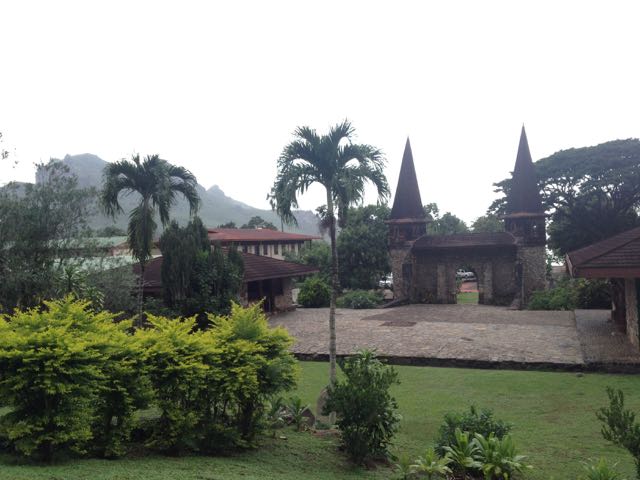
We decided to continue to the next crest and have a look before giving up. When we got there, on the other side around a short bend was a big hardware store. What a strange place to put the town’s main hardware store. We figured it must have started out as somebody’s house. Since people were already leaving their houses to go to the store, there’s no point making the proprietor do it, too. Like most of our shopping here, we found little that was on our list. However, and to my continuing amazement, they had a couple of completely unexpected gems. The most unlikely of which was the exact replacement for our galley’s original sea water tap. It has been need of replacement for a while, but we couldn’t even find one on the internet. In the meantime, we have gradually replaced needed parts with whatever we can find, none of which was ideal, so now we have a Frankenfaucet made mostly of an international contingent of adapters. I suppose it shouldn’t surprise me so much that we found a French faucet for our French boat in French Polynesia, but it still really does. Along the way through our list, with increasingly heavy packs, we also managed to see all of the cool tourist sights, including a beautiful reproduction of the original Polynesian Plaza (Pae Pae), complete with longhouses, stone platforms and tikis. Taiohae also has a cathedral. They were having a small mass when we arrived, so we only peeked in, but the surrounding grounds looked like an old English castle covered in tropical verdure. We also went to see their new, giant statue overlooking the harbor, depicting a female tiki and a legendary Marquesan warrior. So, with all of our “City” chores done, it was time to head to the peace and quiet of our last Marquesan island.


Reproduction Tikis and the Catholic cathedral