[Kyle]Once Begonia was all repaired and weighed down with full food, fuel and water, we left Townsville for the sail north to Cooktown. It was one of those rainy, gusty mornings that kept all of the local sailors tucked into their beds at home while their boats rode it out in the marinas alone. An ex-tropical storm was passing down the coast about a hundred miles to the east. As the cold water sapped its strength, its dying gasp was to unload the last of its wind and rain on the southern Queensland coast.


The passage was a bit gloomy, but that meant we'd have good weather once we arrived in Cooktown
We felt a bit silly being out there ourselves, but behind the big winds was forecast to be a big few days of calms before the trade winds fell back into their normal pattern. Leaving too late would either make for a long sail or a whole lot of motoring.
At least the winds were from astern. As rain ran in sheets off of the foot of each sail, we had a fast reach past Magnetic Island, which we could only see between showers. The distant outer Great Barrier Reef reduced the swell to where it wasn’t awful. It wasn’t great, but it wasn’t awful.
When Maryanne woke me at midnight for my night watch, I was surprised to find us heading due east in a light north wind. She had just spent the last hour heading due west after the twenty-five knot tailwinds quit and swung around. She had just tacked to avoid getting too close to the coast. We were now retracing our steps and were right back to where we were halfway through her watch. That was disappointing.
Before I decided to give up and start an engine, I had another look at three different forecast models. None of them predicted anything other than twenty to twenty-five knot south-easterlies. So much for that! These models use supercomputers to predict the behavior of each square kilometer through several iterations, taking into account the effect of the adjacent boxes each time until the result stabilizes. Such computations are too coarse to take into account any of the smaller effects of terrain or individual thunderstorms.
There was lightning both far ahead and close behind and the cool air had a hint of the smell of earth in it. We seemed to be in a zone where all of the vectors between the background south-easterlies and the two convective cells were almost cancelling each other out, leaving us with just a residue of a breeze from the north. The cells would eventually either move on or dissipate, so I decided to ignore my irritation at our lack of progress and just be patient until it all passed.
The wind then died completely. I went on deck to see if I could make out anything in the moonless sky. It was like being in the water park in Townsville. I looked up and got a giant bucket of water on my head. By the time I made the three steps back under the bimini, I was soaked through. I decided to go back out into it and throw in a couple of reefs just in case it started gusting.
It never did. As the rain decreased, the wind gradually filled in in its place. By the time it was down to a light drizzle, we were romping along like we had been the day before, except that the waves had had six hours of calms to dissipate. When I woke Maryanne in the morning, we were on a broad reach in twenty-knot south-easterlies again and I had been completely blow-dried.
Since we were sailing through the night on this trip, we were sticking close to the deepwater shipping channels. Maybe once or twice per watch, we would have to ease out on one side or the other to let ships pass. Other than that, consistent conditions left us with nothing much to do but watch the passing of each of the reefs and islets along the way.
During my third night watch, we were passed from astern by two big ships, each going more than twenty knots. Halfway through, a third target appeared going only nine-and-a-half knots. It was a tug pulling a barge. Their lights appeared over the horizon and gradually closed on us. As the sun came up, we were both just past Hope Islands, where the shipping channels make several turns to avoid the shallows. A southbound ship appeared and it looked like we would all arrive at a bend right at the narrowest point and all at the same time.
AIS intercept predictions are based on current heading and speed, so it was harder to tell how everything was going to play out once we all started turning at the bend. The assumption is that the commercial shipping would pass each other port-to-port on their respective sides of the channel. Our target was the big wild card since our speed and direction were both constantly changing due to the wind.
We had the spinnaker flying then. Sailing as close to the wind as we could, without going to the trouble to bring it down and switch to the white sails, we were still slowly edging into the channel ahead of the tug. Turning downwind until we were right on the edge of gybing, we made the mad dash to the other side by passing just ahead of both. I fully expected one or the other of them to start yelling at us on the radio about our timing for the maneuver, but they never did.
The big ship threaded the needle between us and the tug, leaving just the two of us abeam each other. Just after they passed us, we sailed past a gap in the mountains and the wind picked up. Then we passed them. Then it died again and they passed us. Then we passed them again. I suspected the tug was wanting to be clear of us since before the three-way crossing they had been favoring the west side of the channel. We thought they might even want to eventually turn ahead of us into Cooktown. In the end, we got there just before they did and were surprised to see them continuing on.
The bar into the Endeavor River was a little choppy, but the flood had us through it in no time. We threaded our way into the shallows just outside the channel and dropped anchor off of the main fuel dock. More rain was coming, so we had plenty of excuse to stay aboard, reset our sleep clocks and see how Begonia swings through a few wind and tide cycles.
In the morning, we went ashore to have a look around. Cooktown is a small, practically a one-street town and the last civilization for those heading north by road. Every other settlement on the east coast of Australia also wanted to be called Cooktown. For those that have been to the eastern U.S., where “George Washington Slept Here” signs are common, Australia’s versions are the ubiquitous James Cook Slept/Camped/Sat/Walked/Stood/Had a Wee Here” signs. This one beat them to the Cooktown name on account of this place being the first that Capt. James Cook spent any time.
After wrecking the Endeavour on the reef that now bears its name. Cook’s crew refloated the ship and headed for the Hope Islands on the hope that they would make it there before sinking again. They did better than expected. A boat was sent ahead that returned with good news about a safe, secure harbor. They continued on to present-day Cooktown for several weeks of repairs.


We walked to the top of Grassy Hill in a cooling drizzle, and back down the other side to the beaches
Meeting up with the Botanic Garden (for lunch)
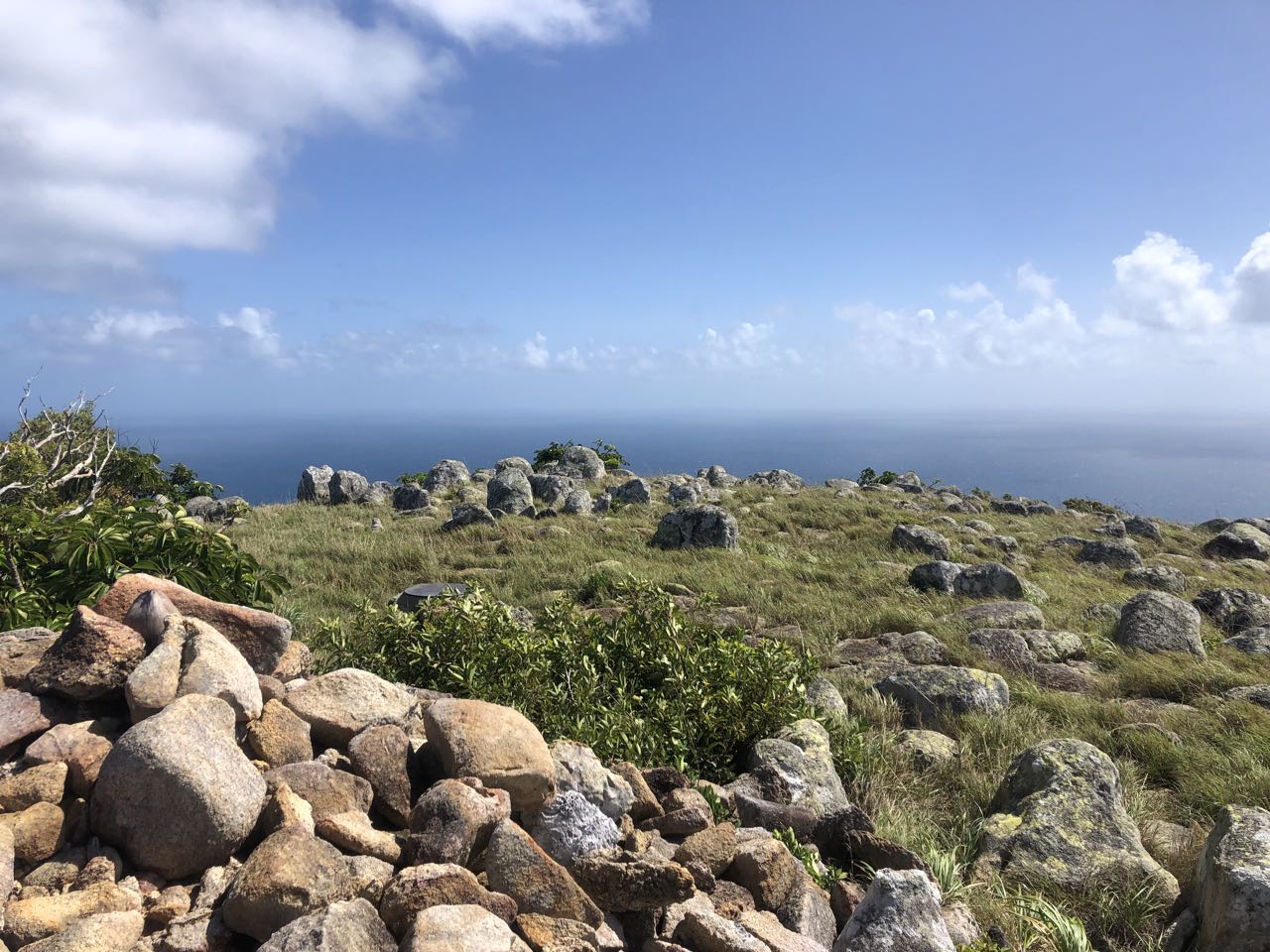
Maryanne and my first order of business in the area was to climb to the top of Grassy Hill for the view of the Great Barrier Reef. There is a lot of reef out there and the area around Cooktown is where it really starts to crowd the coast going northwards. Cook’s notes of what he saw were somewhat despondent, noting no obvious exit for them from the torment of the reefs.
Maryanne and I descended down the other side of Grassy Hill to two different beaches. We were hoping to make a loop out of our walk and ascend the much higher Mt. Cook. When we got to the last beach, though, we were stopped by an overly deep and wide river crossing. Anywhere else, we might have held our packs over our heads and waded across, but this is croc country so that ain’t happening. The only way to Mt Cook was to backtrack almost all of the way into town before joining the other trail.
We stopped for tea and a snack at the Botanic Gardens. After a bit of a pokey examination, we both decided that it was too late in the day and we were too worn out from the tropical heat to be starting a second climb. I was all for calling it a day then, but Maryanne was keen to get the James Cook Museum before they closed. We made it and immediately realized we wouldn’t have nearly enough time to see it. The woman at the counter told us she was working the next day and would remember us if we wanted to finish tomorrow.
The Museum closed right at the same time as all of the kitchens in Cooktown’s few pubs. Dinner service would start around sunset. We ambled around trying to kill as much time as we could, but it had been an early morning, it was super-hot, and we didn’t want to wait that long to eat again. We decided to walk to the end of the waterfront and then head home.
Rounding the corner, we came upon a mini-version of Townsville’s water park, complete with 3/4-sized dumping bucket! Best of all, it was unoccupied. There was no water flowing, though. We had a look around and found a pole with a button. I pressed it to see if it would do anything. It didn’t. That was too bad, it was so hot!
Then the park gurgled to life. I handed Maryanne my phone and ran in fully clothed. Oh, that feels good! Then the bucket dumped its contents on me and all of the excess heat of the day was gone. After fifteen minutes or so, the park once again went dry. We pressed the button again and I had one more go at everything. Continuing our walk afterwards, with all of my clothes sticking to me and making squeak, squeak noises with my wet shoes. I remarked to Maryanne several times how thoroughly refreshed I was. I think she may have been a little annoyed by this as she had only been wearing thin, white clothes and so had not partaken.


It's a pretty town, and Kyle LOVED having the splash-zone water park to himself
We were a bit sorer than we had expected the next morning. After a brief consultation, we decided to give Mt Cook a miss and instead to expend our planned mileage on a much flatter exploration of the town, along with a trail through the nearby wetlands, and hit the museum that Maryanne wanted to visit too.
We were just striking out on the latter when a meter-and-a-half-long snake flushed out of the grass ahead of Maryanne and darted for the edge. It was moving so quickly that we couldn’t tell if it was a Taipan or an Eastern Brown. Either would be bad. We both froze, suddenly feeling like we could be in a minefield of venomous snakes. We continued on for a bit, this time more slowly and carefully. When we reached the trail’s true beginning at the edge of the wetland, we saw not an interesting variety of birds and frogs and such. Instead, the path ahead seemed to be made up of ever-thickening grass and undergrowth. Perhaps it was time to skip the wetland idea and settle for a pub crawl instead.


We soon swapped outdoor activities for indoor ones - but there was no avoiding the snakes (haha)
At the first one, the menu seemed reasonable enough, so we decided to stop in for a whole lunch. As soon as we entered, we saw our first snake. This one was a non-venomous Black-Headed Python named Wanda. Her owner assured us that she was quite docile and handed her over to Maryanne for a cuddle while we waited for our order.
We stopped by a couple of other pubs on the way home, but neither had any petting snakes, so we left after our first drink.
Today, Maryanne was prepared. She had brought her swimsuit so it was her turn to push the button at the park and have all of the fun. She was still overheated from the day before, but since we hadn’t climbed the big hill and since we had spent much of our day lounging in shaded pubs, I was okay. Unlike me, though, she had brought a towel and everything so I didn’t get any of the fun at giggling at her squelching noises afterwards.
Just as we were settling in for the night, we were visited by Rick, who had just arrived today on a bigger Fountaine-Pajot of the same general vintage as Begonia. Our visit was brief, but when we discovered we were both heading the same general direction, we agreed to meet up at a later anchorage.