Monday, March 14, 2016

Dos Rios - Glacier tour

[Kyle]For our first day in El Calafate (which was also our 13th wedding anniversary), we took a boat tour of two of the main glaciers in the park: Upsala and Spegazzini.

{Maryanne: El Calafate has high mountains which slope down to practically sea-level lakes. The climate at the bottom is very mild (Temperate, more like the UK or D.C. area), so the foot of the glacier is carving/melting through the year, and it is much more accessible than the more polar glaciers. The glaciers are also extensive, covering huge areas of wilderness, and nudging close to a reasonable size town at the base. They are spectacular to see - so make for a tourist hot-spot, and are the number one reason to visit El Calafate. We figured we may not have seen enough ice in Antarctica and had pre-booked out tours... haha..}

A bus picked us up at our hotel, then stopped at several others until it was full. We then made the forty-minute drive along the southern shore of Lago Argentino to a large power catamaran tied to a pier along with a few others.

The boat untied and we headed toward the spine of the Andes through a narrow pass called The Devil's Throat. There, the surrounding landscape changed quickly from gently rolling hills to big, steep mountains. Looking up at them it was hard to imagine there were sea level fjords less than twenty nautical miles away on the other side that would lead all of the way to the Pacific.

It is this steep terrain that makes the glaciers at Los Glaciares part of of very small group in the world that are not receding dramatically. The warmer air of the last few decades can hold more water vapor. This water vapor condenses out as the rapidly lifting air cools as it climbs the Andean ridge. As the air climbs higher and higher the water droplets freeze and form snowflakes. As the winds crest the ridge, the flakes are no longer held aloft by updrafts and massive amounts of snow fall and collect on giant ice fields high in the mountains at 5000m (15,000') The one nearest El Calafate is called Hielo Sur (South Ice). The snow compresses into ice that is pulled down the steep valleys by gravity at a speed that is five times faster than colder, shallower glaciers in places like Antarctica. Since the terrain is so steep, most of the ice lies in the high altitude accretion zone and only spends a short period in the warm, low altitude melting zone. The melt zone is larger than it used to be and the ice is melting faster there, but this is balanced by a massive increase in snowfall on the ice fields. The result is that the position of the calving face remains relatively stable.

As soon as the boat was underway, we headed out on deck to get a better view. Only the aft deck was open while we were moving at high speed, so we ended up on the side deck just behind the chain that blocked off the forward decks. As we neared the calving face of Glaciar Upsala, it got colder and windier in our chosen spot. Maryanne eventually gave up and retreated into the warm cabin along with most of the other passengers. I was determined to stay put, so I cinched my waterproof jacket down tight, turned my back to the wind and rode it out.

I almost gave up, too, but I'm glad I didn't. At the first big berg, when the boat slowed down and the deckhand pulled the chain gate aside, I was the first one at the bow where I had my choice of vantage points. I managed to get way up to the peak of one of them, where I had a 270° uninterrupted view. Maryanne wasn't so lucky and spent most of her time peeking through gaps between people's shoulders. Since I knew there were a lot of people behind me as well, I crouched down until only my head and camera cleared the railing.


The other bow was commandeered by the staff photographers. They were very enthusiastic as they would guide their subjects over and over through the same basic three poses. They were: Hands flat like you're holding back the glacier, arms high in a vee as if to say, "Look how big!", and thumbs up, like the Fonz! They worked as a team, with one guy taking photos and giving directions and his assistant off at a distance holding a wireless flash. Since the glacier ice was so bright and backlit, the flash made it easier to shoot without the people in the foreground ending up in silhouette. The unfortunate unintended result of this was that the shadow on the passengers being photographed didn't match the shadows behind. This made all of the finished photos look like they were taken in a studio in front of a mural. There was no sense of the size or majesty of the ice behind, or that the people were actually there.


Typical Upsala scenes

We went by a few bergs the size of the ship, marvelling at their unreal, seemingly artificially-colored blueness. Upsala has a long calving face that drains into a narrow river. This made for an increasing density of bergy bits that eventually prevented us from getting any closer than a mile or so from the face. Further along, the boat ran out of clear water and nudged right up against a big expanse of brash ice. A deckhand brought out a line and lassoed a big chunk, presumably to be used at the bar.


Enjoying the scenery while the crew gather ice for the drinks

We got up close to another big berg that was taller than the ship. We were all photographing it like crazy when the Captain let out a couple of little toots on the horn. A couple of seconds later, there was a loud report from the berg. The throttles opened wide and the boat leapt away with a lurch. Once we were 50m or so away, we mushed to a stop just as the berg split in two. A big piece slid into the water, throwing a big wave. Then both remaining pieces tumbled, searching for new stable positions. Trapped air would shoot toward the surface throwing jets of spray. Big walls of water were lifted way clear of the surface before pouring back down. Sometimes the weight of the water would break off a piece of the berg and the whole process would start again. Then suddenly, the once giant berg seemed to spontaneously disintegrate into a million little ice cubes, leaving behind a patch of slush. We all cheered with delight at being so close to such a spectacle.


A little of the turmoil as one of the glacier rolls

The boat turned and then headed at high speed for the Spegazzini glacier. I had been so pleased with my spot at the bow that I retreated no further than necessary for the journey. I ended up being the only one out there by the time the throttles were brought back at our arrival.

Spegazzini is unlike Upsala in that the calving face is narrow and tall and drains steeply into a widening channel. This makes for relatively little ice, so the boat was able to get very near the face.


Spegazzini Glacier front

We repeated the hilarity of the photographers' shoot:

"Okay, now do this!"

"Good!", Click

"Now do that! ... the other hand"

"Good!", Click

"Now, thumbs up like this!"

"Good!", Click

"Next!"


Kyle eventually joined in the fun of taking photos of people

When the boat reached one end of the face, we turned to make a pass in the other direction. 'My' bow suddenly became the one backed by the glacier and the photographers quickly migrated my way. I ceded the bow to them, but they were very nice and kept insisting I could stay. I really was in the best spot for them, though, so I made my way aft while the boat made one more pass.

Pretty skies on the return journey

The boat headed back to the dock. Finally, I went to our seats and had my pack lunch while most of the rest of the passengers fell asleep. It wasn't that boring! I ate quickly and was back on deck for the trip back through the Devil's Throat.

Back at the dock, we were looking in vain for our bus when our driver found us. We had walked right by him. We made a mental note to make a better effort at remembering what our drivers look like in the future.

Back in town, we wandered the streets, peeking into shops and looking at menus. Maryanne was hungry, so she was keen to stop anywhere that looked decent. It was our anniversary, though, so I was being much more particular about location and atmosphere. I must've made her walk the whole town twice before we agreed on a place and went in.


Back in town, I was unable to persuade Kyle to partake of the local speciality
Most restaurants had lamb cooking, in full view, on open wood fire pits

We had a very nice meal of homemade pasta (which is a speciality of the predominant Italian-Argentinian population), while reminiscing and making googly-eyes at each other over a bottle of local wine. When it came time for the bill, our server, in a very pointed way, slapped it on the table and said, "Sin servicio." Those were the ONLY two words she said to us the entire meal. Well, I never!

A few words about restaurant bills in Argentina: In addition to the charge for the food itself and the tax on that food, many places also charge a 'cubierto' (cover charge) for table service. (This is required in Buenos Aires) This is usually a small charge for standard things like bread, butter, water, condiments, etc. Argentinian law is actually very specific and generous about what items must be included. Usually, for example, there has to be two different kinds of bread with fancy flavored butter or spread plus either nuts or olives. The rule goes on in similar fashion about all the items included. Restaurants all seem to vary on how much they comply with the rule, but most make what I think is a better effort than I've seen in other parts of the world. Four proper cubiertos a day could probably sustain a person. Next is 'Servicio': It's really hit or miss whether a restaurant includes this on the bill. If they do, it is given to the service staff essentially as tips. If not, it's the diner's option to give a traditional tip, called a 'propina'. It is quite common and not considered rude in the least for a server to clarify whether a bill is 'con servicio' or 'sin servicio'.

When we entered the pretty little restaurant, we were shown to our table by a charming man, who then handed us over to our brooding teenaged server. We ordered appetizers. She rolled her eyes, sneered at us, wrote down our order and left without saying a word to us, and while maintaining a conversation with one of her cool friends at a different table. She repeated the same for our drinks, our entrées and our desserts. When we asked for water refills halfway through the meal, she looked as though she wanted to throw it on us. We know our Spanish couldn't have been THAT bad, because we got all of the right stuff.

I am in no way a difficult customer in restaurants. I try to be understanding that it can be a trying job. I don't complain if things aren't just so - we're all only human. I try to bunch any requests so I'm not hogging all of my server's time with trivial tasks and I try my best not to make a mess. Maryanne is all of that, PLUS she's cute and adorable. In short, we are practically model patrons. We were that night. So we were just starting to wonder what the hell our snotty server's problem was when she slapped the bill on our table and spat, "Sin servicio" at us, before stomping off.

Maryanne let out quite a snort of disbelief and responded, "Exactamente! Sin servicio!" I'm pretty sure she heard that. The old man at the next table chuckled and gave me a smile.

Ordinarily, I am an excellent tipper. (Maryanne thinks too much so) My method is to generally start at 20% and round up to the next nice, round number. If the service is good, I'll throw a little extra on top of that. If the service is bad, I'll still usually give the 20%. If it's just awful, I'll start rounding down toward 15%. In Argentina, tips are generally just under 10% and 10% is usually the suggested amount printed on credit card receipts. It took some doing, but I gradually got used to starting at 10% before rounding (ok, double rounding).

I gave that woman 3%, and then I rounded down. Maryanne still said I over tipped her.

With that out of our system, we had another walk around the pretty little town, before we went back to our hotel, we popped into a sports bar for a beer. When the waiter brought us our three-dollar bill, He very politely said, "Just so you know, service is not included"

"Oh, yes, of course! No problem at all." I said, and then left him a three-dollar tip.

Sunday, March 13, 2016

The End of the Road

[Kyle]We would have slept in after our exhausting day driving to and from Rio Grande, But we had a rental car and Maryanne had a plan:

She wanted to get up early and drive to the terminus of the Pan American Highway, known to Argentinians as Ruta Nacional 3 and to Ushuaians as "The Road". Not only that, but she wanted to do it for sunrise.

{Maryanne: The Pan-American Highway is a network of roads that stretch from Prudhoe Bay, in Alaska to Ushuaia in Argentina (with a road-less gap through the Darien jungle) - it ends in the national park just to a few miles west of Ushuia and is one of the world's classic road journeys for motorcycles and jeeps}

Well, we were definitely the first car in the park. We had the whole place to ourselves as the sun rose gloriously out of the Beagle Channel. We did a few short hikes to take in various views and then returned to where we started. There is supposedly a population of transplanted North American Beavers living at the water's edge at the end of the trail at the end of the road. Maryanne has never seen beavers and was keen to take a look.


An early start to enjoy the sunrise a the end of the Pan-American highway

It seemed that it had been too dry for them for a while and they have apparently moved off a bit. As a consolation, Maryanne spotted a cute little bird. At first, we thought it was a baby owl, but it turned out the South American Pygmy Owl. It was no bigger than a robin.


Hanging out at the Park before our flight

On the drive out, we saw the wall of tourist busses going the other way. You're gonna have to get up earlier than that!

We returned the car at the airport, where we boarded our flight to our next destination: El Calafate, near Los Glaciares Nacional Park.

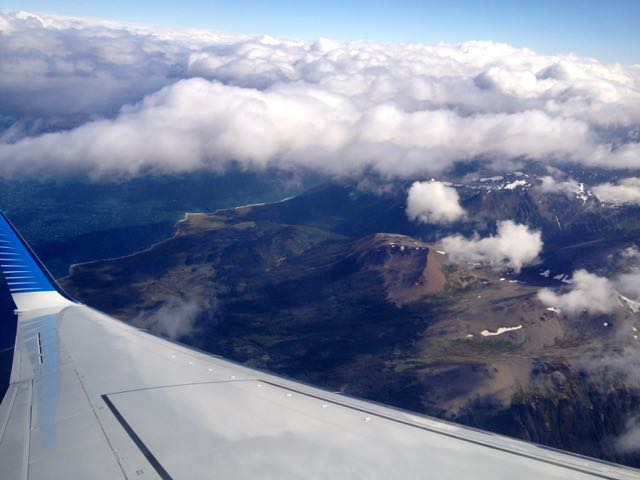
For some reason, I had expected a place nestled right up to the Andes to be forested, or at least very lush. It was a surprise to break out of the clouds and see dry, rolling hills.

We collected our bags and headed to the taxi stand where we were assigned a driver. As soon as the guy was paired with us, he took our bags and weaved through the crowds as fast as we could walk. We alternated between thinking he was in a hurry and thinking he might actually be trying to lose us and take our stuff.

Once we were in the car, he mashed the pedal to the floor and pretty much left it there until we made it to our hotel twenty minutes later. Argentinian law seems to require a speed alarm in commercial vehicles and he had that thing going off most of the time. When we got into town, where the speed limit dropped from 110kph to 50, and then 35, he kept going 120 except for when he was going around corners. There are only a few busy times of day at the airport and he was clearly trying to make it back in time to catch another fare, no matter who he had to kill to do it.

After screeching to a stop at our hotel and then dumping our bags on the street, Maryanne tried telling him in Spanish that he drove way too fast. He seemed to take it as a compliment and responded, "Oh, yes! VERY fast!" He then screeched away.


Leaving Tierra Del Fuego for Mainland Patagonia

Once we got our breaths back, we went out to have a look at El Calafate. I'm pleased to say that it is a very pleasant little town with lots of trees, median strips filled with flowers and little cafés with shaded tables out on sidewalks interrupted with potted plants. What a difference a day makes.

Saturday, March 12, 2016

Arriving Back in Tierra Del Fuego

[Kyle]Our plan was to be out on deck enjoying our glorious return to Ushuaia as Expedition made her way up the Beagle Channel. Just after we entered, we were told the port of Ushuaia was closed due to high winds. Expedition would now be anchoring in the Beagle for the night, with the plan of getting under-way again in time to be berthed alongside at first light.


Dock, leave the boat and hit the road to explore Tierra Del Fuego

After the previous rough night in the Drake, everybody seemed ready for a good night's sleep at anchor. That was until they told us we needed to have our bags packed and outside of our cabins by 0630. We would have breakfast then and then disembark in groups afterwards.

Maryanne and I were in the last group, so that meant we left the ship at 0800. The expedition staff all came out and made a point of each saying goodbye to each one of us personally. While they were doing so, provisions were already being loaded aboard behind us for the next trip, which was their last of the season. The crew had six hours before the next group of wide-eyed passengers would be coming aboard for their first day.

We had booked a night in the Albatros for our return, so we headed there to check in and try to use their internet. I especially needed time to review and submit my bid for my next month's work schedule. Most of the other people who had been on the ship had the same idea and the Albatros' already slow internet ground to a stop.

We decided to head out for hot chocolates at a place nearby that we had run out of time for before we left. They weren't open, so we found ourselves in an all-too-familiar for us position of going around town trying to locate ANY internet.

We finally found a decent signal at the tourist office once they opened and I was just able to place my bid before it was time for us to be heading to the airport.

We weren't leaving yet, but we had booked a 24-hour car rental from there so we could return it and then just get on our flight out the next day. It was also half the price versus renting one from the same company from their office across the street from the Albatros.

We had no real plan, but since Ushuaia is at the end of the only really long road around, we basically decided to get as far north as we could in the time that we had. We figured we would stop anywhere that looked interesting and stay for as long as we liked while we were on the way out. On the way back, we could make a straight shot because we would have already seen the interesting places on the way up.

Almost immediately after leaving Ushuaia, the chaotic traffic ceased. We entered the mountains of Tierra del Fuego National Park where we had a smooth, winding road almost completely to ourselves. We stopped at several viewpoints that looked out over big green glacial valleys and imposing peaks.

We left the mountains and came to the southern shore of Lago Fagnano. There, the road followed the curve of the lake to the northeast.

Lago Fagnano lies in the gap between two tectonic plates. On the south side, steep mountains come right down to the shore. The land to the north starts off as very gently rolling hills which soften into flat plains to as they slope away to the Atlantic coast. As we left the lake, the road straightened and the going got faster. We were entering ranch country.

We had intended to stop at a little town called Telhuin for lunch, but there was almost no sign of it from the road. A couple of billboards hinted that we were getting near, then we passed over a rise and it was suddenly clear there was going to be nothing for quite a while. We decided to continue to the next town about 100km further. {Maryanne: Telhuin was billed as a small town, and a great place to grab something to eat - but in reality it was a truck stop with a small shanty town behind it... not quite the picturesque lunch spot we had in mind}

Rio Grande appeared on the horizon and grew larger. It was quickly apparent that there was no way we were going to accidentally drive past. Huge warehouses formed the walls of a canyon through which the road threaded. There were traffic lights at almost every intersection and the traffic became a snarl.

The city had been originally founded as a company town for one of the big ranches in the area that controls most of the surrounding land. The ranch still exists, but automation has reduced the number of hands needed. Since then, Rio Grande has moved into other industries, aided by tax incentives from the government. The area now exists as kind of an extended company town for lots of big factories and distribution centers.

There is complex after complex of hastily built, perfectly uniform housing. Most are made from corrugated metal with some stucco and all are painted in exactly the same way. At the edges of these are a scattering of bodegas, newsstands and takeout places which seem to serve the housing units. Filling the gaps in between are lots of houses built of what appears to be the corrugated metal scraps from the construction of the complexes.

None of these housing developments appeared to have allowed even a tiny budget for any public space whatsoever. There were no parks, no picnic tables, no benches, no grassy medians, not even any sidewalks. People lived in neighborhoods where there was nothing but dust and clutter right up to their front doors.

The City itself seems to have at least tried with a smattering of public space in the town center, but it was all clearly done as a grudging afterthought. Most of it involved painting surplus concrete, angle-iron or pipe stock in garish colors and then calling it a day. These areas were surrounded by construction, dust and litter, which would have seemed a better target for the city's resources. Maryanne kept wanting to take pictures of how bad this all was for the blog, but it didn't seem like the kind of place it would be a good idea to whip out even a cheap camera.

It looked like living in Rio Grande would be an incredibly demoralizing experience. Everyone we encountered seemed to be plodding through the dust of their private lives. We never saw anybody smile. This gave the place a slightly menacing air.


The only possible attraction we found in Rio Grande was padlocked

We drove around for a bit hoping to find a better part of town, but it never happened. We were pretty hungry, so we gave up and parked near the town center, where we could see a few places that seemed to be selling food. Upon closer inspection, most of them weren't. Most of the places that weren't boarded up were one form of second-hand store or another, each manned by a cheerless cashier. Our walk seemed to be taking us further from any industry, so we went sideways a block and then doubled back to the car. Along the way, we came upon a Tante Sara.

This was the inexplicable third restaurant in the chain. The other two were in Ushuaia, one of which was where we had our first big, delicious meal. It seemed to be BY FAR the nicest place in town. We knew the name and we were hungry, so we went in. The food was as good as we remembered in Ushuaia, but our server was clearly less amused by our level of understanding of her language. No mind, we were keen to get out of there.

We bought some delicious alfajores from their adjoining bakery to take as food for the road and then we took what we hoped would be the shortest route out of town. Once we were back on the open, empty road, we let out a sigh of relief at never having to see Rio Grande ever again. We agreed that based on our admittedly limited sample size, Rio Grande is: The Worst Place in Argentina. Don't ever go there. You don't need to ever go there.

To think, that morning we had nearly cancelled our room at the Albatros and booked a place in Rio Grande for the night. Only when we discovered our Ushuaia booking was non-refundable did we drop the idea of staying in Rio Grande - and now we realized how terrible that decision would have been - we were looking forward to getting back to Pretty Ushuaia and the comfy Albatros - whew!.

Back on the road with lovely baked goods upon which to nibble, our moods gradually improved. We were soon back in ranch country. Argentina is, of course, known for their delicious beef - which really is free range. Out here, they also have horses and sheep. Those are all things you can see lots of places. What's really cool are the native Guanacos. Guanacos are related to Llamas, which are more distantly descended from Camels, or at least the same animals from which another line ended up being camels.

Enjoying the wildlife and scenery on the drive back to Ushuaia

Maryanne was taken by the yellow "Guanaco Crossing" signs in the area and kept wanting me to stop so she could get a picture of one. Every opportunity seemed to come just as we passed it when there was someone coming up from behind. She made increasingly sad faces after each one until I finally ground to a stop in a cloud of dust in front of one. She was so pleased until I spotted a real Guanaco, for which I would not stop. There's the face again. Look away for a few seconds. Look back. Nope, still there. Try it again. Nope. It's getting worse.

I spotted a couple more and decided to turn around on the now empty road and go back. Jackpot! We found a whole herd standing right by the road. That had her squeaking with joy all of the way back to Ushuaia.

Thursday, March 10, 2016

Drake Passage Northbound

[Kyle]As Expedition made her way north, the weather deteriorated and the seas became rougher. By morning, the motion was enough to knock unsecured things over and require that a hand be always available for the ship. This wasn't helping poor Maryanne's state, although she did seem to be slowly getting over the worst of it.

I went upstairs as usual for coffee, where Kathleen had a fresh pot ready even though I was the only taker. I'm sure most of the people suffering in their cabins wouldn't think so, but I was kind of enjoying the feel of the ocean swell. By Begonia's standards, the motion was probably a low medium, which my mind has come over all of the miles Maryanne and I have sailed to subconsciously associate with pleasant offshore sailing. For those used to hotel rooms that never move, I can understand why their experience was different. Of course, we were actually in the Drake Passage, and conditions were not that nice. It only felt like it because we were in a 100m steel ship.

I went outside for a look. The wind was biting cold. Six meter (20ft) waves were hitting Expedition right on the beam and exploding into spray that got blown away by the wind. That made for much more roll than any other wave direction would have. I popped into the bridge. Their instruments were reading winds in the high 20s to low 30s (kts). I noticed that the weather chart they had posted was indicating that we should just be getting into the worst of it.

We went for breakfast, where we had my choice of seating (Maryanne was feeling better, but not fully recovered, she had some toast). It seemed as if only about a quarter of the passengers were present. We were all doing that funny walk with our plates where we would wait until the ship tilted just so, walk fast until it reversed and then wait again.

Wait..zig...wait...zag...wait...zig...sit!

As a means of distraction, the ship's historian, Scott, gave an excellent lecture about Shackleton's escape from Antarctica to South Georgia Island and the subsequent rescue of the rest of his crew from Elephant Island after their ship was crushed by the ice they had been trapped in for months.

Next up was Gerard. If you ever need a guy to act like the worsening weather was nuttin', he's it.

If you recall, he was the guy I mentioned who was stationed at Port Lockroy. Subsequent to that, he was hired as a cook for the British Halley Base. Cook seems to be a tremendous understatement. Gerard showed us photos of mini pastry cities he made that took up whole tables. One of the winters that he was there, the base's generator developed a terminal coolant leak. Two weeks later, it failed and they were left without power or heat for the rest of the winter. Gerard brought a camping stove into his kitchen and continued to crank out yummy stuff by the light of his headlamp. He said they had a period of a week or so where the inside temperature was around -20°C (-4°F).

As he regaled us, he kept having to brace himself and the screen upon which his slides were being projected kept jumping around.

Noon log: Moderate visibility, clouds, overcast; Wind: N F7; Sea: very rough; Air Temp: 5°C (5-7m swells)

Lunch was up to about 50% attendance, including Maryanne, who was cautiously getting her appetite back.

We got a whale lecture next from Kevin, the bouncing naturalist.

Maryanne and I paid another visit to the bridge, where the wind was now nudging 40, with seas that had moved slightly ahead so they were striking the port bow. Expedition was now pitching and rolling, with occasional shudders going through the structure. I went to the top deck just to be out there to see it. That required both hands and both feet. Yikes! I would definitely NOT want to be out here in our boat. Expedition's bow came over a wave and crashed into the next one. A couple of seconds later, I got hit in the face with salty spray.


The bridge was a great place to visit

At dinner, 20 feet below on the fifth level above the water, there were about half a dozen times when the windows were completely covered by spray. We heard crashing plates a couple of times and I had to brace myself to keep from falling out of my chair. A lot of us did on that one. Mostly, everyone in attendance seemed to find it amusing, although the staff seemed to be gritting their teeth through their smiles.

We visited the bridge again before turning in. The wind seemed to be the same, but the seas were getting larger and farther apart. A look at their chartplotter showed their next waypoint to be Cape Horn, although they were heading just a little leeward of that course. The ETA was around dawn. Well, that would be exciting to see. I made sure I set an alarm.

Conditions seemed to slowly get worse through the night. Expedition would roll slowly, then groan and shudder. Roll, groan, shudder, over and over. Sometime either very late or very early, things got noticeably worse. The ship seemed to be rolling a lot more and things we thought we had secured reasonably well started falling. Once, Maryanne and I (and I'm sure at least half of the rest of the ship) woke up as we started sliding off our well-secured mattresses. The ship repeated this a couple of times and then the motion smoothed considerably, allowing us to go back to sleep.

In the morning, I went upstairs for coffee. The library's floor was covered with books and magazines. Almost all of the stock in the ship's store was on the floor. Kathleen was trying to stabilize herself while sweeping up broken glass from the bar. I offered to help, but she was just finishing. She told me to relax and have some coffee. She still made the coffee! She knew I'd be the only one there for a while, but she still made sure it was made BEFORE cleaning up the glass so it would be ready for me!

The Bridge was closed, so I had a look at the repeater display. It appeared they had turned upwind (and into the waves) for Cape Horn for a time, maybe about ten miles, then gave up and turned for a downwind run to the Atlantic Beagle entrance. That explained the night's motion. Oh, well. The weather was bad enough that we probably wouldn't have seen it anyway.

As I was drinking my coffee, I noticed I was eye level with a few of the wave tops. Where I was sitting, that was probably an eye height of about thirty-five feet above the waterline. What oceanographers call the 'significant wave height' (the height of the top third) was probably around thirty feet. I have often said that I hope I never see a thirty foot wave. Well, it looks like I may have. I still definitely don't ever want to see one from my boat. Captain Nesterov later said the crossing was an eight on a one to ten scale for roughness. Maryanne's finally with me on this one: We're never sailing down here.

Noon log: Moderate visibility, clouds, overcast; Wind: WSW 8; Sea: very rough; Air Temp: 7°C (6-8m swells)

The ship closed on the continent. As we entered the lee of Tierra del Fuego, the seas dropped to flat in a matter of a few hours. Everyone came out of their cabins to witness our return to South America.

Wednesday, March 09, 2016

Halfmoon Island

[Kyle]A couple hours after leaving the gloom at Deception Island, the sky began to clear, until we were left with a brilliant blue sky with just enough cloud cover for dramatic effect. A couple hours after that, Expedition rounded Livingston Island and headed toward the unoccupied Argentine base on the smaller Halfmoon Island, which is located within one of Livingston's bays. The anchor was lowered and the zodiacs were put in the water for the afternoon's excursion.


.. and then the sun shone!


Icebergs on our zodiac tour

We were landed on a beach toward one end of the island. There, we were greeted by much tamer seals lounging near the hulk of an old whaling boat. We crossed over a saddle to the Livingston side, passing several different groups of Chinstrap penguins along the way. We walked along a cobbled beach full of more seals before angling back up the hill towards the island's main Chinstrap colony at the top. Hidden among the Chinstraps was a lone Macaroni penguin that has apparently been living among them for over a decade.


Another trip ashore to wonderland!

It was at the colony that Maryanne started to feel a little queasy. The dense colony had been a bit more pungent than we had encountered before and it was getting to her. We retreated to some fresh air, but that didn't seem to help. Eventually, she decided to return to the beach and wait for a zodiac back to Expedition. I lingered for a while taking pictures, but still made it to the beach before her zodiac left. We returned to the ship together.

There had been a stomach bug making its way through the ship since leaving Ushuaia. The ship's doctor, Kristina, was aware of it and had briefed us all very well about the importance of frequent hand washing and avoiding contact with those who have been sick. It looked like Maryanne's number finally came up.

I talked to the doctor while she lay in her berth. She said she could give Maryanne something to reduce the symptoms, but it would also slow the progression and recovery from the illness. Otherwise, I was told, Maryanne would have a rough eight to twenty-four hours. Maryanne decided to tough it out and get it over with.


Our final evening in Antarctica was a beauty

Well, at least it happened at the very last stop. It was a shame, though. It was a beautiful clear evening as Expedition left the island and began the trip back to the NNE along Bransfield Strait. The sunset was gorgeous and one last time, the ship was surrounded by whales feeding by enormous blue icebergs in the last of the light. It was a perfect goodbye to the frozen continent. It was such a shame Maryanne had missed it.

I checked on her again. She was feeling the same and insisted that I go to the evening briefing without her. I showed up late and ended up standing in the back. A slideshow of the amazing entries for the black and white photo contest was shown and then a countdown was announced of the winners. I was shocked when my photo of the spotlight during the blizzard won me the first prize of a bottle of Malbec. There were some very good entries in there. Mine was just unusual.

I have to give Maryanne a lot of the credit. On the night I took the photo, I was going to leave the camera in our cabin since it was dark outside. Maryanne suggested I take our little waterproof camera in a pocket just in case something interesting happened. I also wasn't even going to submit an entry into the contest, but she did it when I wasn't looking, so I couldn't have done it without her. The bartender told me he would find me at dinner and make sure I got our wine.

Expedition made a big left turn into the English Strait, passing by our first stop at Cecilia and Barrientos islands. This kept the ship's motion to a minimum as dinner was served. I had a quick look outside and then headed to our cabin to check on Maryanne to see if she might be feeling up to eating. The dining room was abuzz with conversation as everybody relived their trip. There was a heightened sense of celebration and I didn't want her to miss it. She still felt lousy, so I rushed up to try to get some food for myself.

I got there just as the last of the desserts were being cleared away. I managed to get a slice of chocolate cake and my bottle of wine to take back to our cabin. It was disappointing. I felt like I had missed the whole party. I returned to our cabin alone. Maryanne was asleep by then, so there was no point opening the wine. I ate my slice of cake and went to bed. Almost as soon as I turned out the light, Expedition passed abeam Greenwich Island and exited the English Strait. We were now back in the open Drake Passage. The swell arrived and the ship started to roll back and forth.

Good visibility, clear skies, sunny; Wind: SE F1; Sea: calm; Air Temp: 12°C